
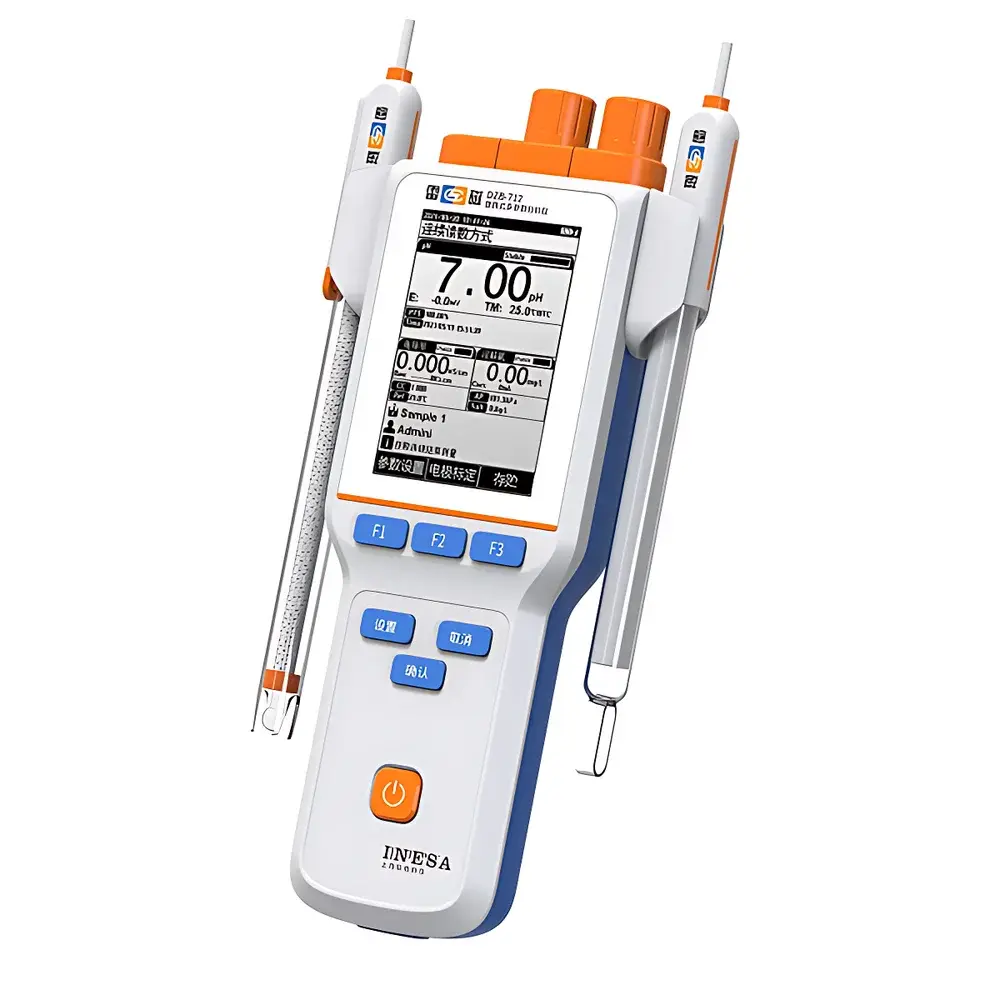
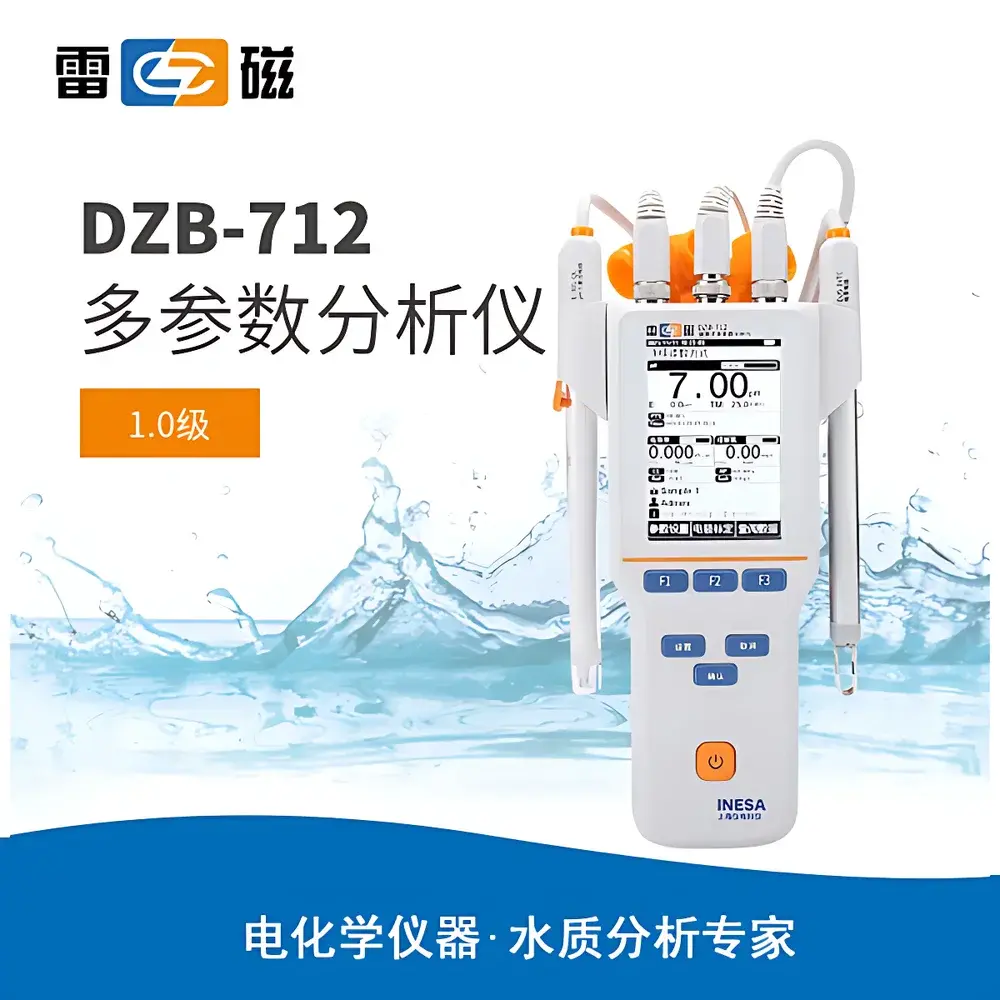
Leici DZB-712 Portable Multi-Parameter Water Quality Analyzer
| Brand | Leici |
|---|---|
| Origin | Shanghai, China |
| Manufacturer Type | Original Equipment Manufacturer (OEM) |
| Product Category | Domestic |
| Model | DZB-712 |
| Instrument Type | Portable / Handheld Water Quality Analyzer |
| Measurable Parameters | pH/pX, Conductivity, Dissolved Oxygen, Temperature, TDS, Salinity, Resistivity, ORP (mV), DO Saturation |
| IP Rating | IP65 |
| Display | High-Resolution LCD |
| Power | Rechargeable Li-ion Battery (DC5V input compatible) |
| Dimensions | 80 × 235 × 42 mm |
| Weight | 0.4 kg |
| Calibration | Auto-recognized standard buffers (GB/DIN/NIST), 1–5-point pH/pX |
| Data Storage | 500 sets per parameter group |
| Compliance | GLP-compliant data traceability, audit-ready metadata (timestamp, electrode ID, calibration history, operator ID) |
Overview
The Leici DZB-712 Portable Multi-Parameter Water Quality Analyzer is an engineered field-deployable instrument designed for simultaneous, real-time measurement of critical water quality parameters in environmental monitoring, municipal water supply, aquaculture, and industrial effluent assessment. Based on electrochemical sensing principles—including potentiometric ion-selective electrode (ISE) detection for pH and specific ions (e.g., Na⁺, K⁺, NH₄⁺, F⁻, Cl⁻), four-electrode or two-electrode conductometric measurement with automatic cell constant compensation, and Clark-type polarographic dissolved oxygen (DO) sensing—the DZB-712 delivers laboratory-grade accuracy under rugged field conditions. Its modular sensor architecture supports interchangeable electrodes optimized for diverse matrices: triple-junction pH electrodes with liquid junction stability, graphite or platinum-based conductivity cells with selectable cell constants (0.01–1.0 cm⁻¹), and temperature-compensated DO probes with built-in barometric pressure correction. The device operates across a wide thermal range (−5.0 to 110.0 °C), enabling deployment in cold streams, hot process water, or saline estuaries without recalibration drift.
Key Features
- IP65-rated enclosure with silicone protective sleeve and wrist strap—engineered for dust resistance and transient water exposure during field sampling.
- High-contrast monochrome LCD display with adjustable backlight—optimized for outdoor readability under direct sunlight or low-light conditions.
- Intelligent endpoint detection: configurable auto-read, timed-read, interval-read, or manual acquisition modes to accommodate variable sample equilibration kinetics.
- Comprehensive temperature compensation: automatic NTC thermistor-based compensation for pH, conductivity, and DO; optional reference temperature selection (20 °C or 25 °C) for conductivity reporting per ISO 7888 or ASTM D1125.
- Electrode diagnostics and health monitoring: real-time impedance checks, slope validation, and offset verification logged with each measurement to support preventive maintenance and regulatory compliance.
- Multi-standard buffer recognition: automatic identification of GB, DIN, and NIST pH standards; customizable multi-point calibration sequences up to five points with user-defined buffer sets.
- Flexible ion concentration reporting: seamless unit switching among mol/L, mmol/L, mg/L, μg/L, g/L, and pX—with GRAN plot analysis, standard addition, and sample addition methods implemented per ISO 10523 and EPA Method 150.1.
Sample Compatibility & Compliance
The DZB-712 is validated for use with freshwater, seawater, wastewater, cooling tower water, boiler feedwater, and aquaculture systems. Its electrode suite accommodates turbid, high-suspended-solid, and low-conductivity samples (down to 5.00 Ω·cm resistivity) when paired with appropriate cell constants and membrane configurations. All measurement protocols align with internationally recognized frameworks: pH and conductivity measurements conform to ISO 10523 and ISO 7888; DO determinations follow ISO 5814 (polarographic method); TDS and salinity calculations apply ASTM D1125 and APHA Standard Methods 2510B. Data integrity meets GLP requirements through embedded timestamping, operator ID tagging, electrode serial number logging, and full calibration history retention. While not FDA 21 CFR Part 11 certified out-of-the-box, audit trails are exportable in CSV format for integration into validated LIMS environments.
Software & Data Management
Data acquisition and transfer occur via USB interface using Leici’s proprietary PC communication software (Windows-compatible), supporting bidirectional synchronization of measurement records, calibration logs, and system settings. Stored datasets (500 entries per parameter type) include raw signals, compensated values, confidence indicators (e.g., electrode slope %, response time), and environmental metadata (ambient pressure, sample temperature). Exported files retain hierarchical structure for traceability—enabling reprocessing with updated algorithms or inter-laboratory comparison. Optional RS-232 output permits direct connection to serial printers compliant with ESC/POS command sets; print templates support customizable headers, units, and statistical summaries (min/max/avg). No cloud connectivity or mobile app dependency—ensuring data sovereignty and offline operability in remote or secure facilities.
Applications
- Regulatory field surveys: EPA Region-specific ambient water monitoring (e.g., NPDES discharge verification, watershed health assessments).
- Drinking water safety: On-site verification of disinfection byproduct precursors via pH/conductivity correlation and residual chlorine interference screening.
- Aquaculture management: Real-time tracking of DO saturation, pH shifts during algal blooms, and salinity gradients in hatchery recirculation systems.
- Industrial process control: Cooling water corrosion potential evaluation (via ORP and conductivity trends), boiler feedwater purity assurance (resistivity >1 MΩ·cm).
- Educational laboratories: Modular electrode interchange enables comparative studies of sensor selectivity, temperature effects on ISE response, and diffusion-limited DO kinetics.
FAQ
What electrode configurations are supported for low-conductivity ultrapure water measurement?
The DZB-712 accepts conductivity cells with cell constants of 0.01 cm⁻¹ or 0.1 cm⁻¹ for resistivity measurements down to 20.00 MΩ·cm; automatic frequency switching prevents polarization error in sub-μS/cm ranges.
Does the instrument support dual-standard calibration for pH across non-overlapping ranges?
Yes—up to five calibration points may be distributed across acidic, neutral, and alkaline buffers; the system calculates separate slope and offset coefficients per segment if required.
How is atmospheric pressure compensation performed during DO measurement?
An integrated barometric sensor provides real-time kPa/mbar/Torr/Atm readings; users may also enter manual pressure values when sensor calibration is unavailable.
Can historical calibration data be exported separately from measurement records?
Yes—calibration logs (including date/time, standard IDs, measured mV/pH/mS values, and pass/fail flags) are stored independently and exportable as standalone CSV files.
Is firmware upgrade capability available in offline mode?
Firmware updates are delivered via signed .bin files loaded from USB storage; no internet connection or vendor server authentication is required.
Related Products







