
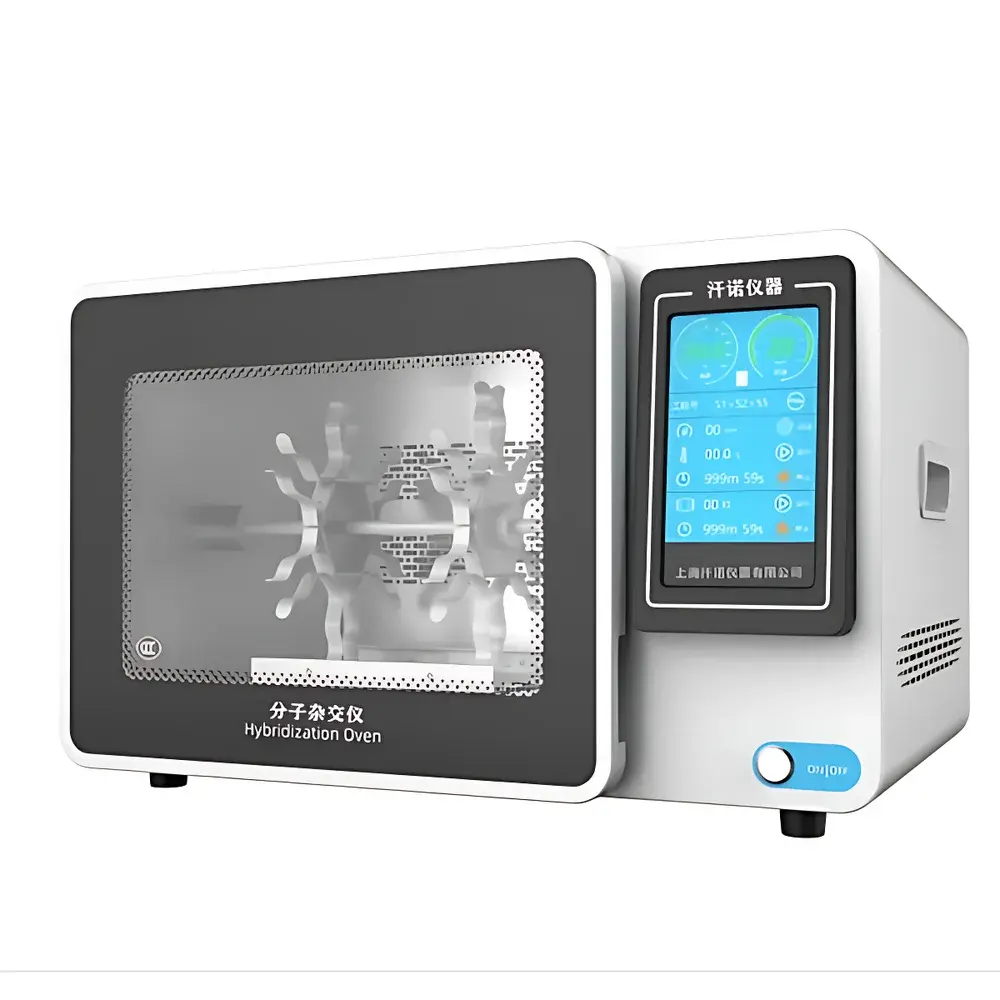
Hanuo LF-IIIN Molecular Hybridization Oven
| Brand | Hanuo |
|---|---|
| Origin | Shanghai, China |
| Manufacturer Type | Direct Manufacturer |
| Region of Origin | Domestic (China) |
| Model | LF-IIIN |
| Instrument Category | Nucleic Acid Molecular Hybridization Instrument |
| Temperature Range | RT+5°C to 100°C |
| Temperature Uniformity | ±0.03°C |
| Rotational Speed | 0–99 rpm |
| Temperature Control Accuracy | ±0.5°C |
| Temperature Resolution | 0.1°C |
| Temperature Equilibration Time (at 37°C) | <20 min |
| Display | 7-inch TFT True-Color Touchscreen |
| Max. Operating Time | 999 min 59 sec |
| Programmable Segments | 5 |
| Data Storage Capacity | 50 protocols |
| Hybridization Tube Capacity | 6 or 12 tubes (standard: Ø35×240 mm ×3 |
| optional | Ø35×150 mm / Ø35×300 mm) |
| Base Vibration Intensity | 0–99 levels adjustable |
| Safety Features | Door-open auto-stop, electronic door sensor, tempered glass door with sealing gasket, 3C-certified |
| Chamber Material | 304 stainless steel interior and rack |
| Power Supply | 220 VAC, 50 Hz |
| Rated Power | <800 W |
| Optional Interface | Modbus RTU communication protocol |
Overview
The Hanuo LF-IIIN Molecular Hybridization Oven is an engineered platform for controlled nucleic acid hybridization—designed to support stringent thermal and mechanical conditions required for DNA–DNA, DNA–RNA, and RNA–RNA duplex formation. It operates on the principle of precise temperature-regulated annealing combined with programmable rotational mixing, enabling efficient probe-target binding under reproducible kinetic conditions. Unlike passive water-bath or bag-based hybridization methods, the LF-IIIN integrates forced-air convection heating, real-time thermal feedback control, and dual-mode agitation (tube rotation + optional base vibration), ensuring uniform heat distribution and consistent fluid dynamics across all sample positions. Its operational range (RT+5°C to 100°C) covers standard pre-hybridization, hybridization, and post-hybridization wash steps per widely adopted protocols—including those referenced in ISO/IEC 17025-accredited molecular diagnostics labs and CLIA-compliant clinical testing environments.
Key Features
- Forced-air convection heating system with real-time temperature monitoring and ±0.03°C spatial uniformity across the chamber—validated per ASTM E2251-22 for thermal performance in laboratory ovens.
- Stepper motor-driven tube rotation with speed resolution of 1 rpm (0–99 rpm range), eliminating belt slippage and ensuring long-term mechanical stability.
- One-touch jog mode for manual tube loading/unloading without interrupting ongoing programs—optimized for high-throughput workflows involving multiple membrane or blot formats.
- 304 stainless steel inner chamber and rack, corrosion-resistant and compatible with common hybridization buffers (e.g., SSC, SSPE, Denhardt’s solution) and stringent decontamination cycles.
- 7-inch TFT true-color touchscreen interface with intuitive icon-based navigation, graphical temperature curve display, and dynamic door status indicator (open/closed).
- Dual-agitation capability: independent control of tube rotation and bottom-base oscillation (0–99 intensity levels), supporting both traditional tube-based hybridization and microplate-based immuno- or enzyme-linked incubations.
- Five-segment programmable protocol storage with up to 50 user-defined method sets—enabling gradient hybridization, stepwise stringency washes, or multi-stage ELISA incubation sequences.
- Automatic door-open safety interlock halts rotation and heating immediately upon detection—compliant with IEC 61010-1 safety requirements for laboratory equipment.
Sample Compatibility & Compliance
The LF-IIIN accommodates standard hybridization tubes (Ø35 mm × 240 mm, Ø35 mm × 150 mm, Ø35 mm × 300 mm) and supports up to 12 tubes simultaneously. Its chamber geometry and airflow design are validated for uniform thermal exposure across all positions—even when loaded asymmetrically. The unit meets China’s CCC (3C) certification requirements and conforms to electromagnetic compatibility standards GB/T 18268.1–2010 (equivalent to IEC 61326-1). While not FDA-cleared as a medical device, its operational parameters align with analytical method validation expectations outlined in USP <1058> Analytical Instrument Qualification and ISO/IEC 17025:2017 clause 6.4.7 for equipment used in nucleic acid detection workflows.
Software & Data Management
All operating parameters—including time, temperature setpoint, rotation speed, vibration intensity, and segment transitions—are logged locally with timestamped records. The system stores up to 50 complete protocol configurations with full parameter recall. Temperature history is visualized as a real-time waveform graph during operation, facilitating immediate verification of thermal ramping fidelity and equilibrium attainment. Optional Modbus RTU (RS-485) interface enables integration into centralized lab automation systems for remote monitoring, audit trail generation, and synchronization with LIMS platforms—supporting GLP/GMP-aligned data integrity practices including ALCOA+ principles.
Applications
- Membrane-based nucleic acid hybridization (Southern, Northern, dot/slot blots)
- Pre-hybridization blocking and post-hybridization stringent washes
- Antibody and enzyme incubation steps in ELISA, Western blotting, and immunohistochemistry
- Controlled denaturation and renaturation studies of nucleic acid secondary structure
- High-stringency SNP detection assays requiring precise temperature ramping
- Microbial colony hybridization on solid-phase filters
FAQ
What is the maximum temperature ramp rate achievable on the LF-IIIN?
The unit achieves full thermal equilibration at 37°C in less than 20 minutes from ambient start; ramp rates vary by load and setpoint but are optimized for hybridization kinetics—not rapid cycling.
Can the LF-IIIN be used for non-hybridization applications such as ELISA plate incubation?
Yes—the adjustable base vibration mode and wide temperature range support microplate-based immunoassays, provided plates are secured using compatible holders.
Is temperature calibration traceable to national standards?
The instrument includes factory calibration documentation; users may perform field verification using NIST-traceable PT100 probes per ISO/IEC 17025 internal calibration procedures.
Does the system support 21 CFR Part 11 compliance?
Standalone operation does not include electronic signatures or role-based access control; however, when integrated via Modbus into validated LIMS or ELN systems, it can contribute to Part 11–compliant workflows.
What maintenance is required for long-term reliability?
Routine cleaning of the stainless-steel chamber and inspection of door seal integrity are recommended; no consumables or periodic recalibration are mandated under normal use conditions.





