
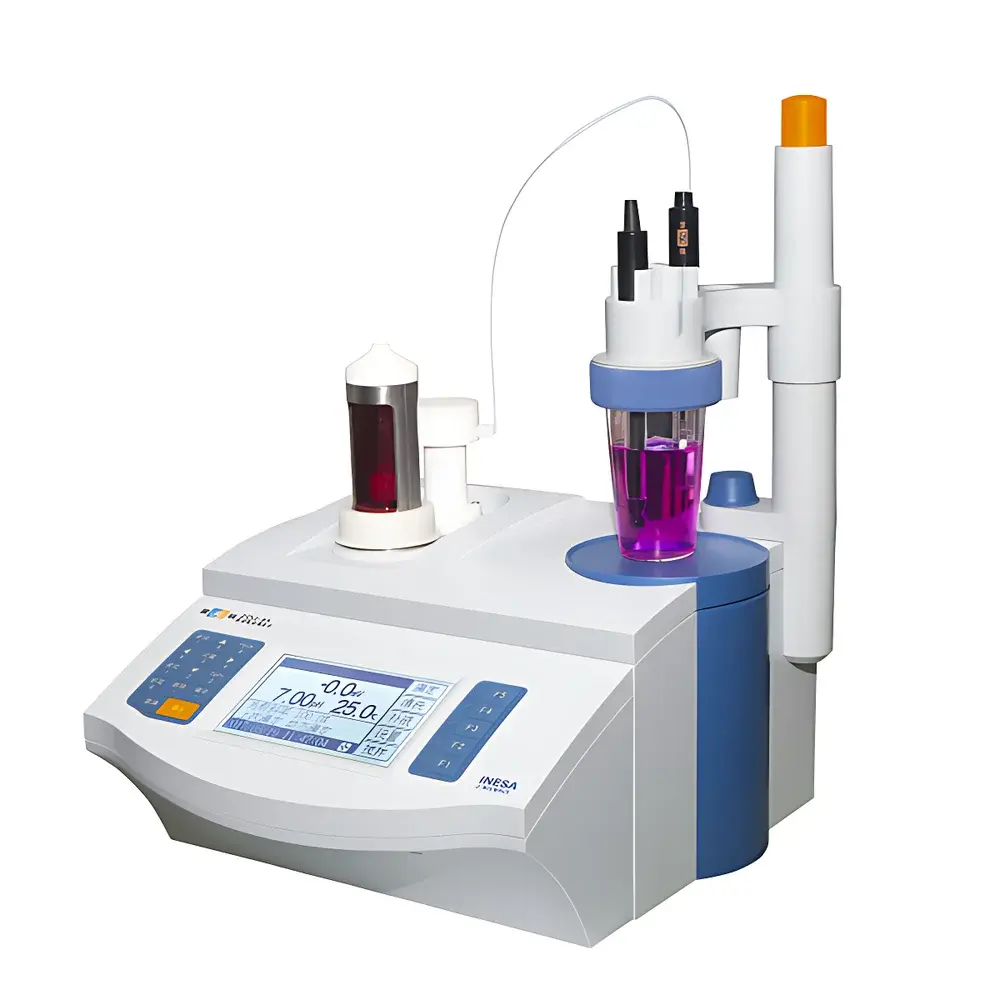
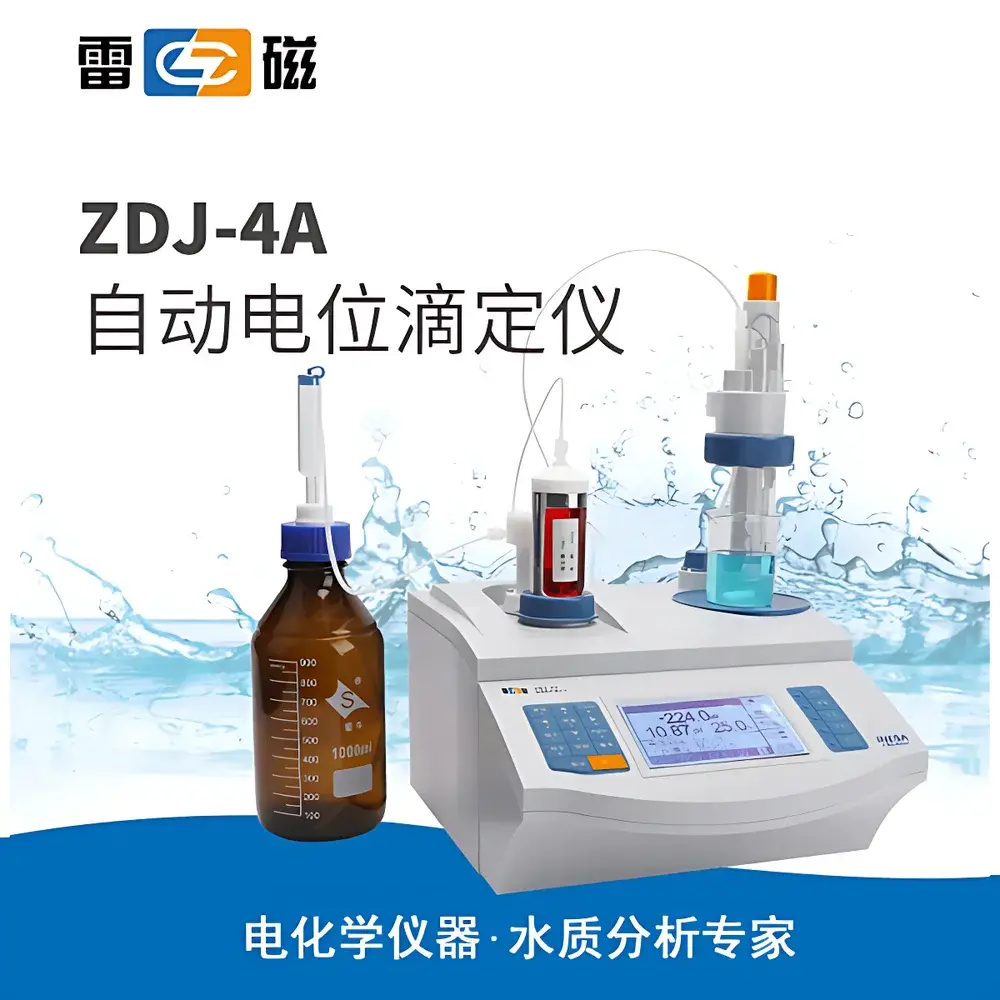
LeiCi ZDJ-4A Automatic Potentiometric Titrator
| [Brand | LeiCi |
|---|---|
| Origin | Shanghai, China |
| Manufacturer Type | Direct Manufacturer |
| Product Category | Domestic |
| Model | ZDJ-4A |
| Instrument Type | General-Purpose Potentiometric Titrator |
| Application Scope | Universal |
| Measurement Range | (0.00–14.00) pH |
| Meter Accuracy | ±0.2% of full scale |
| Meter Resolution | 0.01 pH |
| Titration Accuracy | (±0.3 mV ±1 digit) / 3 h |
| Titration Resolution | 10 mL burette: 1/20,000 |
| 20 mL burette | 1/10,000 |
| Burette Error | 10 mL: ±0.025 mL |
| 20 mL | ±0.035 mL |
| Temperature Compensation Range | (−5.0–105.0) °C |
| Resolution | 0.1 °C |
| Accuracy | ±0.3 °C |
| Power Supply | AC (220 ± 22) V, (50 ± 1) Hz |
| Dimensions (W×D×H) | 340 × 400 × 400 mm |
| Weight | 10 kg] |
Overview
The LeiCi ZDJ-4A Automatic Potentiometric Titrator is a benchtop electrochemical analyzer engineered for precision and reproducibility in volumetric titrimetric analysis. It operates on the fundamental principle of potentiometric endpoint detection—measuring the potential difference between a reference electrode and an indicator electrode as titrant is incrementally added to the analyte solution. The inflection point in the E–V (potential vs. volume) curve identifies the stoichiometric equivalence point with high resolution, enabling accurate quantification across acid-base, redox, precipitation, complexometric, and non-aqueous titration systems. Designed for routine QC laboratories, academic teaching labs, and R&D environments, the ZDJ-4A delivers robust architecture, intuitive operation, and compliance-ready data handling without requiring external PC dependency for core functionality.
Key Features
- Dot-matrix LCD display with tactile keypad interface—supports real-time visualization of titration curves, method parameters, and endpoint results;
- Multi-mode titration control: dynamic titration (with adaptive addition rate), preset-endpoint titration, equal-volume titration, manual titration, and user-defined custom method generation;
- Integrated pH/mV measurement module with dual-range capability: (0.00–14.00) pH and (−1800.0–+1800.0) mV, calibrated per ISO 3696 and ASTM E2087;
- PWM-controlled magnetic stirring system with software-adjustable speed—ensures homogeneous mixing while minimizing mechanical noise and electrode disturbance;
- Burette options: interchangeable 10 mL (resolution 1/20,000) or 20 mL (resolution 1/10,000) glass burettes, each certified to ISO 8655-3 for volumetric accuracy (±0.025 mL and ±0.035 mL respectively);
- Stability performance validated at (±0.3 mV ±1 digit)/3 h—meeting long-duration assay requirements under ambient lab conditions;
- Power-fail protection mechanism retains active method settings and partial titration progress upon unexpected shutdown;
- RS-232 serial interface supports direct connection to dot-matrix or thermal serial printers for GLP-compliant hardcopy output of curves and reports.
Sample Compatibility & Compliance
The ZDJ-4A accommodates aqueous and non-aqueous matrices—including organic solvents used in Karl Fischer or perchloric acid titrations—when paired with compatible electrodes (e.g., Ag/AgCl, Pt, glass, or composite pH electrodes). Its measurement architecture conforms to IUPAC recommendations for potentiometric titration and supports method validation per USP , EP 2.2.17, and ISO 8655 series standards. Data storage adheres to GLP principles: up to 50 complete titration records—including raw mV/pH vs. volume data, derivative plots, and endpoint annotations—are timestamped, non-volatile, and individually recallable. All stored entries include operator ID (manual entry), date/time stamp, method name, and electrode calibration history—enabling full traceability during internal audits or regulatory inspections.
Software & Data Management
The optional ZDJ-4A dedicated PC software (Windows-compatible, USB/RS-232 bridge) enables post-acquisition analysis of titration kinetics, second-derivative peak identification, and comparative overlay of multiple runs. It exports ASCII- or CSV-formatted datasets for integration into LIMS or statistical process control platforms. Audit trail functionality logs all user actions—including method edits, calibration events, and data deletions—with immutable timestamps. While not natively 21 CFR Part 11 compliant, the system supports implementation of procedural controls (e.g., dual-operator verification, printed signature logs) required for GMP-aligned workflows. Firmware updates are delivered via USB flash drive, allowing field-deployable enhancements to algorithm logic, language support, or peripheral compatibility—without hardware modification.
Applications
- Quality control of pharmaceutical excipients (e.g., assay of sodium carbonate, citric acid, or EDTA);
- Determination of chloride in water samples via argentometric titration (Mohr or Volhard methods);
- Acid number and base number testing in lubricants and biodiesel per ASTM D974 and D664;
- Redox titrations for iron(II) quantification using cerimetric or permanganometric protocols;
- pH-stat titrations for enzymatic activity assays and buffer capacity evaluation;
- Educational use in analytical chemistry curricula for teaching equivalence point theory, electrode response characteristics, and method development fundamentals.
FAQ
Does the ZDJ-4A support automatic electrode calibration?
No—it requires manual calibration using standard buffer solutions (e.g., pH 4.01, 7.00, 10.01) or redox standards (e.g., quinhydrone, Zn²⁺/Zn), but stores calibration coefficients and dates for traceability.
Can it interface with an autosampler?
Not natively—the ZDJ-4A lacks built-in autosampler drivers; however, third-party programmable autosamplers with RS-232 TTL-level trigger outputs may be integrated via custom scripting.
Is temperature compensation mandatory during titration?
Yes—temperature affects electrode potential and reaction equilibrium; the integrated Pt100 sensor enables automatic correction of pH and mV readings across −5.0 to 105.0 °C.
What is the maximum data retention capacity?
The instrument stores one active method and up to 50 completed titration records internally; older entries must be manually exported or overwritten.
Are replacement burettes and electrodes supplied by LeiCi?
Yes—original-specification 10 mL and 20 mL burettes, glass pH electrodes, double-junction reference electrodes, and platinum redox electrodes are available as genuine spare parts with documented metrological traceability.




