
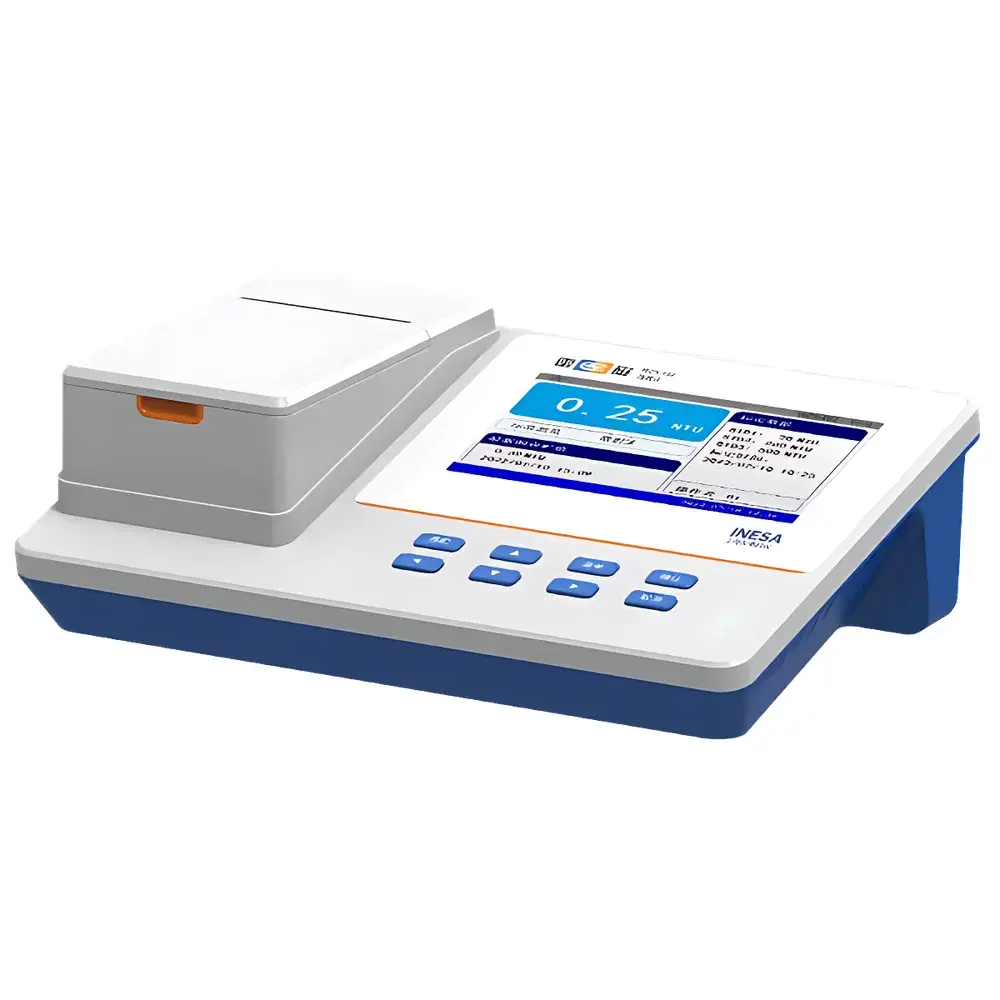
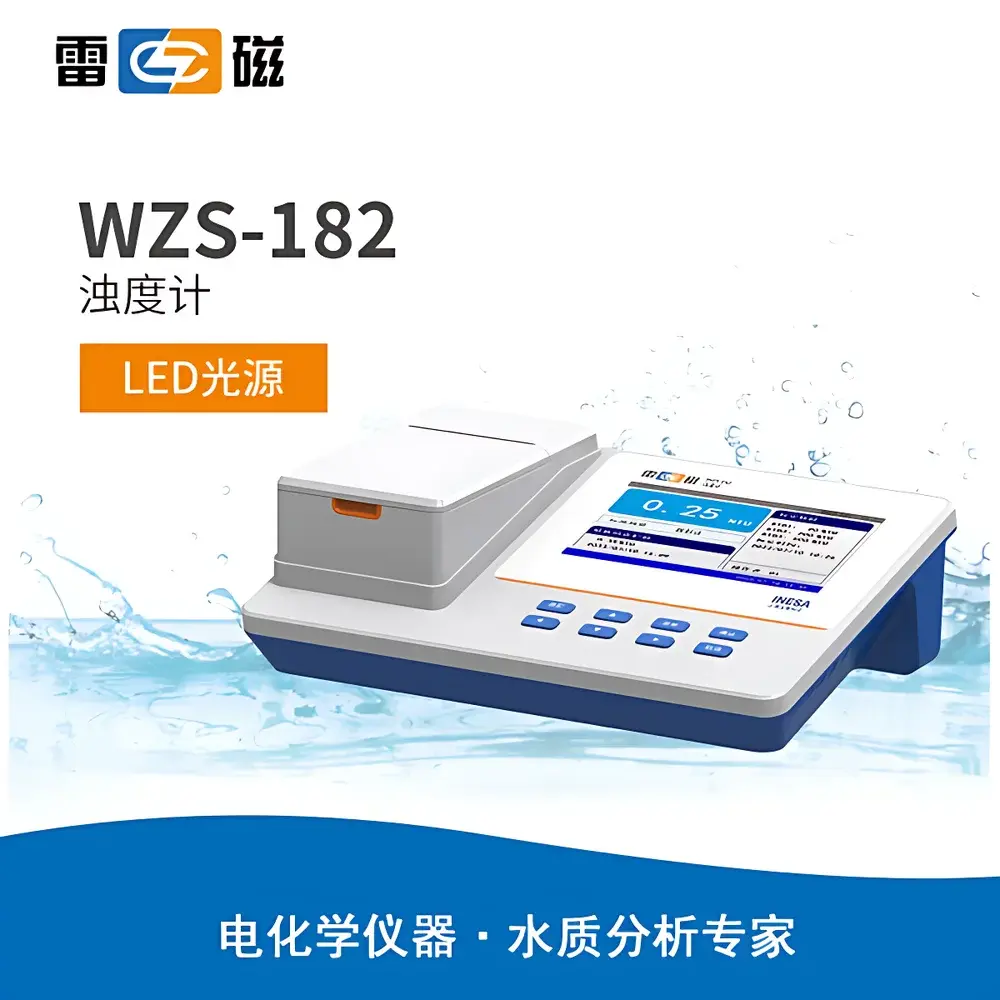
Leici WZS-182 Benchtop Turbidimeter
| Brand | Leici |
|---|---|
| Origin | Shanghai, China |
| Manufacturer Type | Original Equipment Manufacturer (OEM) |
| Product Type | Benchtop Laboratory Turbidimeter |
| Measurement Range | 0.00–500 NTU |
| Resolution | 0.01 NTU (at low range), 0.1 NTU (mid range), 1 NTU (high range) |
| Operating Temperature | 5–35 °C |
| Accuracy | ±6% FS |
| Repeatability | ≤0.5% |
| Zero Drift | ±0.5% FS / 30 min |
| Stability | ±0.5% FS / 30 min |
| Calibration Points | Up to 5 points (2, 20, 50, 200, 500 NTU) |
| Data Storage Capacity | 1000 records |
| Display | 5.7-inch color LCD |
| Protection Rating | IP54 |
| Power Supply | DC24V adapter (AC100–240V input) |
| Dimensions & Weight | 189 × 282 × 84 mm, ~1.5 kg |
| Compliance | ISO 7027, HJ 1075-2019 |
| Measurement Principles | Nephelometric (90° scatter) and Ratio (scatter + transmission) methods |
| Units Supported | NTU, FNU, EBC |
| Connectivity | RS-232 serial port, USB interface |
Overview
The Leici WZS-182 Benchtop Turbidimeter is an ISO 7027-compliant optical instrument engineered for precise, reproducible turbidity quantification in laboratory and quality control environments. It employs a stable 860 nm infrared LED light source—selected to minimize interference from sample coloration and comply with international nephelometric standards—and measures scattered light at 90° relative to the incident beam, as defined by ISO 7027 for formazin-based calibration traceability. The instrument further supports ratio-mode measurement, simultaneously detecting both 90° scattered and transmitted light intensities to compensate for high-absorbance or highly colored samples where conventional nephelometry may yield biased results. Designed for routine analysis of drinking water, wastewater effluents, pharmaceutical process streams, and fermentation broths, the WZS-182 delivers consistent performance across its full 0.00–500 NTU range, segmented into three auto-switching sub-ranges (0.00–9.99, 10.0–99.9, and 100–500 NTU) to optimize signal-to-noise ratio and dynamic response.
Key Features
- 5.7-inch high-resolution color LCD with intuitive icon-driven interface for real-time parameter visualization and menu navigation
- Dual-measurement methodology: selectable nephelometric (90° scatter only) or ratio (scatter + transmission) mode to accommodate diverse sample matrices
- Multi-point calibration capability (up to five points: 2, 20, 50, 200, and 500 NTU) using certified long-life turbidity standards included in the factory-supplied calibration kit
- GLP-compliant data management: timestamped storage of 1000 measurements with operator ID tagging (via optional software configuration), automatic zero-point validation, and full audit trail support
- Robust mechanical architecture with IP54-rated enclosure—dust-resistant and protected against water splashes—suitable for shared lab benches and QC wet labs
- Flexible unit selection: direct switching between NTU (nephelometric turbidity units), FNU (formazin nephelometric units per ISO 7027), and EBC (European Brewery Convention units) without recalibration
- Two operational modes: Standard Mode for single-point acquisition and Average Mode (3–9 readings, user-selectable) to mitigate transient fluctuations caused by particle settling or Brownian motion
Sample Compatibility & Compliance
The WZS-182 is validated for use with standard 25-mm round glass turbidity vials (supplied), ensuring optical path consistency and minimizing wall-scatter artifacts. Its 860 nm LED source meets spectral requirements specified in ISO 7027:2016 and China’s environmental monitoring standard HJ 1075–2019, enabling direct comparability with certified reference materials and inter-laboratory proficiency testing programs. The instrument satisfies fundamental GLP data integrity criteria—including electronic signature readiness, immutable record timestamps, and secure calibration history logging—making it suitable for regulated environments requiring adherence to US FDA 21 CFR Part 11 principles (when used with validated PC software). While not intrinsically GMP-certified, its design facilitates integration into pharmaceutical water system monitoring protocols under USP and EP 2.2.20 guidelines when deployed with documented SOPs and periodic verification.
Software & Data Management
Data export and instrument control are enabled via USB interface using Leici’s proprietary Windows-compatible communication software, which supports raw data download, report generation (PDF/CSV), and firmware updates. The RS-232 port permits direct connection to standard serial printers for hard-copy documentation of measurement sessions—a critical requirement in auditable workflows. All stored records include sample ID, measurement time/date, operator code (if configured), selected unit, measurement mode, and calibration status flag. Internal memory retains data during power interruption (non-volatile storage), and factory-reset functionality preserves original zero and calibration coefficients for traceable revalidation. Audit log entries capture all calibration events, parameter changes, and data deletion actions—supporting internal quality audits and external regulatory inspections.
Applications
- Drinking water treatment: compliance monitoring of finished water turbidity per WHO guidelines and national regulatory limits (e.g., ≤1 NTU)
- Wastewater discharge verification: effluent clarity assessment prior to release into receiving waters
- Pharmaceutical water systems: monitoring of purified water (PW) and water for injection (WFI) distribution loops
- Food & beverage R&D: stability evaluation of colloidal suspensions, juice clarification, and beer haze analysis
- Environmental laboratories: field-deployable benchtop verification of portable turbidimeter calibrations
- Educational institutions: teaching core principles of light scattering, Beer–Lambert law limitations, and metrological traceability in analytical chemistry
FAQ
What standards does the WZS-182 comply with?
It conforms to ISO 7027:2016 (nephelometric turbidity measurement) and China’s HJ 1075–2019 standard for environmental water quality analysis.
Can the instrument measure colored samples accurately?
Yes—by selecting Ratio Mode, the device compensates for absorbance-related attenuation using simultaneous scatter and transmission detection, improving accuracy for yellow/brown-colored waters.
Is multi-point calibration required for routine use?
Single-point calibration (e.g., at 20 NTU) suffices for most applications; however, 5-point calibration is recommended for full-range validation or regulatory submissions requiring linearity verification.
How is data integrity ensured during power loss?
All measurement records and calibration parameters are written to non-volatile memory before confirmation, preventing data corruption during unexpected shutdowns.
Does the WZS-182 support LIMS integration?
Direct LIMS connectivity is not built-in, but ASCII-formatted CSV exports generated via PC software can be parsed by most laboratory information management systems after format mapping.





