
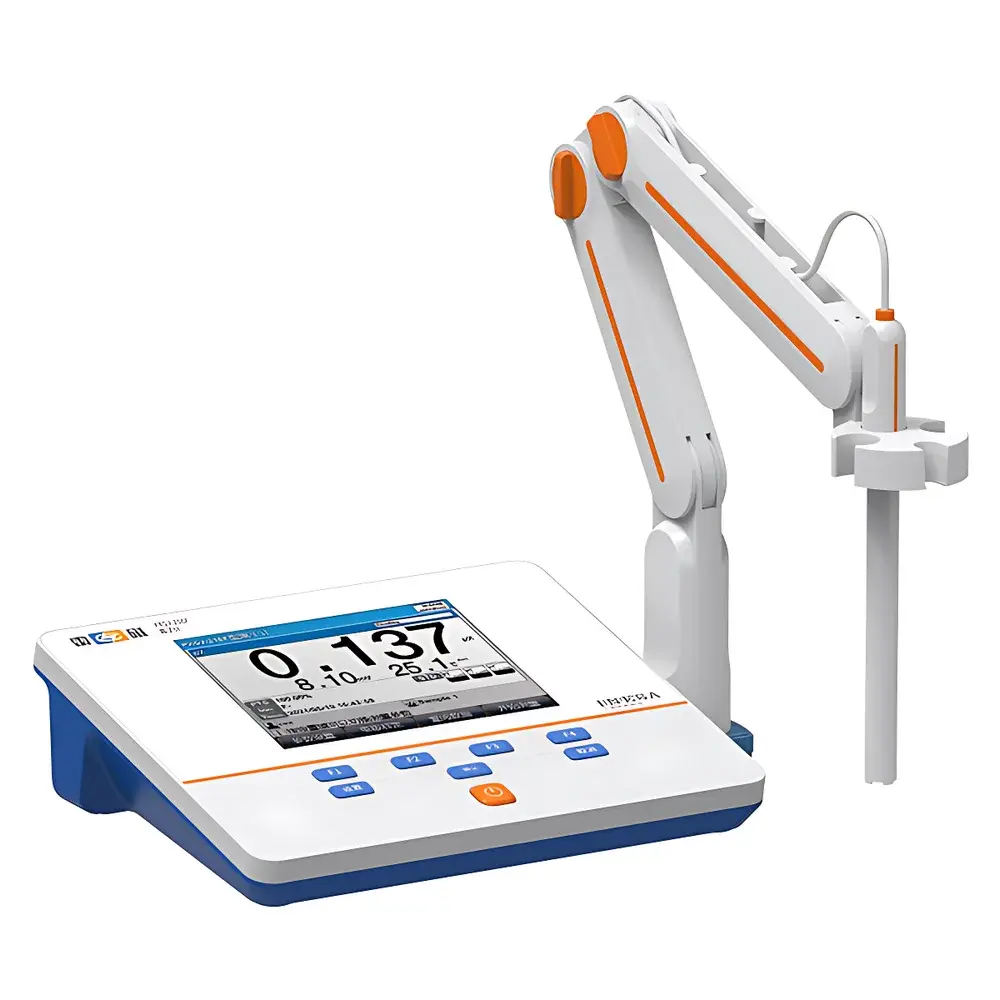
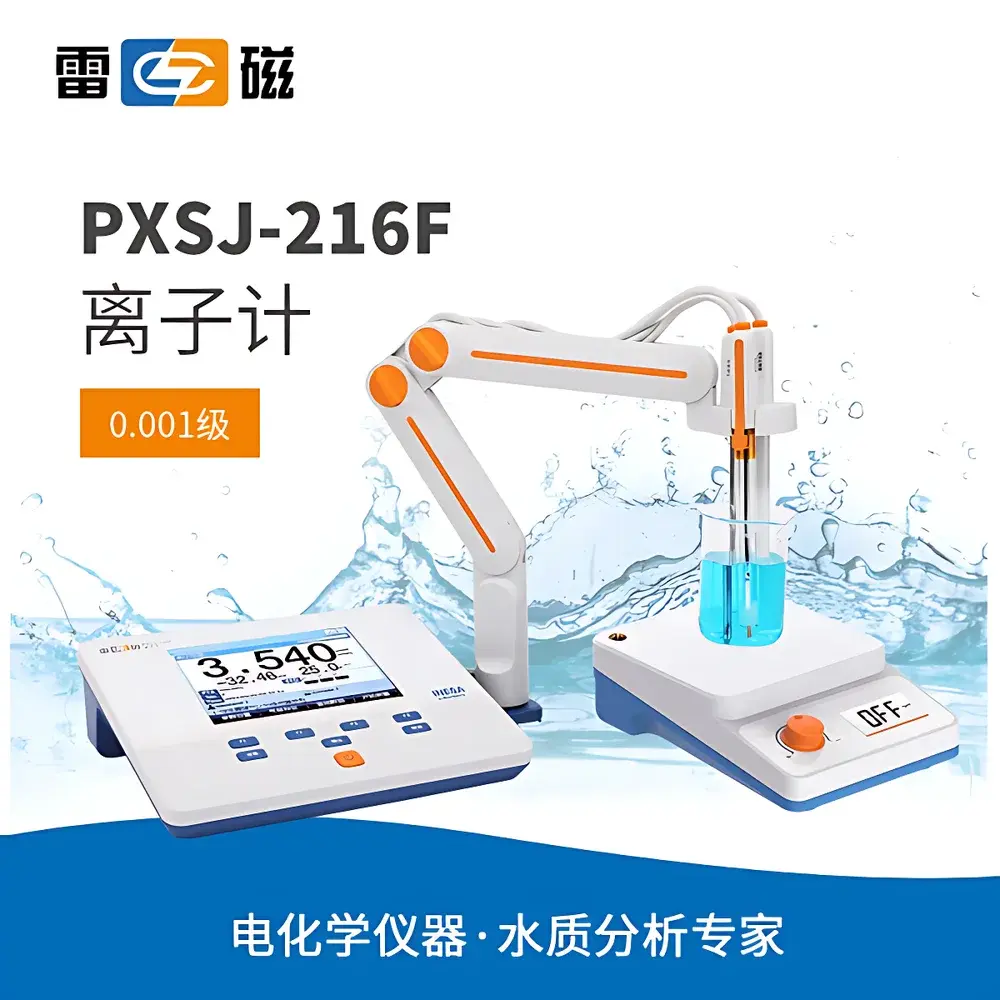
Leici PXSJ-216F Benchtop Ion Meter
| Brand | Leici |
|---|---|
| Origin | Shanghai, China |
| Manufacturer Type | Original Equipment Manufacturer (OEM) |
| Product Category | Domestic |
| Model | PXSJ-216F |
| Instrument Type | Benchtop |
| Ion Measurement Range | (−2.000 to 20.000) pX |
| Measurement Resolution | 0.001 pX |
| Temperature Range | (−10.0 to 135.0) °C / (14.0 to 275.0) °F |
| pH Range | (−2.000 to 20.000) pH |
| mV Range | (−2000.00 to 2000.00) mV |
| Temperature Resolution | 0.1 °C/°F |
| Accuracy (pX/pH) | ±0.002 pX/pH |
| Accuracy (mV) | ±0.03% or ±0.1 mV |
| Accuracy (Temperature) | ±0.1 °C |
| Ion Concentration Units | mol/L, mmol/L, g/L, mg/L, μg/L |
| Data Storage Capacity | 500 datasets |
| Communication Interfaces | RS-232, USB |
| IP Rating | IP54 |
| Power Supply | AC 100–240 V input, DC 9 V output |
| Dimensions (W×D×H) | 242 × 195 × 68 mm |
| Weight | 0.9 kg |
Overview
The Leici PXSJ-216F Benchtop Ion Meter is a high-precision potentiometric analyzer engineered for quantitative determination of monovalent and multivalent ions in aqueous solutions via selective ion electrode (ISE) measurement. Based on the Nernst equation, the instrument measures the electromotive force (EMF) generated at the interface between an ion-selective membrane and the sample solution, converting voltage signals into logarithmic concentration units (pX) with trace-level resolution. Designed for routine and regulatory-compliant water quality analysis, it supports direct concentration measurement, standard addition, sample addition, and Gran plot titration—enabling rigorous quantification across environmental monitoring, municipal wastewater treatment, drinking water safety verification, and industrial process control laboratories.
Key Features
- High-resolution color LCD display with intuitive icon-based navigation and real-time parameter visualization
- Selectable resolution modes: 0.001 / 0.01 / 0.1 pX and 0.01 / 0.1 / 1 mV for flexible analytical granularity
- Dual temperature unit support (°C / °F) with automatic temperature compensation (ATC) and manual override
- Intelligent endpoint detection algorithms enabling auto-read, timed-read, interval-read, and manual sampling protocols
- Comprehensive electrode calibration suite: 1–5-point pH calibration with automatic recognition of GB, DIN, NIST, USA, and MERK buffer sets; user-defined buffer group management
- Built-in ion mode library covering Na⁺, K⁺, NH₄⁺, Cl⁻, F⁻, and customizable ion configurations for method-specific deployment
- Multi-unit ion concentration conversion: seamless switching among mol/L, mmol/L, g/L, mg/L, and μg/L without recalibration
- Robust hardware architecture compliant with IP54 ingress protection for dust resistance and limited water splashing tolerance
- Firmware-upgradable platform supporting functional expansion, protocol updates, and long-term serviceability
Sample Compatibility & Compliance
The PXSJ-216F is optimized for aqueous liquid samples with conductivity ≥50 μS/cm and total dissolved solids (TDS) ≤5000 mg/L. It accommodates standard combination ISEs and separate indicator/reference electrode configurations—including supplied fluorine-selective, Ag/AgCl reference, and Pt1000 temperature electrodes. All measurements adhere to ISO 10523 (water quality — determination of pH), ISO 10304-1 (ion chromatography — part 1: determination of anions), and ASTM D1293 (standard test method for pH of water). Its data handling architecture satisfies GLP (Good Laboratory Practice) requirements through mandatory audit trail metadata (operator ID, timestamp, electrode serial number, calibration history), ensuring full traceability for regulatory submissions and internal QA/QC review.
Software & Data Management
Data integrity is maintained via dual-interface connectivity: RS-232 enables direct printing to industry-standard serial printers using configurable report templates (including raw EMF, pX, temperature, and calibration logs); USB interface facilitates secure bidirectional transfer to Windows-based PCs using Leici’s certified communication software. The instrument stores up to 500 complete measurement records—including all intermediate values from Gran plots and standard addition sequences—with searchable indexing by date, ion type, or operator tag. Stored datasets can be exported as CSV or PDF for integration into LIMS environments or statistical analysis platforms. All stored entries include embedded calibration verification flags and electrode response slope diagnostics, supporting FDA 21 CFR Part 11–aligned electronic record retention where enabled via host software configuration.
Applications
- Environmental field labs: Fluoride monitoring in groundwater per WHO guidelines (≤1.5 mg/L) and EPA Method 300.0
- Municipal water utilities: Sodium and chloride tracking in desalination brine streams and distribution system corrosion control
- Pharmaceutical manufacturing: Quantitative verification of residual ammonium in purified water (USP )
- Academic research: Multi-ion speciation studies in soil leachates and simulated rainwater matrices
- Food & beverage QA: Chloride content validation in bottled water and dairy processing rinse waters
- Electroplating facilities: Real-time monitoring of bath composition stability (e.g., Ni²⁺, Cu²⁺, SO₄²⁻)
FAQ
Does the PXSJ-216F support GLP-compliant data logging?
Yes. Each measurement entry includes timestamp, operator ID (if configured), electrode identification, calibration status, and environmental conditions—meeting core GLP documentation requirements.
Can custom ion calibration curves be saved and recalled?
Yes. Users may define, name, store, and load up to 10 custom ion calibration profiles, including non-linear curve fits and slope-based concentration interpolation.
Is the instrument compatible with non-Leici ion-selective electrodes?
It accepts any BNC-compatible ISE or reference electrode meeting standard potentiometric impedance specifications (≤10¹² Ω input impedance, <100 mV offset drift/hour).
What maintenance routines are recommended for long-term accuracy?
Daily electrode rinsing with deionized water, weekly storage in appropriate electrolyte solution, and monthly verification using certified reference standards traceable to NIST SRMs.
How does the Gran plot method improve low-concentration ion analysis?
By linearizing the titration curve near the equivalence point, the Gran method reduces sensitivity to junction potential errors and extends reliable detection down to sub-ppb levels for target ions such as F⁻ or NO₃⁻.







