
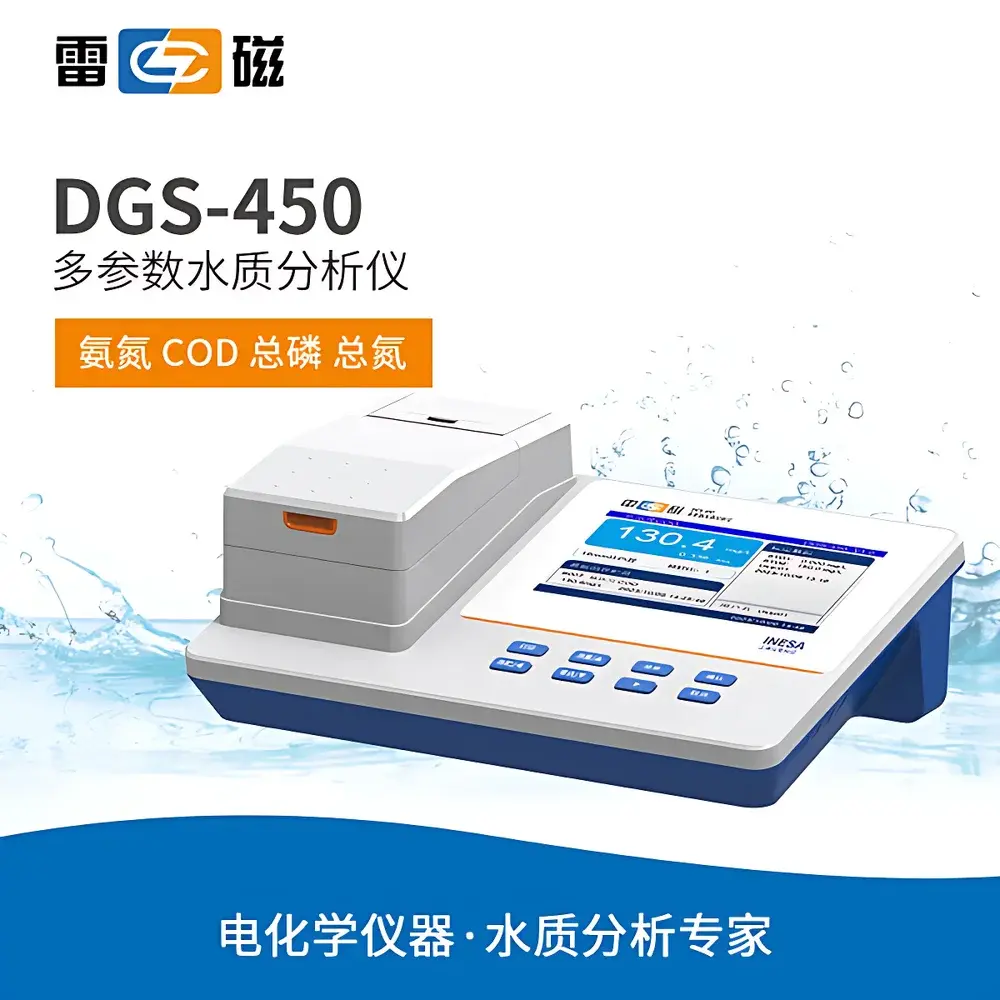
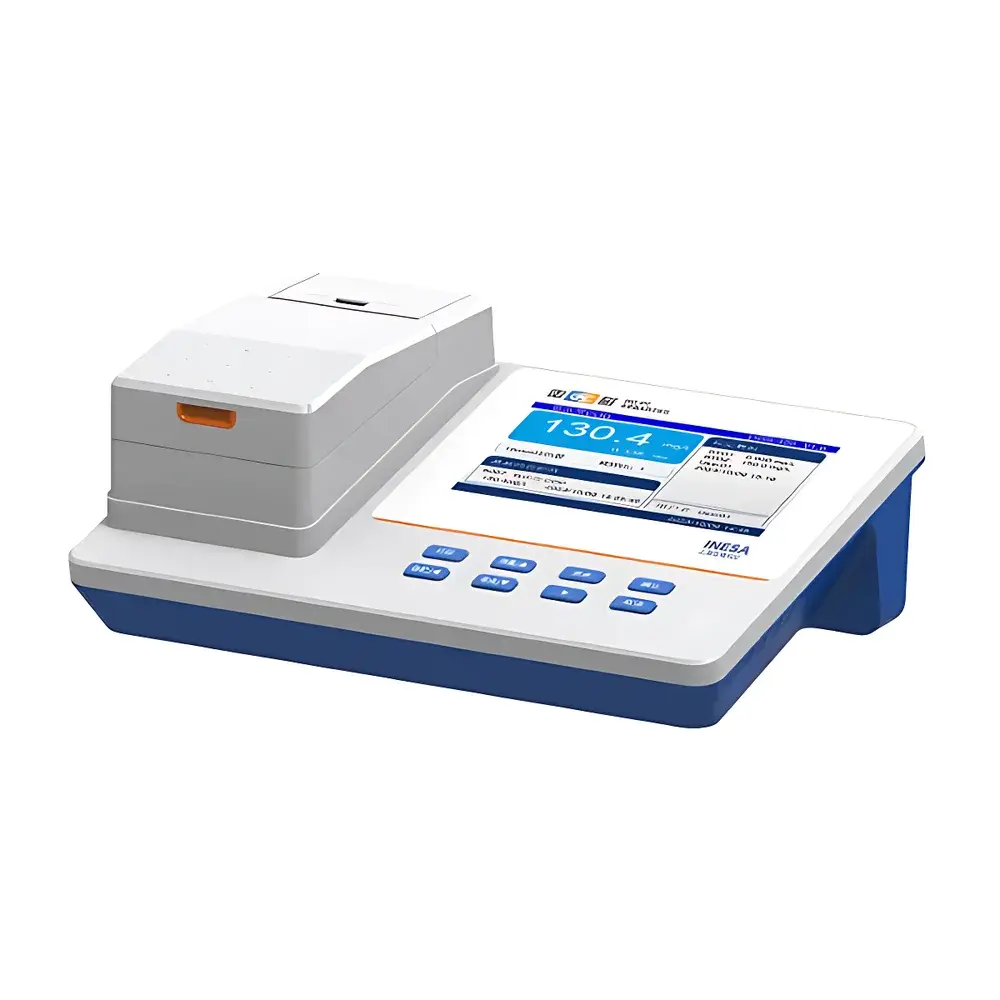
LeiCi DGS-450 Multi-Parameter Water Quality Analyzer (Ammonia-N, COD, Total Phosphorus, Total Nitrogen)
| Brand | LeiCi |
|---|---|
| Origin | Shanghai, China |
| Manufacturer Type | Direct Manufacturer |
| Regional Classification | Domestic (China) |
| Model | DGS-450 |
| Instrument Type | Benchtop Laboratory Analyzer |
| Measurement Principle | Potassium Dichromate Digestion Method (for COD), Nesslerization (for Ammonia-N), Molybdate Blue Spectrophotometry (for Total Phosphorus), Alkaline Potassium Persulfate Digestion with Chromotropic Acid (for Total Nitrogen) |
| Wavelengths | 420 nm, 470 nm, 620 nm, 700 nm |
| COD Range | (0.000–1500) mg/L (extendable to 15,000 mg/L) |
| Ammonia-N Range | (0.000–10.00) mg/L (extendable to 100.0 mg/L) |
| Total Phosphorus Range | (0.000–1.000) mg/L (extendable to 10.00 mg/L) |
| Total Nitrogen Range | (0.000–30.00) mg/L (extendable to 300.0 mg/L) |
| Absorbance Range | (0.000–2.000) Abs |
| Wavelength Accuracy | ±4 nm |
| Transmittance Error | ±2% |
| Photometric Repeatability | ≤0.5% |
| Ammonia-N Accuracy | ±5% |
| COD & Total Phosphorus & Total Nitrogen Accuracy | ±8% (COD & TP), ±1 mg/L (≤10 mg/L TN) or ±5% (>10 mg/L TN) |
| Repeatability (all parameters) | ≤3% |
| Detection Limits | Ammonia-N ≤0.03 mg/L |
| Cell Format | 25 mm cuvette / 16 mm tube |
| Power Supply | AC 100–240 V input, DC 20 V output |
| Dimensions | 302 × 205 × 122 mm |
| Weight | 1.33 kg |
| Data Storage | 500 records per parameter |
| Interface | RS-232, USB-B, U-disk export support |
Overview
The LeiCi DGS-450 Multi-Parameter Water Quality Analyzer is a benchtop spectrophotometric platform engineered for precise, standardized quantification of key water quality indicators in environmental monitoring laboratories, municipal wastewater facilities, and industrial effluent testing centers. It implements internationally recognized wet-chemistry methodologies—Nesslerization for ammonia-nitrogen (NH₃-N), potassium dichromate digestion coupled with spectrophotometric detection at 420 nm (low-COD) and 620 nm (high-COD), molybdate blue reaction for total phosphorus (TP) at 700 nm, and alkaline potassium persulfate digestion followed by chromotropic acid colorimetry for total nitrogen (TN) at 420 nm. The instrument integrates four high-stability LED light sources (420 nm, 470 nm, 620 nm, 700 nm), each calibrated to ±4 nm wavelength accuracy and optimized for long-term photometric stability (<0.5% photometric repeatability). Its optical path accommodates both 25 mm square cuvettes and 16 mm round tubes, supporting flexibility in sample handling while maintaining consistent pathlength-dependent absorbance linearity across the 0.000–2.000 Abs range.
Key Features
- Intelligent endpoint recognition algorithm that autonomously determines reaction completion for digestion-based assays, eliminating subjective visual judgment and improving inter-operator consistency.
- Programmable dilution factor input: the system automatically back-calculates original sample concentration from diluted measurements, reducing manual error in high-range analysis (e.g., COD up to 15,000 mg/L).
- Built-in calibration curve library with preloaded methods for NH₃-N, low/high COD, TP, and TN—each compliant with standard reference protocols (e.g., ISO 6777, ISO 8467, ISO 11908, EPA 365.4, APHA 4500-P E).
- Flexible calibration: supports 2–5 point user-defined curves; enables re-standardization of individual calibration points without full curve regeneration.
- GLP-compliant data integrity architecture: time-stamped measurement logs, operator ID tagging, audit-trail-enabled calibration history, and non-volatile memory retention during power interruption.
- Dual data output: integrated thermal printer with customizable report templates (including method ID, date/time, operator, raw absorbance, calculated result, and QC flags) + USB mass-storage mode for direct U-disk export of CSV-formatted datasets.
Sample Compatibility & Compliance
The DGS-450 is designed for aqueous matrices including surface water, groundwater, domestic wastewater, industrial effluents, and treated discharge streams. All digestion-dependent assays (COD, TP, TN) require external thermal digestion using compatible block digesters (sold separately); the analyzer itself performs only optical measurement post-digestion. Sample introduction uses standard 25 mm cuvettes (for high-precision work) or 16 mm test tubes (for rapid screening), with automatic cell recognition logic minimizing misalignment errors. The system conforms to fundamental requirements of ISO/IEC 17025:2017 for testing laboratories, supports traceability per ISO Guide 34 and ISO Guide 35, and enables compliance-ready documentation for regulatory submissions under US EPA, EU Water Framework Directive, and China’s HJ/T 399–2007, HJ 535–2009, HJ 670–2013, and HJ 636–2012 standards. While not inherently 21 CFR Part 11 compliant, its audit-trail functionality and password-protected configuration settings provide a foundational framework for laboratory validation under GxP environments.
Software & Data Management
Data acquisition and reporting are managed via embedded firmware—not external PC software—ensuring deterministic response and immunity to host OS vulnerabilities. Each parameter stores up to 500 independent results with full metadata: sample ID, measurement date/time, operator code, method version, calibration ID, raw absorbance values, dilution factor, and pass/fail QC status. Exported CSV files include column headers compatible with LIMS integration (e.g., LabWare, STARLIMS) and statistical software (e.g., JMP, Minitab). RS-232 and USB-B ports support bidirectional communication with laboratory PCs using LeiCi’s optional terminal emulation utility (ASCII protocol), enabling remote instrument control, firmware updates, and batch data retrieval. No cloud connectivity or proprietary drivers are required; all operations function offline, preserving data sovereignty and network security.
Applications
- Regulatory compliance monitoring for municipal wastewater treatment plants (WWTPs) performing daily NH₃-N, COD, TP, and TN checks per national discharge permits.
- Environmental impact assessment (EIA) field labs conducting baseline and post-intervention water profiling in rivers, lakes, and reservoirs.
- Industrial pretreatment verification for electroplating, food processing, and pharmaceutical manufacturing sites subject to local effluent limits.
- Educational laboratories teaching standard methods for nutrient and organic load analysis in environmental science curricula.
- Third-party testing laboratories requiring ISO/IEC 17025 traceable instrumentation with documented uncertainty budgets for accredited reporting.
FAQ
Does the DGS-450 perform digestion internally?
No. Digestion is an exothermic chemical process requiring controlled heating (e.g., 150 °C for 2 hours for COD). The DGS-450 is a dedicated photometer; digestion must be conducted externally using a certified block digester prior to measurement.
Can I use third-party reagents with this instrument?
Yes—provided reagents conform to the same reaction chemistry and stoichiometry specified in the referenced standards (e.g., ASTM D1252, ISO 6060). However, calibration curves and accuracy claims apply only when using Leici-certified reagent kits, which undergo lot-specific verification.
Is method validation documentation available?
LeiCi provides instrument-specific performance qualification (PQ) protocols and blank/standard recovery data per ICH Q2(R2) principles upon request for qualified laboratories engaged in formal method transfer or regulatory audits.
How is photometric accuracy verified during routine use?
Users may run NIST-traceable neutral density filters (e.g., Schott NG1, NG2) at 420 nm and 620 nm to confirm absorbance linearity and wavelength alignment; built-in diagnostic routines verify LED intensity drift and dark-current stability before each measurement cycle.
What happens to stored data during a power outage?
All measurement records, calibration data, and system configurations reside in non-volatile flash memory. Power failure recovery restores the last stable operational state without data loss or corruption.







