
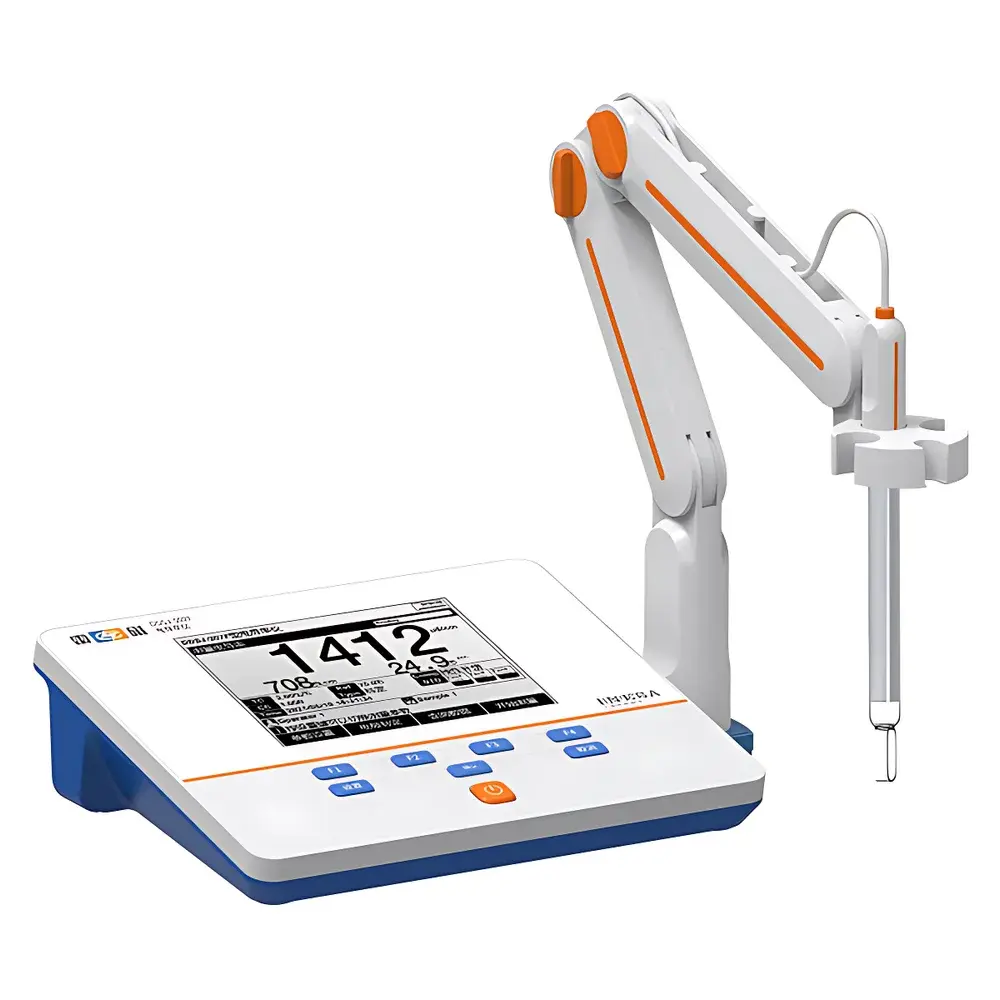
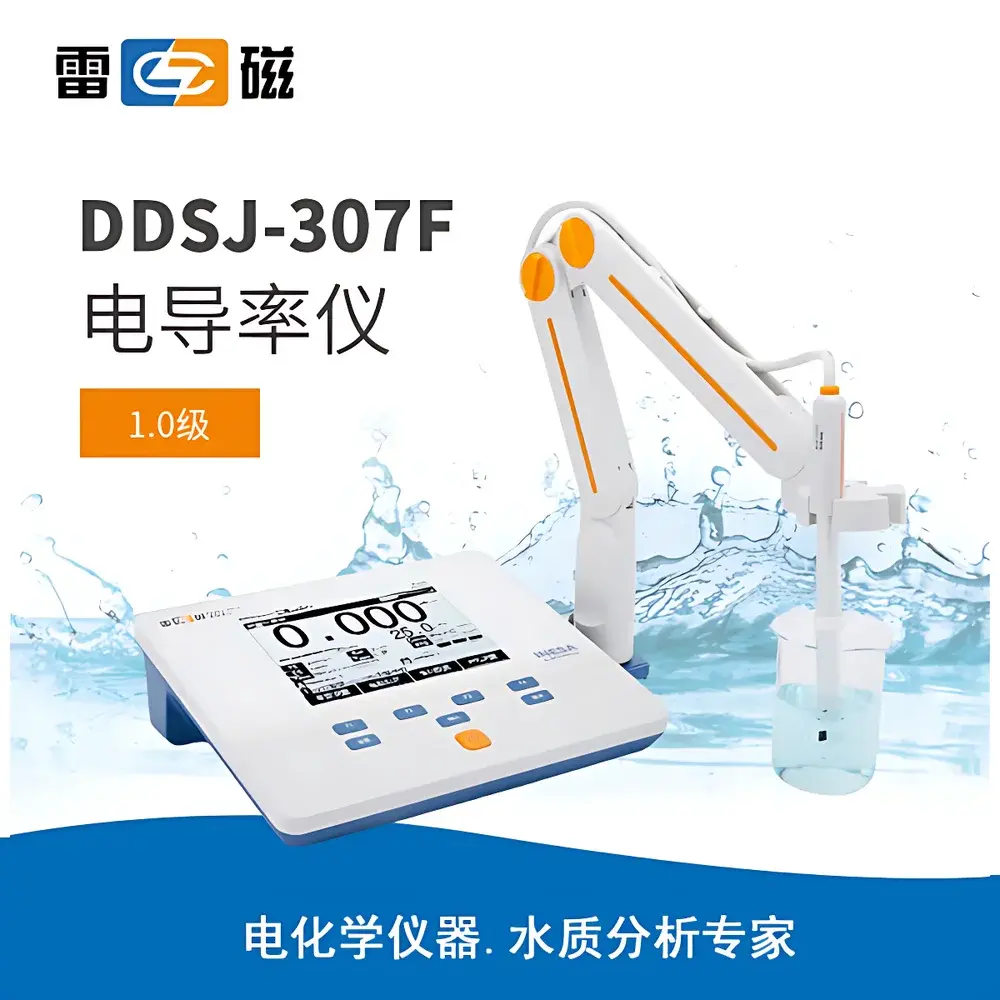
Leici DDSJ-307F Benchtop Conductivity Meter
| Brand | Leici |
|---|---|
| Origin | Shanghai, China |
| Manufacturer Type | Original Equipment Manufacturer (OEM) |
| Product Category | Domestic |
| Model | DDSJ-307F |
| Price Range | USD 420–690 |
| Measured Parameters | Conductivity, Resistivity, TDS, Salinity, Temperature |
| Form Factor | Benchtop |
| Intended Use | Laboratory |
| Conductivity Range | 0.000 µS/cm to 1000 mS/cm |
| TDS Range | 0.00 mg/L to 300 g/L |
| Resistivity Range | 5.00 Ω·cm to 20.00 MΩ·cm |
| Salinity Range | 0.00–8.00 % |
| Temperature Range | −5.0 to 110.0 °C (23.0–230.0 °F) |
| Minimum Conductivity Resolution | 0.001 µS/cm (auto-ranging) |
Overview
The Leici DDSJ-307F is a precision benchtop conductivity meter engineered for routine and research-grade electrochemical analysis in regulated laboratory environments. It operates on the principle of two-electrode or four-electrode AC conductivity measurement—applying a low-frequency alternating current across a conductive cell to determine solution conductance while minimizing polarization effects. The instrument simultaneously computes derived parameters—including resistivity, total dissolved solids (TDS), and salinity—using standardized conversion algorithms aligned with IEC 60746-3 and ASTM D1125. Designed for stability under variable ambient conditions, it features built-in temperature compensation referenced to either 20 °C or 25 °C, supporting both linear and non-linear (e.g., pure water) compensation models. Its 1.0-class accuracy per JJG 376–2007 (Chinese national metrological verification regulation) ensures compliance with basic quality control requirements in pharmaceutical QC, environmental testing, and academic teaching labs.
Key Features
- High-resolution 4.3-inch TFT LCD display with adjustable contrast and backlight for clear parameter visualization under varied lighting conditions
- Auto-ranging conductivity measurement with dynamic resolution switching: 0.001 µS/cm at low ranges, up to 0.1 mS/cm at high ranges
- Intelligent endpoint detection: supports auto-read, timed-read, interval-read, and manual-read modes for flexible workflow integration
- Multi-mode temperature compensation: selectable between no compensation, linear (α = 2.0 %/°C default), and pure-water mode per ISO 7888
- Automatic electrode constant recognition for K = 0.1, 1.0, and 10.0 cm⁻¹ cells; optimized full-range coverage using a standard K = 1.0 cell (recommended K = 0.1 or 0.01 for samples < 20 µS/cm)
- IP54-rated enclosure for dust resistance and limited water splashing protection—suitable for general lab bench use without dedicated fume hood placement
- Integrated firmware upgrade capability via USB interface, enabling traceable version control and future protocol expansion
- Power management suite: automatic shutdown after 30 minutes of inactivity, power-loss data retention, and factory reset security lock
Sample Compatibility & Compliance
The DDSJ-307F accommodates aqueous solutions across wide ionic strength gradients—from ultrapure water (≥18.2 MΩ·cm) to saturated brines and industrial process streams. It accepts standard DIN/ISO-compliant conductivity cells with BNC or mini-DIN connectors. Calibration is validated against certified GB/T 6682–2008 reference standards (KCl solutions at 0.01 mol/kg, 0.1 mol/kg, 1.0 mol/kg, and 0.5 mol/kg). While not inherently 21 CFR Part 11 compliant, its GLP-aligned data handling—including time-stamped entries, operator ID tagging (via optional software), and immutable audit trails when paired with Leici’s LSPC LabSuite software—supports inspection readiness for ISO/IEC 17025-accredited laboratories. All electrical safety meets IEC 61010-1:2010 requirements for laboratory measurement equipment.
Software & Data Management
- Onboard storage for up to 500 complete measurement records per parameter type (conductivity, TDS, etc.), each including date/time stamp, temperature, electrode constant, and calibration status
- Data review modes: list view, chronological plot, and trend curve overlay—exportable as CSV via USB mass-storage emulation
- RS-232 serial interface supports direct connection to ESC/POS-compatible thermal printers; configurable print templates include header fields, units, and pass/fail flags
- USB Type-B port enables bidirectional communication with Windows-based LSPC LabSuite v3.x software for advanced reporting, statistical analysis (mean, SD, RSD), and electronic signature workflows
- Full GLP compliance: every stored record includes metadata such as calibration history, sensor ID, ambient temperature, and user-defined sample ID—enabling full analytical traceability per ISO/IEC 17025 clause 7.7
Applications
This instrument serves critical roles in multiple regulated and non-regulated domains: monitoring feedwater and boiler blowdown conductivity in power generation facilities; verifying conductivity specifications of purified water (PW) and water-for-injection (WFI) per USP ; assessing soil extract conductivity in agricultural testing; evaluating electrolyte concentration in battery R&D; and routine quality checks of cleaning agents, dialysate solutions, and semiconductor rinse baths. Its dual-unit temperature display (°C/°F) and configurable reference temperature support international method transfer, while the robust mechanical design ensures long-term repeatability in high-throughput university teaching labs.
FAQ
What electrode constants are supported?
Standard K = 0.1, 1.0, and 10.0 cm⁻¹ cells are automatically recognized. For measurements below 20 µS/cm, use K = 0.1 or K = 0.01 cells to maintain signal-to-noise ratio and minimize uncertainty.
Does the DDSJ-307F meet ASTM or ISO conductivity measurement standards?
Yes—it implements algorithms consistent with ASTM D1125 (conductivity of water) and ISO 7888 (electrical conductivity of water)—including temperature correction models and TDS conversion factors based on NaCl equivalence.
Can calibration data be exported and archived externally?
Yes. Calibration logs—including date, standard used, measured value, deviation, and acceptance criteria—are stored onboard and exportable via USB or RS-232, supporting internal QA documentation and external audit requirements.
Is the device suitable for field use or only lab environments?
It is strictly a benchtop instrument rated IP54. Not designed for portable or outdoor deployment; intended for stable, climate-controlled laboratory benches with AC power access.
How is measurement uncertainty quantified?
Electronic unit error is ±1.0 % of full scale for conductivity/resistivity/TDS, and ±0.2 % for salinity; temperature measurement error is ±0.2 °C. Combined uncertainty accounts for electrode fouling, calibration drift, and temperature probe positioning—typical expanded uncertainty (k=2) is ≤±1.5 % for mid-range aqueous samples.





