
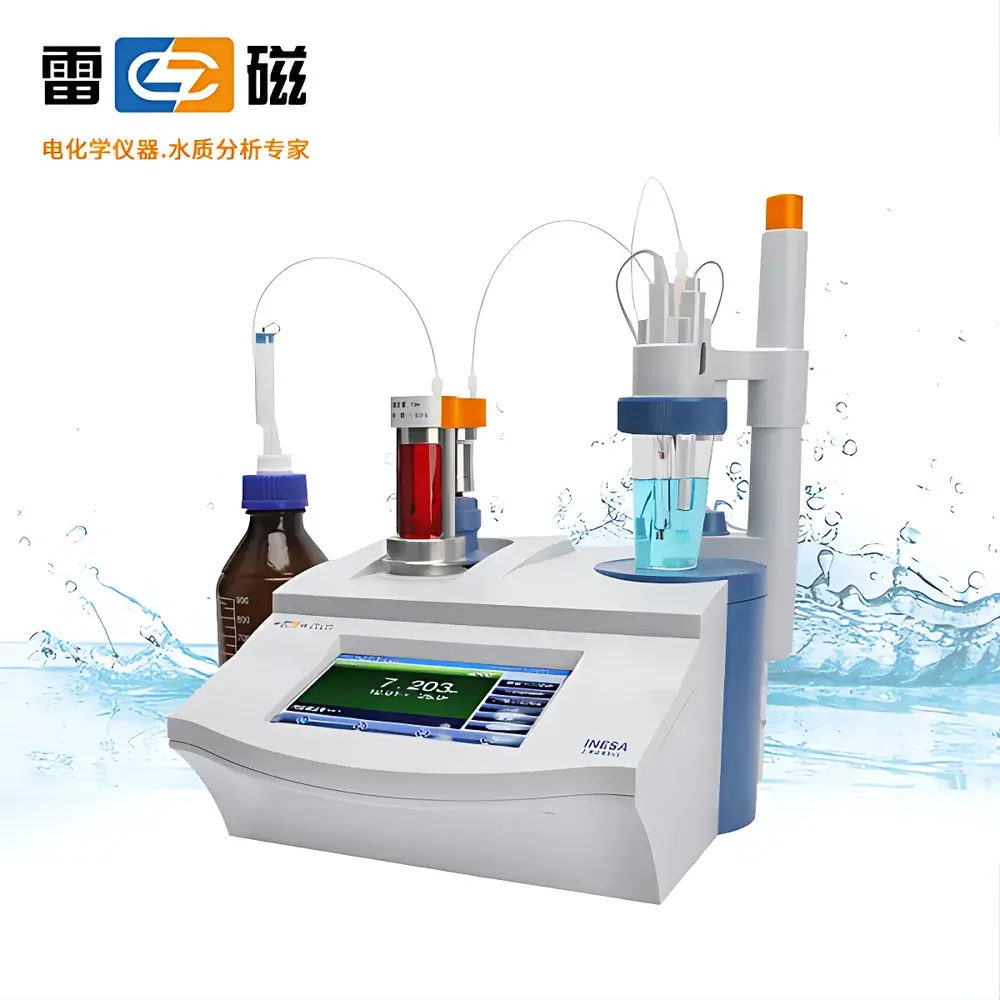
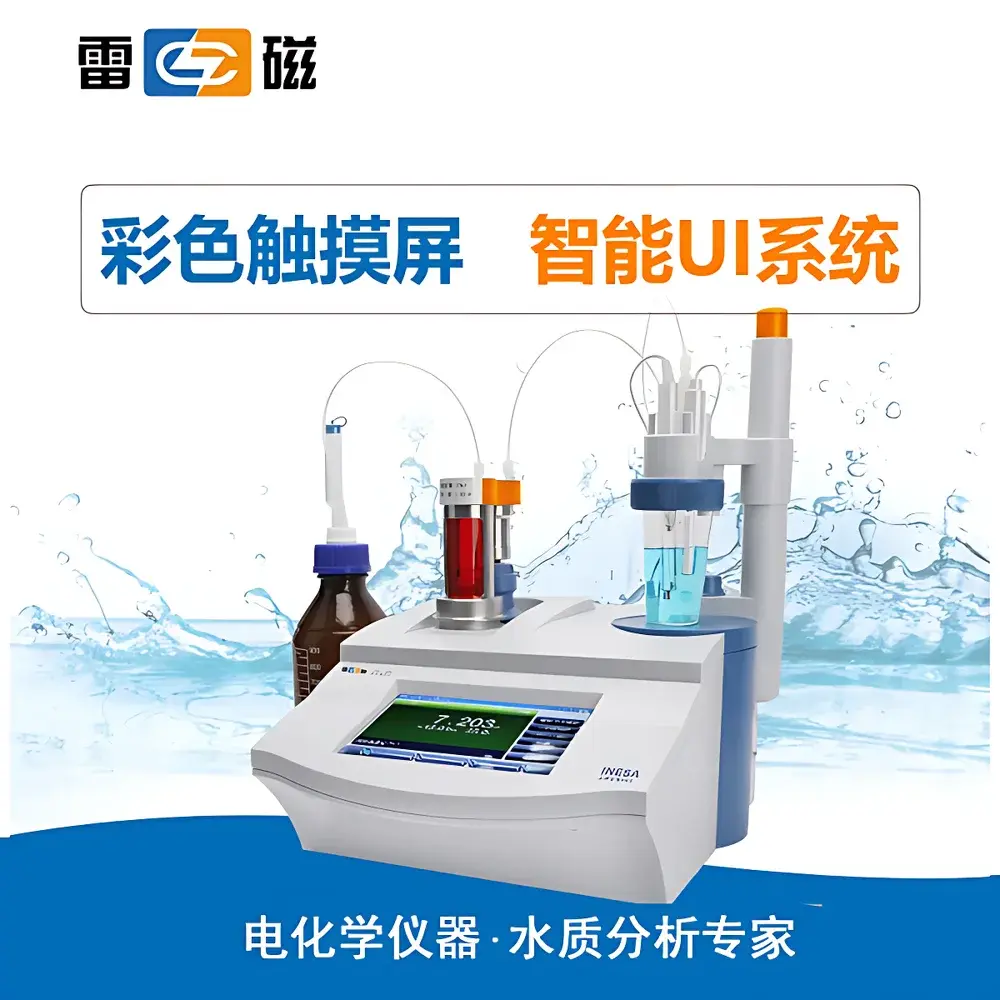
Leici ZDJ-5B Automatic Potentiometric Titrator
| Brand | Leici |
|---|---|
| Origin | Shanghai, China |
| Manufacturer Type | Direct Manufacturer |
| Regional Category | Domestic (China) |
| Model | ZDJ-5B |
| Instrument Type | General-Purpose Potentiometric Titrator |
| Application Scope | Universal |
| Measurement Range | (−2000.00 to +2000.00) mV, (0.000 to 20.000) pH |
| Meter Accuracy | ±0.01 mV, ±0.001 pH |
| Meter Resolution | pH: ±0.002 pH |
| mV | ±0.03% or ±0.2 mV |
| Titration Repeatability | 0.2% |
| Titration Resolution | 1/30000 |
Overview
The Leici ZDJ-5B Automatic Potentiometric Titrator is a benchtop electrochemical analysis system engineered for precision, reproducibility, and method flexibility in routine and regulated laboratory environments. It operates on the fundamental principle of potentiometric titration—measuring the potential difference between a reference electrode and an indicator electrode as a function of titrant volume—to determine stoichiometric endpoints with high sensitivity. Designed for universal applicability, the ZDJ-5B supports acid-base, redox, precipitation, complexometric, and non-aqueous titrations without hardware modification. Its dual-channel architecture accommodates both built-in and optional external burette modules, enabling multi-reagent workflows and method scalability. The instrument complies with core metrological requirements for volumetric analysis per ISO 8655 (burette accuracy), ASTM E2087 (electrochemical measurement validation), and USP (potentiometric endpoint detection), making it suitable for QC laboratories operating under GLP or GMP-aligned quality systems.
Key Features
- 7-inch capacitive color touchscreen with intuitive, menu-driven navigation—displays real-time titration curves, method parameters, and live electrode potential/pH values.
- Integrated burette module with quick-swap valve-tube assembly—supports 10 mL and 20 mL glass burettes (10 mL standard); burette accuracy meets ISO 8655 Class A tolerances (±0.020 mL for 10 mL, ±0.030 mL for 20 mL).
- Chemically resistant fluid path constructed from PTFE, ETFE, and sapphire components—compatible with strong acids, bases, perchloric acid, and organic solvents (e.g., acetic anhydride, glacial acetic acid) used in non-aqueous titrations.
- Multi-mode titration control: dynamic (incremental), fixed-volume, preset-endpoint, constant-dosage, blank correction, manual override, and user-defined stepwise protocols.
- Onboard method management: stores up to 100 validated titration methods; supports formula definition, parameter inheritance, method cloning, and 10 customizable quick-access shortcuts.
- Comprehensive electrode support: automatic pH calibration (1–3 point), mV offset verification, temperature compensation (−5.0 to 105.0 °C, 0.1 °C resolution), and stability monitoring (±0.3 mV/3 h).
Sample Compatibility & Compliance
The ZDJ-5B interfaces with standard laboratory electrodes—including combination pH electrodes, platinum redox sensors, silver/silver chloride reference electrodes, and ion-selective probes—enabling direct analysis of aqueous, alcoholic, and mixed-solvent samples. Its modular design allows seamless integration with optional modules (conductometric, amperometric, photometric, thermometric) via standardized signal inputs. From a regulatory standpoint, the system satisfies essential elements of FDA 21 CFR Part 11 when operated with the optional GMP-compliant software package, including electronic signatures, audit trails, role-based user access control, and immutable data archiving. All stored results include timestamped metadata (operator ID, method version, environmental temperature, electrode ID), fulfilling GLP documentation requirements per OECD Principles of Good Laboratory Practice.
Software & Data Management
Data integrity is maintained through dual-layer storage: 200 complete titration records (including raw mV/pH vs. volume time-series, derivative curves, endpoint calculations, and operator annotations) are retained onboard with full recall, reprocessing, and statistical summary functions (mean, RSD, confidence intervals). Export options include USB mass-storage mode (CSV, PDF, TXT), RS-232 serial transmission, and PC synchronization via Leici’s certified communication suite—supporting batch export, spectral overlay, and compliance-ready report generation. U disk import/export enables secure method transfer across instruments without network exposure. Firmware updates are performed locally via USB, ensuring continuity in validated environments.
Applications
The ZDJ-5B delivers traceable quantitative results across pharmaceutical, food & beverage, petrochemical, environmental, and academic sectors. Typical use cases include: assay of active pharmaceutical ingredients (APIs) via non-aqueous acidimetry (e.g., pyridine-perchloric acid titration per USP ); chloride determination in wastewater by argentometric titration; peroxide value analysis in edible oils using cerimetric redox titration; total alkalinity profiling in dairy products; and chelometric quantification of Ca²⁺/Mg²⁺ in hard water samples. When coupled with an optional autosampler, throughput increases to >50 samples per unattended shift—ideal for release testing in cGMP manufacturing.
FAQ
Does the ZDJ-5B support audit trail functionality for regulated environments?
Yes—when configured with the optional GMP software module, the system provides full 21 CFR Part 11–compliant audit trails, including user login/logout logs, method modification history, result changes, and electronic signature capture.
Can I perform temperature-compensated titrations across extreme ranges?
The integrated Pt1000 temperature sensor covers −5.0 to 105.0 °C with ±0.3 °C accuracy (0–60 °C range); automatic compensation adjusts Nernst slope and activity coefficients in real time.
Is method validation supported out-of-the-box?
The instrument includes built-in repeatability assessment (RSD ≤0.2%), endpoint precision reporting, and raw data reprocessing—enabling partial validation per ICH Q2(R2) guidelines without third-party tools.
What electrode types are natively compatible?
Standard BNC and DIN connectors accept all common potentiometric sensors: combination pH electrodes, redox (Pt or Ag), ion-selective (F⁻, Cl⁻, CN⁻), and specialized non-aqueous probes.
How is data security ensured during USB transfer?
All USB exports generate timestamped, read-only files with embedded checksums; no executable code or configuration edits are permitted via removable media to prevent accidental system corruption.





