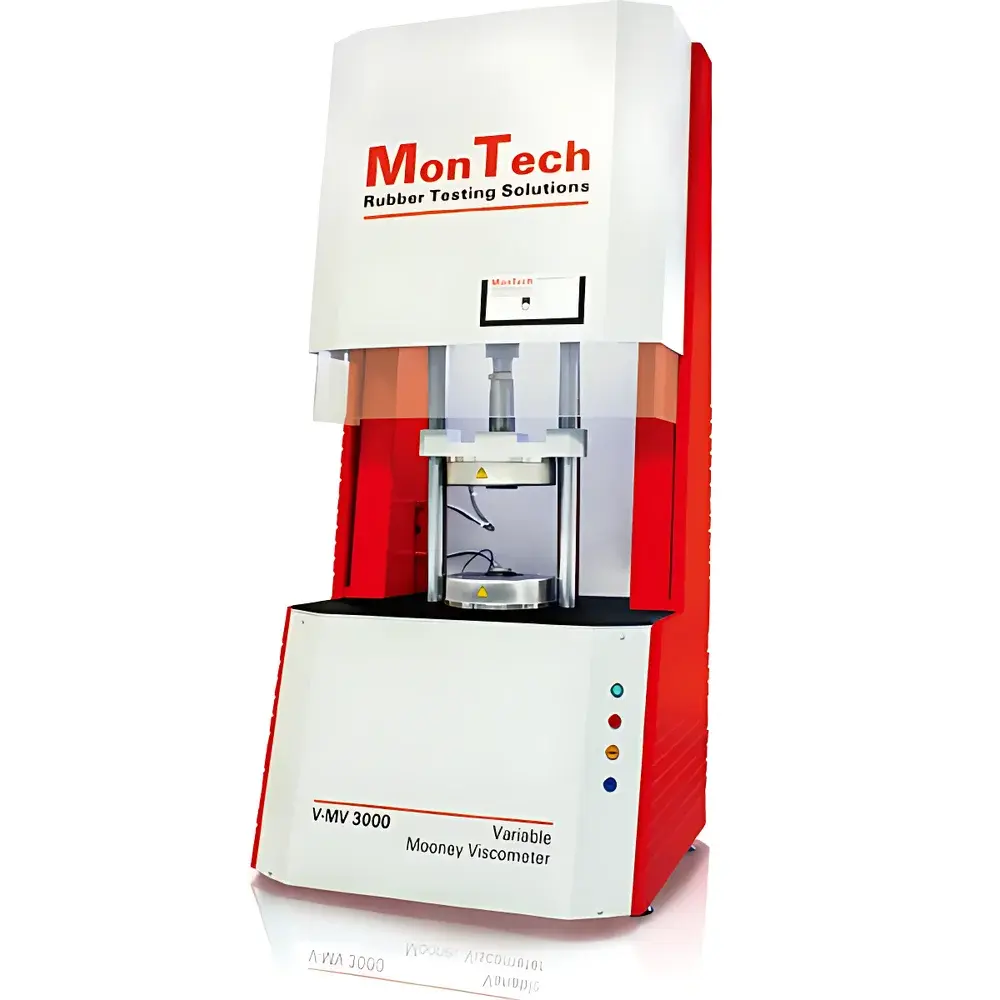
MonTech V-MV 3000 Mooney Viscometer
| Brand | MonTech |
|---|---|
| Origin | Germany |
| Model | V-MV 3000 |
| Standards Compliance | ISO 289:2005, ASTM D1646, DIN 53523, DIN 53525 Parts 1–3, BS 903 Part A58, AFNOR T43-00/005, JIS K6300, GOST 10722–76 |
| Rotor Options | Large rotor (38.10 mm), Small rotor (30.48 mm) |
| Rotational Speed Range | 0–50 rpm, adjustable in 0.01 rpm increments |
| Temperature Range | Ambient to 232 °C, control accuracy ±0.03 °C |
| Measurement Units | Mooney Units (MU), °C / °F, time (min:min or min:sec) |
| Test Modes | Mooney viscosity, Mooney scorch, stress relaxation, mold release evaluation, Delta Mooney, variable Mooney, stepwise stress relaxation, programmable multi-step test sequences |
| Sealing | Long-life precision sealing system |
| Application Scope | QC, R&D, and production fast-check for raw rubber, compounded elastomers, and thermoplastic elastomers (TPEs) |
Overview
The MonTech V-MV 3000 Mooney Viscometer is a high-precision, microprocessor-controlled rotational viscometer engineered specifically for the rheological characterization of uncured rubber compounds and elastomeric materials. Based on the standardized Mooney shear principle—where torque exerted on a rotating disc (rotor) embedded in a heated, confined cavity of rubber compound is measured as a function of time—the instrument delivers reproducible Mooney viscosity (MU), scorch onset (t5, t35), and stress relaxation behavior. Designed to meet stringent international testing protocols, the V-MV 3000 operates under fully traceable thermal and mechanical conditions, enabling compliance with ISO 289:2005, ASTM D1646, DIN 53523, and related national standards. Its modular architecture supports both routine quality control in manufacturing environments and advanced formulation development in R&D laboratories, delivering data essential for process optimization, batch consistency verification, and predictive vulcanization modeling.
Key Features
- Variable-speed rotor drive (0–50 rpm, resolution 0.01 rpm) enables precise simulation of shear history during mixing and calendering processes.
- Dual-rotor compatibility: Interchangeable large (38.10 mm) and small (30.48 mm) rotors conform to ISO and ASTM dimensional requirements for different material classes and viscosity ranges.
- High-stability temperature control system with ±0.03 °C accuracy across ambient to 232 °C, using digital PID regulation and calibrated platinum resistance thermometers (PRTs).
- Long-life mechanical sealing system prevents compound extrusion and ensures consistent cavity geometry over thousands of test cycles.
- Real-time torque and temperature acquisition at ≥10 Hz sampling rate, supporting full curve logging (MU vs. time, ΔMU vs. time, relaxation modulus decay).
- Programmable multi-step test sequences—including ramped speed profiles, stepped temperature holds, and conditional trigger logic—for advanced protocol automation.
Sample Compatibility & Compliance
The V-MV 3000 is validated for use with natural rubber (NR), synthetic elastomers (SBR, BR, EPDM, NBR, CR, IIR), thermoplastic elastomers (TPEs), and filled or compounded systems containing carbon black, silica, plasticizers, and curatives. All measurement modes—including standard Mooney viscosity (ML1+4), scorch time (t5), stress relaxation (per ISO 289:2005 Annex C), and Delta Mooney—are traceable to certified reference materials and accredited calibration procedures. The system satisfies audit requirements for GLP-compliant laboratories and supports documentation integrity per FDA 21 CFR Part 11 when integrated with MonTech’s optional secure software suite.
Software & Data Management
Control and analysis are executed via MonTech’s Windows-based ViscoWin software, which provides intuitive test method configuration, real-time graphical monitoring, and automated report generation in PDF or Excel formats. Data files include full metadata (operator ID, sample ID, instrument serial number, calibration status, environmental logs), timestamped raw sensor values, and calculated parameters with uncertainty estimates. Audit trail functionality records all user actions, parameter modifications, and result exports. Optional network integration enables centralized data archiving, role-based access control, and electronic signature workflows aligned with ISO/IEC 17025 and GMP documentation standards.
Applications
- Raw material acceptance testing per supplier specifications and internal QC release criteria.
- Compound formulation screening—evaluating filler dispersion efficiency, plasticizer migration, and curative interaction kinetics.
- Process window definition: correlating Mooney scorch time with extruder residence time and die swell behavior.
- Stress relaxation profiling to assess green strength, calendering stability, and pre-vulcanization resistance.
- Delta Mooney analysis for detecting early-stage degradation in recycled or aged stock.
- Regulatory submission support: generating standardized test reports for ISO/TS 16949, IATF 16949, and customer-specific PPAP packages.
FAQ
What standards does the V-MV 3000 comply with?
It fully supports ISO 289:2005, ASTM D1646, DIN 53523, DIN 53525 Parts 1–3, BS 903 Part A58, JIS K6300, GOST 10722–76, and AFNOR T43-00/005.
Can the instrument perform both Mooney viscosity and stress relaxation in a single run?
Yes—programmable multi-step sequences allow automatic transition from viscosity measurement to controlled stress relaxation without manual intervention.
Is rotor calibration traceable to national metrology institutes?
All factory calibration certificates include traceability to PTB (Physikalisch-Technische Bundesanstalt) and NIST-accredited reference standards.
Does the system support LIMS integration?
Via OPC UA and CSV export protocols, the V-MV 3000 interfaces with major laboratory information management systems for automated data ingestion and workflow synchronization.
What maintenance intervals are recommended for long-term accuracy?
Annual performance verification is advised, including thermal uniformity mapping, torque transducer linearity check, and rotor dimensional inspection—documented per ISO/IEC 17025 requirements.