
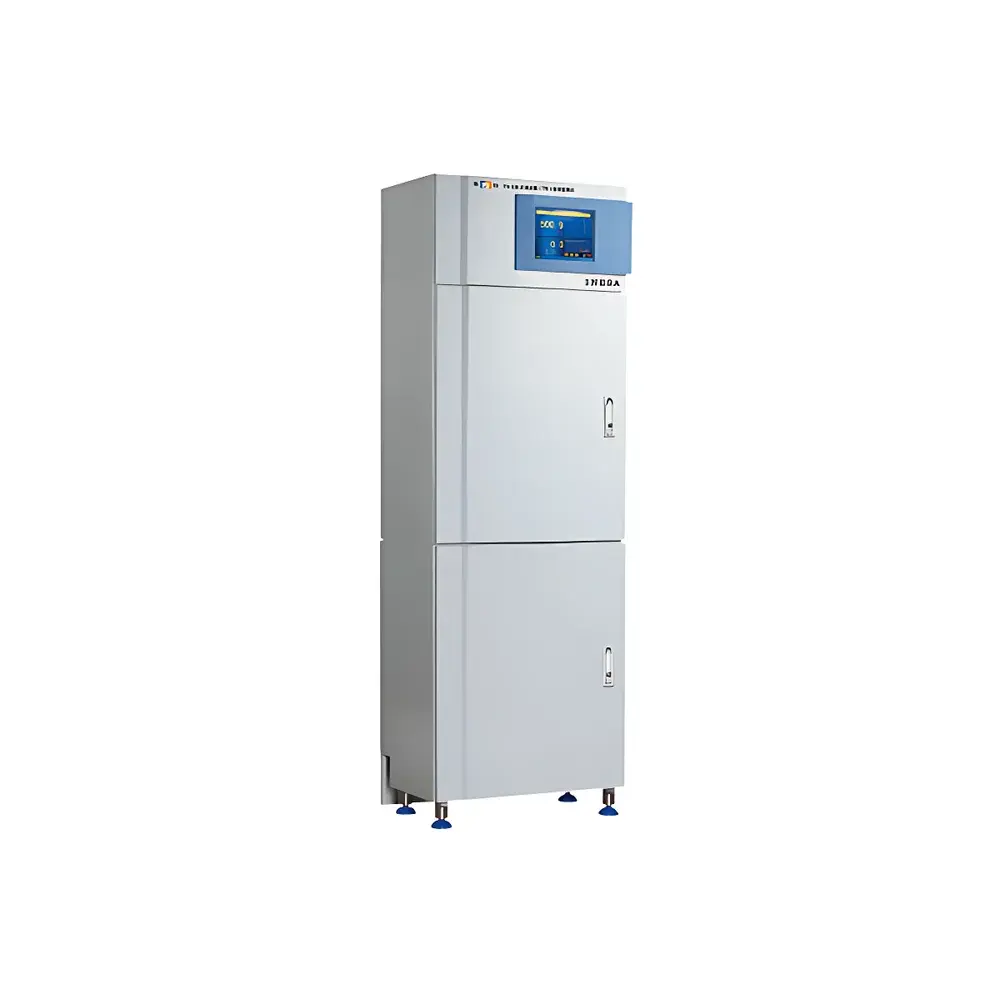
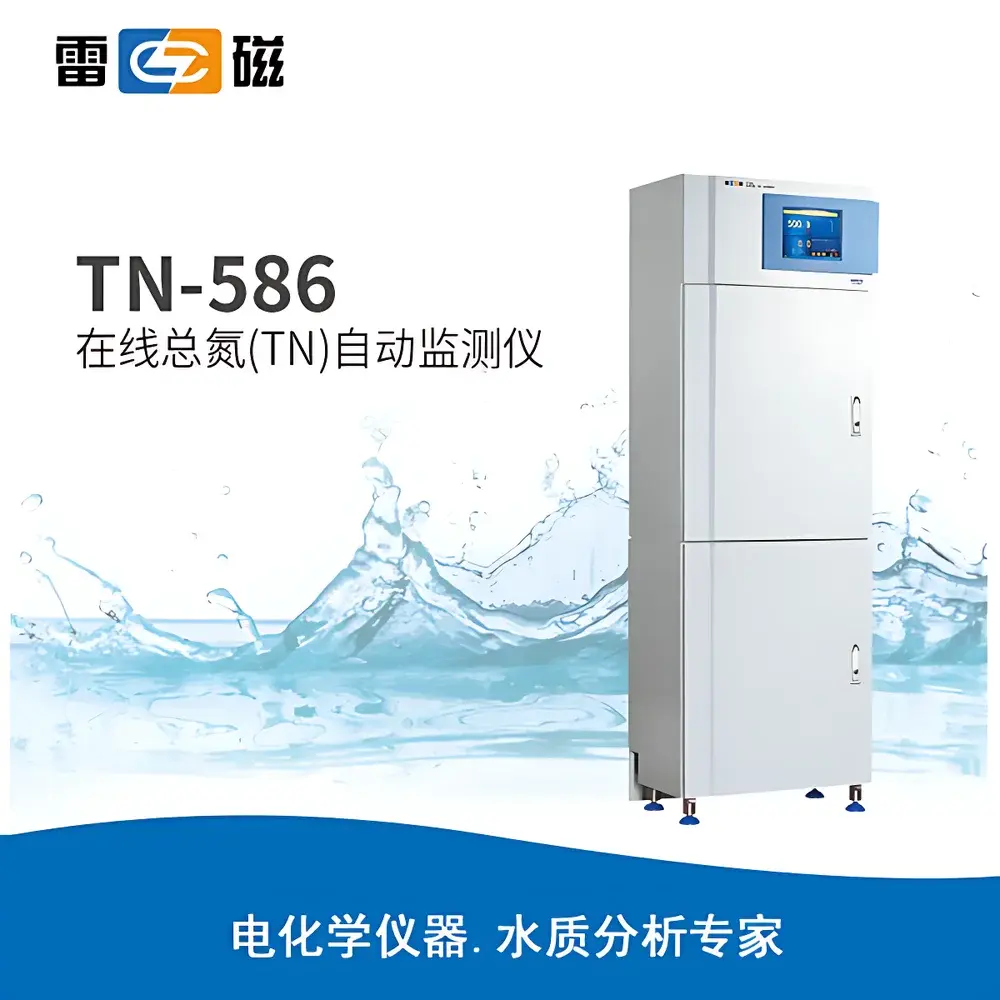
Leichi TN-586 Online Total Nitrogen (TN) Analyzer
| Brand | Leichi |
|---|---|
| Origin | Shanghai, China |
| Manufacturer Type | Direct Manufacturer |
| Country of Origin | China |
| Model | TN-586 |
| Pricing | Upon Request |
| Measurement Method | Alkaline Potassium Persulfate Digestion–UV Spectrophotometry |
| Measurement Range | 0–150.0 mg/L (customizable extension available) |
| Accuracy | ±10% of reading |
| Detection Limit | 0.1 mg/L |
| Resolution | 0.1 mg/L |
| Compliance | GB 11894–1989 |
| Repeatability | ≤±10% |
| Minimum Cycle Time | 40 min |
| Sampling Interval | 10–9999 min (programmable) + On-the-Hour Mode |
| Calibration Options | Manual & Automatic |
| Output Interfaces | RS232, RS485, 4–20 mA analog |
| Field Sample Comparison Error | ≤±10% |
| Dimensions | 1430 × 500 × 403 mm |
Overview
The Leichi TN-586 Online Total Nitrogen (TN) Analyzer is an industrial-grade, fully automated water quality monitoring system engineered for continuous, unattended quantification of total nitrogen in natural and wastewater matrices. It implements the standardized alkaline potassium persulfate digestion–ultraviolet spectrophotometric method (aligned with GB 11894–1989, equivalent in principle to ISO 11905-1 and EPA Method 351.2), wherein all nitrogen species—including nitrate, nitrite, ammonium, and organic nitrogen—are oxidized to nitrate under high-pH, high-temperature alkaline persulfate conditions. The resulting nitrate concentration is then determined via UV absorbance at 220 nm, with correction at 275 nm to compensate for organic interference. Designed for deployment in fixed-site environmental monitoring networks, the TN-586 delivers robust performance across variable water chemistries and ambient conditions, supporting regulatory compliance, process control, and early-warning detection of eutrophication drivers.
Key Features
- Engineered for long-term field reliability: corrosion-resistant fluidic path components—including chemically inert multi-position selection valves and PTFE/PFA tubing—ensure extended service life in aggressive wastewater and surface water environments.
- Integrated intelligent diagnostics: real-time self-checking of reagent levels, digestion temperature stability, photometric baseline drift, and valve actuation integrity; fault codes are logged with timestamps and accessible via local display or remote interface.
- Uninterrupted data continuity: non-volatile memory preserves measurement history, calibration records, and configuration settings during power loss; automatic recovery resumes scheduled cycles and restores pre-interruption operational state without manual intervention.
- Regulatory-grade alarm architecture: configurable concentration thresholds trigger relay outputs for external sampling activation (e.g., composite samplers), enabling legally defensible “exceedance-triggered sample retention” per national discharge monitoring protocols.
- Flexible connectivity: dual serial interfaces (RS232/RS485) support Modbus RTU protocol for SCADA integration, while isolated 4–20 mA analog output provides direct compatibility with legacy PLCs and DCS systems.
- Optimized reagent economy: sequential injection analysis (SIA) architecture minimizes carryover and reduces reagent consumption by >40% compared to conventional flow-injection systems—critical for remote or low-maintenance deployments.
Sample Compatibility & Compliance
The TN-586 is validated for use with raw surface water (rivers, lakes, reservoirs), groundwater, municipal influent/effluent, drinking water treatment plant streams, and industrial effluents containing suspended solids ≤50 mg/L and turbidity ≤100 NTU. It meets the functional requirements of China’s HJ 353–2019 (Technical Specifications for Online Monitoring Systems of Pollutant Sources) and aligns with international best practices for automated nutrient analyzers under ISO 5667-22 (water quality — sampling — guidance on validation of online analyzers). All firmware and data handling routines support audit-trail generation for GLP-compliant operation, including user action logging, calibration event tracking, and raw absorbance value archiving.
Software & Data Management
Embedded firmware supports time-synchronized data stamping (NTP-capable via Ethernet option), internal storage of ≥30 days of 10-minute interval results (including digest temperature, peak absorbance, blank correction values), and CSV export via USB or network transfer. Optional Leichi DataHub software enables centralized fleet management, remote parameter configuration, spectral view of digestion efficiency, and automated report generation compliant with provincial environmental monitoring center templates. Data integrity safeguards include write-protected memory partitions and SHA-256 checksums for firmware updates—supporting traceability requirements under China’s Cybersecurity Law and environmental data authenticity mandates.
Applications
- Real-time assessment of trophic status in eutrophication-prone freshwater bodies (e.g., Taihu Lake, Chaohu Lake)
- Compliance monitoring at municipal wastewater treatment plant discharge points per GB 18918–2002 Class I-A limits
- Source water surveillance for drinking water utilities to inform coagulation and disinfection optimization
- Industrial park effluent tracking for nitrogen load accountability under discharge permit conditions
- Process feedback control in denitrification bioreactors and tertiary treatment units
- Long-term trend analysis in national surface water quality assessment programs (e.g., China’s National Surface Water Quality Assessment Scheme)
FAQ
What digestion standard does the TN-586 follow?
It implements the alkaline potassium persulfate oxidation method specified in GB 11894–1989, with thermal digestion at 120–124 °C for 30 minutes under controlled pressure—ensuring complete conversion of refractory organic nitrogen.
Can the instrument operate without a laboratory technician onsite?
Yes. Its self-diagnostic engine, auto-calibration scheduling, and remote firmware update capability enable unattended operation for ≥30 days between routine maintenance intervals.
Is the 4–20 mA output intrinsically safe for hazardous area installation?
The analog output is non-isolated by default; however, an optional ATEX/IECEx-certified signal isolator module is available for Zone 2 classified environments.
How is interference from high chloride or DOC managed?
The dual-wavelength (220/275 nm) correction algorithm mitigates absorbance contributions from dissolved organic carbon; for chloride concentrations >2000 mg/L, optional dilution modules or pretreatment filtration can be integrated.
Does the system support third-party data platform integration?
Yes—via open Modbus RTU registers and HTTP RESTful API (available with DataHub license), enabling bidirectional communication with platforms such as Siemens Desigo, Honeywell Experion, or custom cloud dashboards.







