
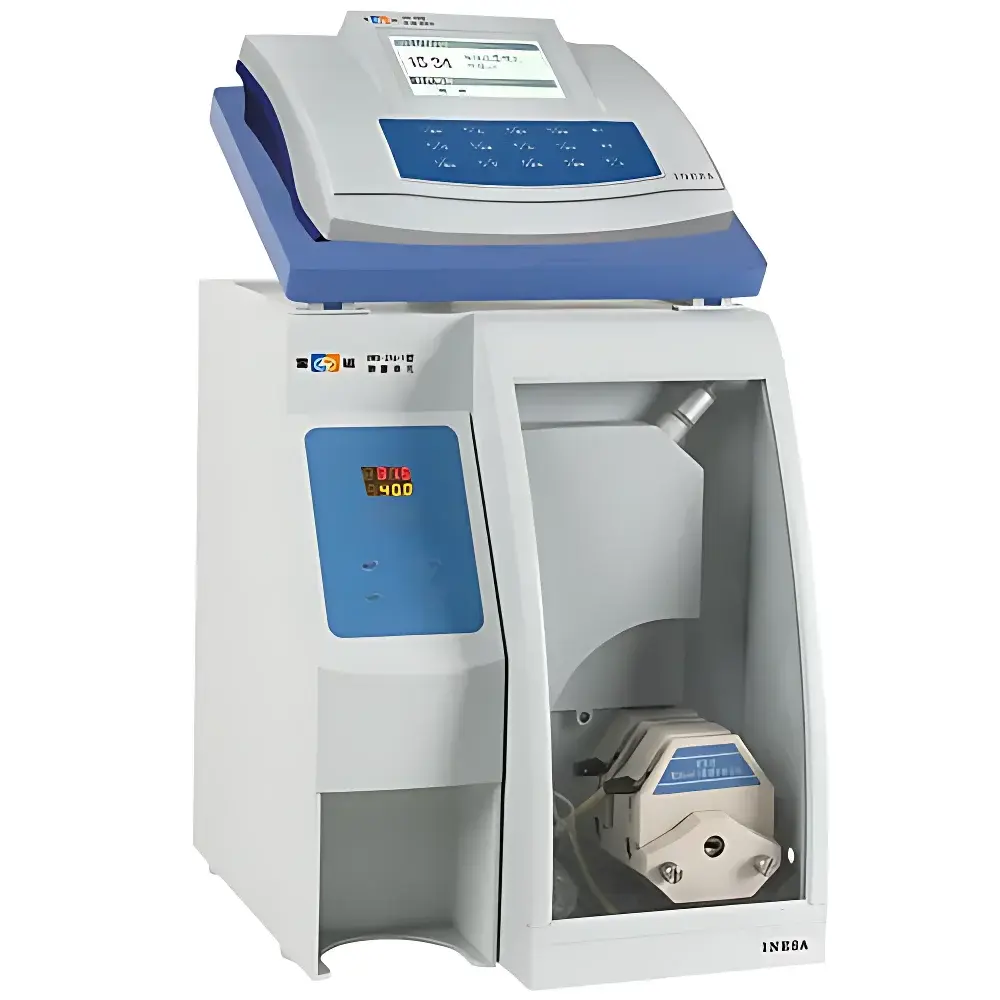
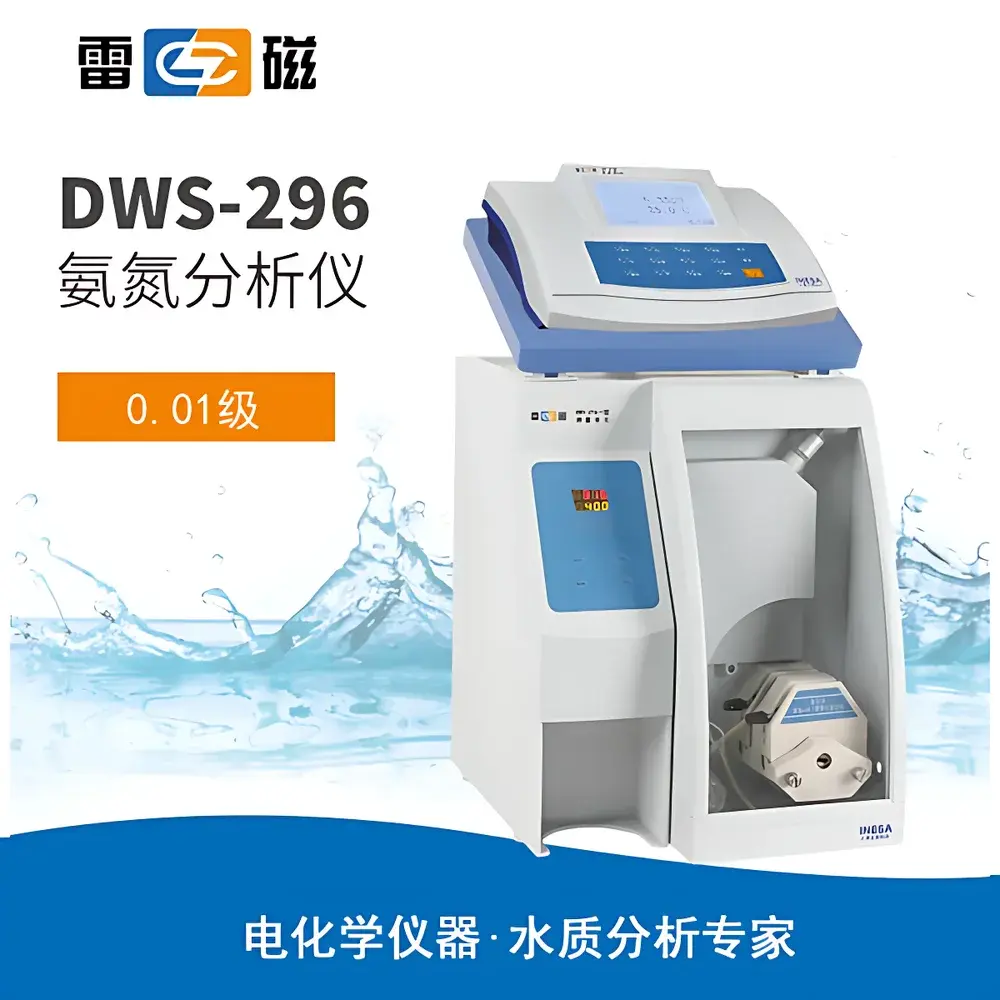
Leici DWS-296 Ammonia Nitrogen Analyzer
| Brand | Leici |
|---|---|
| Origin | Shanghai, China |
| Manufacturer Type | Original Equipment Manufacturer (OEM) |
| Region of Manufacture | Domestic (China) |
| Model | DWS-296 |
| Instrument Type | Benchtop Laboratory Analyzer |
| Measurement Principle | Gas-Sensing Ion-Selective Electrode (ISE) Method |
| Measurement Range | 0.05–1000 mg/L NH₃–N |
| Accuracy | ±1% of reading |
| Detection Limit | 0.05 mg/L |
| Analysis Time | 5–10 minutes per sample |
| Throughput | 1 sample per run |
| Display | LCD with Chinese GUI |
| Data Storage | 200 measurement records |
| Calibration | 2-point calibration supported |
| Connectivity | USB interface for PC communication via proprietary software |
| Temperature Control | Integrated thermostatic system (0.0–40.0 °C) |
| Measured Parameters | pN (–log[NH₃]), mV, NH₃–N concentration (mg/L), temperature (°C) |
| Electronic Unit Error | pN ±0.01 pN ±1 digit |
| Stability | ≤±0.01 pN / 3 h |
| Power Supply | Control unit: 9 V DC, 500 mA (center-positive) |
| Measurement unit | AC 220 V ±10%, 50 Hz ±1 Hz |
| Dimensions & Weight | Control unit: 300 × 220 × 80 mm, 1 kg |
| Measurement unit | 370 × 380 × 510 mm, 13 kg |
Overview
The Leici DWS-296 Ammonia Nitrogen Analyzer is a dedicated benchtop laboratory instrument engineered for precise, reliable quantification of total ammonia nitrogen (NH₃–N) in aqueous environmental and wastewater samples. It operates on the gas-sensing ion-selective electrode (ISE) principle: free ammonia (NH₃) diffuses across a hydrophobic membrane into an internal electrolyte layer, inducing a pH shift in a buffered chloride solution; this change is detected by a pH-sensitive glass electrode, generating a Nernstian potential proportional to the logarithm of NH₃ activity. The instrument converts the measured pN value into NH₃–N concentration (mg/L) using factory-calibrated algorithms and user-defined calibration points. Designed specifically for compliance-driven water quality laboratories, the DWS-296 eliminates interferences from sample turbidity, color, heavy metal ions (e.g., Cu²⁺, Fe³⁺), and residual chlorine—common limitations of colorimetric methods such as Nesslerization or salicylate assays. Its integrated thermostatic measurement chamber ensures consistent reaction kinetics and thermal equilibrium, directly contributing to measurement reproducibility across diurnal temperature fluctuations.
Key Features
- Integrated gas-sensing ammonia ISE with optimized membrane lifetime and low-drift response characteristics
- Automated sample mixing and temperature stabilization (0.0–40.0 °C) within the measurement cell, minimizing operator-dependent variability
- LCD display with intuitive Chinese-language graphical user interface (GUI), supporting real-time pN, mV, NH₃–N concentration, and temperature readouts
- Three operational modes: continuous monitoring, timed endpoint acquisition, and equilibrium-based measurement—enabling method flexibility for diverse matrix types
- Onboard data management: stores up to 200 complete measurement records including date/time stamp, calibration history, and raw sensor output
- Dual-point calibration protocol compliant with ISO 5667-3 and ASTM D1426-15 guidelines for ammonia determination in natural waters and effluents
- USB interface compatible with Leici’s certified communication software for secure data export, audit-trail generation, and report printing in PDF/CSV formats
Sample Compatibility & Compliance
The DWS-296 is validated for use with surface water, groundwater, domestic and industrial wastewater, and treated effluent matrices. Sample pretreatment—such as pH adjustment to ≥11.0 with NaOH to convert NH₄⁺ to volatile NH₃—is required prior to analysis, in accordance with standard methods (e.g., EPA Method 350.1, ISO 5667-16). The instrument meets essential functional requirements of GLP-compliant laboratories: electronic records include immutable timestamps, operator ID fields (via optional login module), and full calibration traceability. While not pre-certified for FDA 21 CFR Part 11, its data export architecture supports integration into validated LIMS environments where electronic signatures and audit trails are externally managed.
Software & Data Management
Leici’s proprietary PC software provides bidirectional communication, enabling remote configuration, firmware updates, and batch export of calibrated results. Each exported dataset includes metadata: instrument ID, serial number, calibration coefficients, ambient temperature, and measurement duration. Exported files comply with ISO/IEC 17025 documentation requirements for accredited testing laboratories. Data integrity safeguards include automatic checksum validation during transfer and write-protection for archived records. No cloud storage or internet connectivity is embedded—ensuring air-gapped operation where required by institutional cybersecurity policies.
Applications
- Regulatory monitoring of ammonia nitrogen in municipal wastewater treatment plant influent, effluent, and receiving waters
- Process control in aquaculture systems where sub-ppm NH₃ levels impact fish health
- Environmental impact assessments requiring high-frequency NH₃–N profiling in rivers and lakes
- Validation of denitrification efficiency in bioreactors and constructed wetlands
- Educational laboratories conducting standardized water chemistry experiments per APHA Standard Methods 4500-NH₃
FAQ
What sample preparation is required before analysis?
Samples must be adjusted to pH ≥11.0 using sodium hydroxide solution to ensure quantitative conversion of ammonium ions (NH₄⁺) to free ammonia (NH₃); filtration through a 0.45 µm membrane is recommended for turbid samples.
Can the DWS-296 measure ammonium ion (NH₄⁺) directly?
No—it measures free ammonia (NH₃) activity; total ammonia nitrogen (NH₃–N) is reported after alkaline pretreatment. It does not distinguish between NH₃ and NH₄⁺ without pH control.
Is the ammonia electrode replaceable, and what is its typical service life?
Yes—the gas-sensing electrode is a field-replaceable consumable; under routine use (≤10 measurements/day) and proper storage in KCl solution, expected lifetime exceeds 12 months.
Does the instrument support multi-point calibration?
It supports only two-point calibration (e.g., 0.5 mg/L and 50 mg/L NH₃–N standards), consistent with ISE performance characteristics and ISO 5667-3 recommendations for ammonia ISE validation.
How is temperature compensation applied during measurement?
The built-in Pt1000 RTD sensor continuously monitors internal cell temperature; the microprocessor applies Nernst equation correction in real time, ensuring accurate pN-to-concentration conversion across the 0.0–40.0 °C operating range.







