
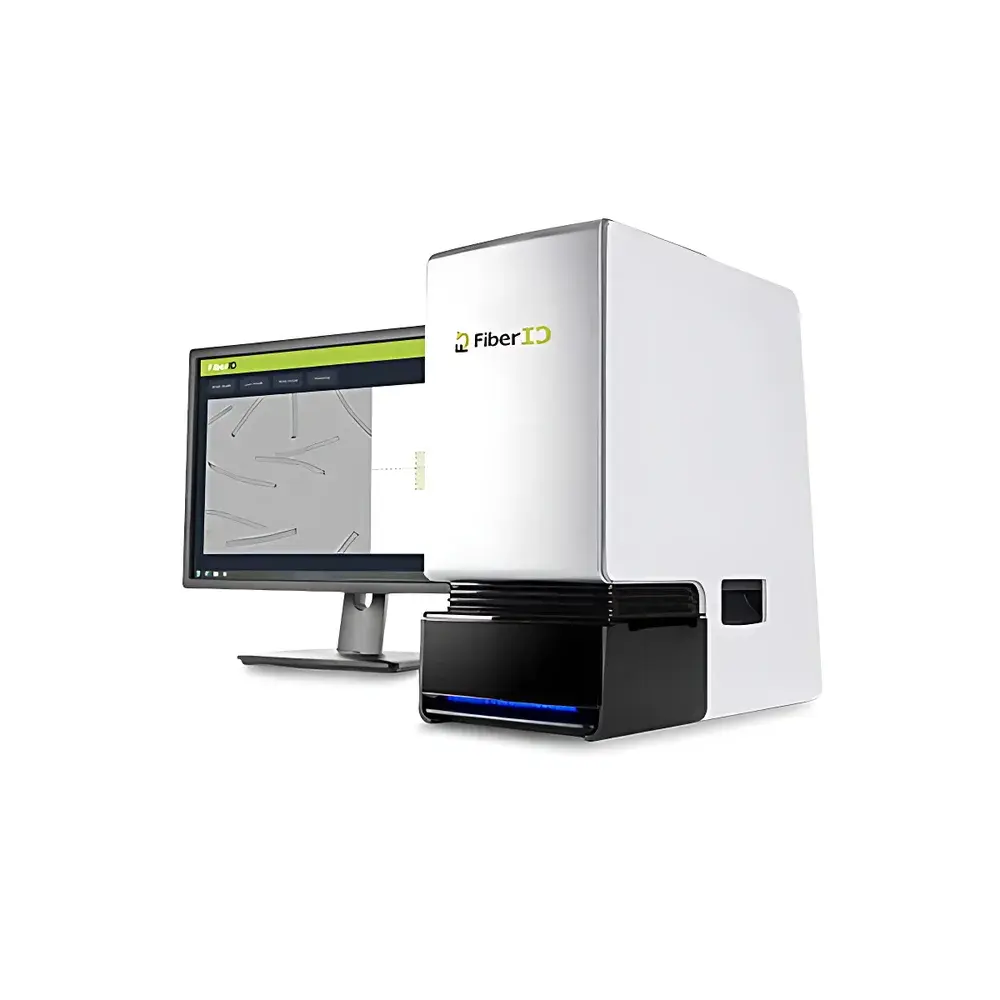
YUNBI FiberID AI-Powered Fiber Composition Analyzer for Down and Wool Blends
| Brand | YUNBI (emust) |
|---|---|
| Origin | Zhejiang, China |
| Manufacturer Type | Direct Manufacturer |
| Regional Classification | Domestic (China) |
| Model | FiberID |
| Price Range | USD 14,000 – 70,000 |
Overview
The YUNBI FiberID AI-Powered Fiber Composition Analyzer is an industry-specific optical metrology system engineered for quantitative identification and morphological characterization of natural down, wool, and mixed animal fibers. Unlike conventional manual microscopy-based methods—which rely on subjective visual interpretation under transmitted or reflected light—the FiberID integrates high-resolution digital microscopy with cloud-deployed deep learning models trained on a continuously expanding, expert-annotated fiber reference database. Its core measurement principle combines automated image acquisition (at standardized magnification and illumination conditions), pixel-level segmentation of individual fiber cross-sections and longitudinal features, and AI-driven classification using convolutional neural networks (CNNs) optimized for keratinous fiber morphology, scale pattern topology, and diameter distribution statistics. Designed specifically for textile QC laboratories, spinning mills, and certification bodies, the FiberID delivers objective, auditable, and repeatable compositional analysis—reducing dependence on scarce microscopy expertise while maintaining alignment with ISO 1833-1:2017 (determination of fiber content in textiles) and AATCC TM20A (microscopic examination of fibers).
Key Features
- Automated digital microscopy workflow: Motorized stage, auto-focus, and programmable illumination ensure consistent sample imaging across operators and shifts.
- Cloud-native AI inference engine: Proprietary CNN architecture trained on >120,000 labeled fiber images—including alpaca, cashmere, mohair, yak, sheep wool, goose down, duck down, and synthetic blends—enables real-time classification with ≥98.2% concordance against consensus expert panels (based on internal validation per ISO/IEC 17025:2017 Annex A.1).
- Quantitative diameter profiling: Measures fiber diameter distribution (µm) across ≥500 fibers per sample using calibrated edge-detection algorithms compliant with IWTO-85 (Wool Fiber Diameter Measurement by Optical Microscopy).
- Full audit trail & GLP-compliant data handling: Each analysis session logs operator ID, timestamp, instrument calibration status, raw image metadata, and model version—supporting FDA 21 CFR Part 11 readiness when deployed with enterprise authentication and encrypted cloud storage.
- Zero-touch reporting: Generates PDF and CSV reports containing fiber type percentages, mean diameter, coefficient of variation (CV%), histogram plots, and annotated micrographs—all exportable for LIMS integration.
Sample Compatibility & Compliance
The FiberID accepts standard textile preparation formats: teased fiber mounts on glass slides (per ISO 1833-1 Annex B), carded batts, and yarn cross-sections. It supports detection of natural protein fibers (including degraded or bleached specimens) and distinguishes between morphologically similar types (e.g., cashmere vs. fine merino; goose vs. duck down) based on scale frequency, medullation ratio, and cuticle contour metrics. All analyses adhere to the observational criteria defined in IWTO Test Method 16 (Microscopic Identification of Animal Fibers) and are traceable to NIST-traceable stage calibration standards. The system meets CE marking requirements for laboratory instrumentation (2014/30/EU EMC Directive and 2014/35/EU Low Voltage Directive) and is designed for operation in ISO 17025-accredited environments.
Software & Data Management
FiberID operates via a secure web-based interface hosted on ISO 27001-certified cloud infrastructure. Local hardware connects via TLS 1.3–encrypted MQTT protocol; no raw images persist on-device. Software updates—including model retraining cycles—are delivered automatically every quarter, incorporating newly validated fiber variants and user-submitted anonymized samples (opt-in). Data residency options include EU (Frankfurt), APAC (Singapore), and North America (Virginia) regions. API endpoints support RESTful integration with major LIMS platforms (e.g., LabWare, Thermo Fisher SampleManager) and ERP systems for automated batch release workflows. Audit logs comply with ALCOA+ principles (Attributable, Legible, Contemporaneous, Original, Accurate, Complete, Consistent, Enduring, Available) for GMP/GLP-regulated operations.
Applications
- Raw material verification for down/wool suppliers and brand compliance teams
- QC screening of incoming lots in spinning and nonwoven manufacturing
- Forensic fiber analysis in textile certification labs (e.g., Oeko-Tex®, Downpass®)
- Research into fiber degradation mechanisms during dyeing or finishing processes
- Training tool for junior analysts—providing immediate feedback against ground-truth AI classifications
FAQ
Does FiberID require routine recalibration by the user?
No—hardware calibration is performed at factory level using NIST-traceable micrometer standards; software-side drift correction is handled automatically during each imaging session via embedded reference markers.
Can FiberID analyze blended fabrics containing synthetics and cellulosics?
Yes—it identifies polyester, nylon, acrylic, viscose, and lyocell alongside natural fibers, though its primary validation scope remains animal-derived keratinous fibers per ISO 1833-1.
Is offline operation supported?
No—cloud connectivity is mandatory for AI inference, database synchronization, and regulatory-compliant audit logging; however, local caching ensures uninterrupted image capture during brief network outages.
How is fiber database expansion managed?
New fiber classes are added quarterly via supervised retraining; customers may contribute anonymized, expert-verified samples to the global training pool under a data sharing agreement compliant with GDPR and China’s PIPL.
What microscope objectives are included?
Standard configuration includes 10×, 20×, and 40× plan-apochromatic objectives with numerical apertures optimized for fiber contrast and depth-of-field control; optional 100× oil-immersion objective available for ultra-fine diameter resolution.





