
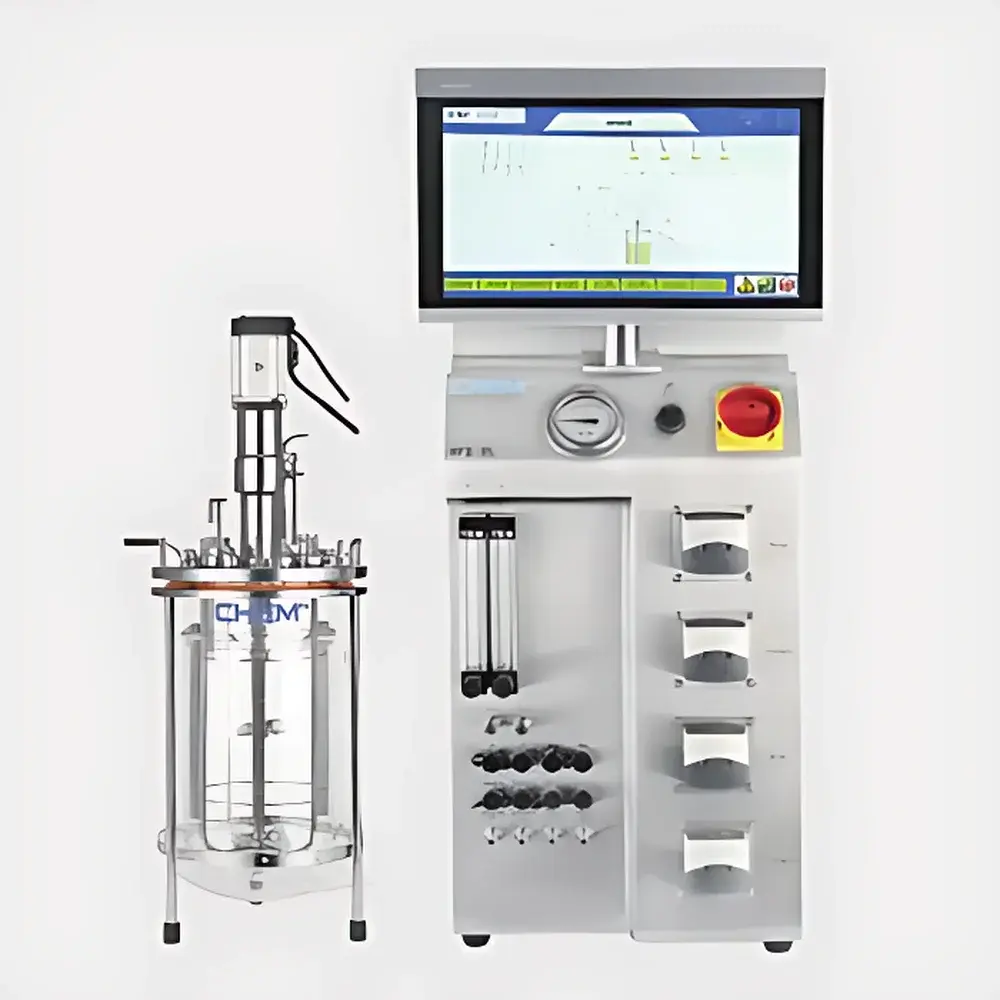
Ahkemi BFS Glass Microbial Fermentor
| Brand | Ahkemi |
|---|---|
| Origin | Anhui, China |
| Manufacturer Type | Authorized Distributor |
| Origin Category | Domestic (China) |
| Model | BFS |
| Price Range | USD 14,000 – 21,000 (FOB Anhui) |
| Working Volume Options | 2 L, 5 L, 10 L |
| Vessel Material | Borosilicate Glass (DIN/ISO 3585 compliant) |
| Operating Pressure | Low-pressure system (max. 0.3 bar(g) standard |
| Vacuum Capability | Not designed for vacuum operation |
| Modular Configuration | Fully configurable with independent functional modules |
Overview
The Ahkemi BFS Glass Microbial Fermentor is a bench-scale, modular bioreactor system engineered for precise aerobic and microaerobic cultivation of prokaryotic and eukaryotic microorganisms—including Escherichia coli, Saccharomyces cerevisiae, Pichia pastoris, filamentous fungi, and other non-pathogenic strains—under controlled physicochemical conditions. Built around a jacketed borosilicate glass vessel, the system employs classical stirred-tank reactor (STR) architecture with impeller-driven mixing, sparged gas delivery, and integrated thermal management. Its design adheres to fundamental bioprocess engineering principles: mass transfer optimization (kLa control via agitation and aeration), heat balance maintenance through circulating coolant in the double-jacket, and real-time monitoring of critical process parameters including dissolved oxygen (DO), pH, temperature, agitation speed, and headspace pressure. The BFS platform is explicitly intended for laboratory-scale process development, strain characterization, media optimization, and small-batch seed train expansion—not for GMP manufacturing or containment of BSL-2+ organisms.
Key Features
- Modular architecture with plug-and-play functional units: gas blending (dual-channel mass flow controllers), liquid addition (peristaltic or syringe pump-based feed systems), sampling (sterile, single-use or reusable valves), and temperature control (integrated Pt100 sensor + PID-regulated jacket circulation)
- Jacketed borosilicate glass vessels (2 L, 5 L, 10 L nominal working volumes) conforming to ISO 3585 specifications for chemical resistance and thermal stability
- Configurable agitation: top-driven mechanical stirrer with interchangeable impellers (Rushton turbine, marine propeller, pitched-blade, or anchor-type) and adjustable speed range (50–1,200 rpm, ±1 rpm resolution)
- Standard low-pressure operation (0–0.3 bar(g)); optional reinforced sealing and pressure-rated components available for applications requiring up to 0.6 bar(g)
- Intuitive touchscreen HMI with preconfigured control loops: DO cascade control (agitation/aeration interlock), pH feedback control (acid/base dosing), and temperature setpoint tracking
- Full PID parameter tuning capability for each control loop, enabling fine-grained adaptation to specific microbial growth kinetics and metabolic profiles
Sample Compatibility & Compliance
The BFS fermentor supports sterile operation for non-hazardous microbial cultures using standard autoclaving (vessel, ports, and removable components) or SIP-compatible configurations (with optional steam-trap and condensate management). All wetted materials comply with USP Class VI and FDA CFR Title 21 requirements for biocompatibility. While not certified to ASME BPVC Section VIII or PED 2014/68/EU, the system meets common laboratory safety standards for low-pressure glass apparatus (e.g., DIN 12878, ISO 15512). It is routinely deployed in academic labs, R&D centers, and pilot facilities operating under GLP-aligned documentation practices. Note: It does not meet full 21 CFR Part 11 compliance out-of-the-box; electronic audit trails and user access controls require third-party SCADA integration or custom firmware licensing.
Software & Data Management
The onboard controller logs time-stamped process data (DO, pH, T, RPM, gas flows, feed volumes) at user-defined intervals (1 s to 5 min) to internal SD card storage. Raw CSV export is supported via USB interface. Optional Ethernet connectivity enables OPC UA or Modbus TCP communication for integration into existing LIMS or MES environments. Data integrity safeguards include cyclic redundancy checks (CRC) on stored files and timestamped event logging for all manual interventions (e.g., valve actuation, setpoint changes). For regulatory traceability, external software solutions (e.g., LabArchives, DeltaV, or custom Python-based dashboards) are recommended to implement electronic signatures, version-controlled SOPs, and long-term archival per ALCOA+ principles.
Applications
- Microbial growth kinetics studies under varied DO/pH setpoints
- Recombinant protein expression optimization in E. coli and yeast hosts
- Fungal morphology control in filamentous cultures via shear-sensitive agitation tuning
- Media component screening and feeding strategy evaluation (pulsed, exponential, or DO-stat)
- Biochemical oxygen demand (BOD)-related respirometry assays
- Scale-down model development for upstream process transfer to stainless-steel production bioreactors
FAQ
Is the BFS fermentor suitable for anaerobic cultivation?
No—it lacks integrated nitrogen/argon purge capability and sealed headspace inerting; it is optimized for aerobic/microaerobic processes only.
Can the glass vessel be sterilized in an autoclave?
Yes, all standard glass components (vessel, lid, probes housings) are autoclavable at 121°C for 20 minutes; verify O-ring material compatibility (EPDM or FKM variants provided upon request).
What level of process automation does the BFS support?
It provides closed-loop PID control for DO, pH, and temperature, but advanced scripting (e.g., feed rate ramping based on OD600), multi-stage protocols, or machine learning–driven optimization require external software integration.
Are spare parts and consumables readily available?
Yes—Ahkemi maintains inventory of glass vessels, impellers, pH/DO electrodes, tubing sets, and gasket kits; lead time for non-stock items is typically 4–6 weeks from Anhui warehouse.



