
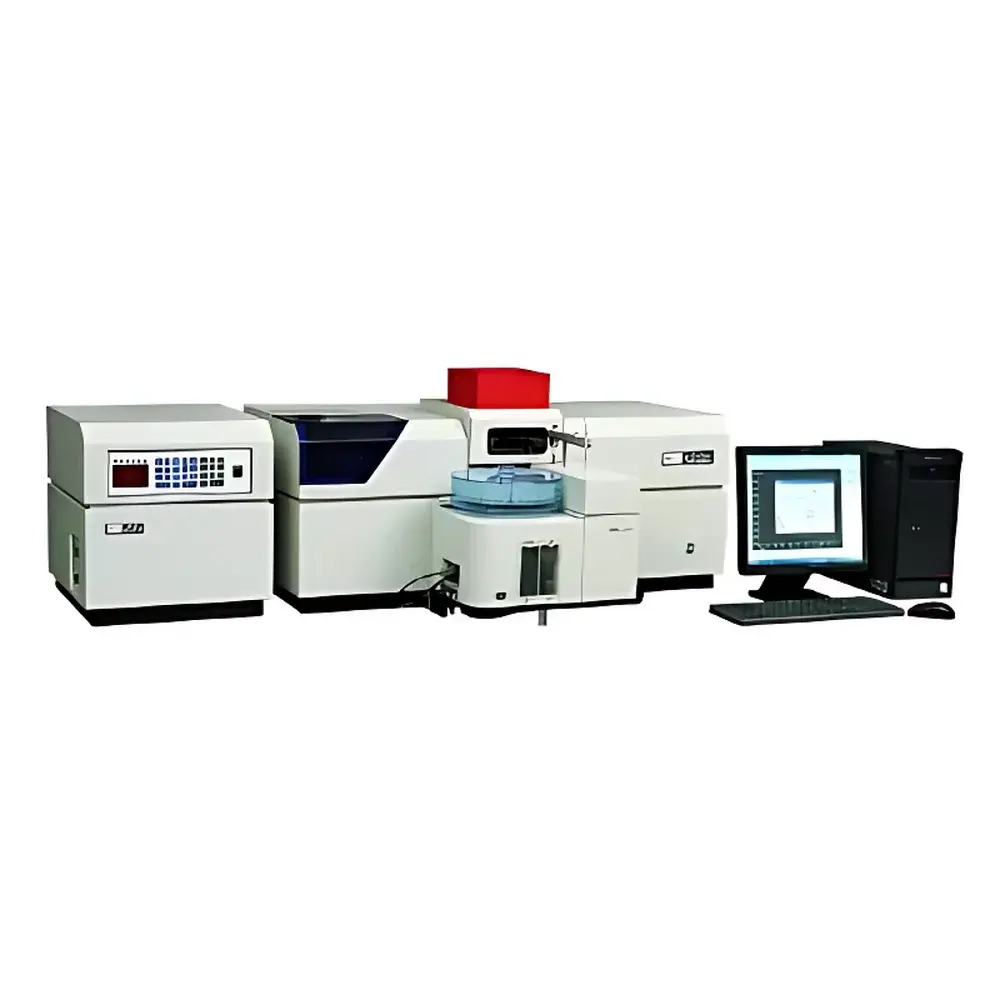
MC016-YRWFX-210 Atomic Absorption Spectrometer
| Origin | Shanghai, China |
|---|---|
| Manufacturer Type | Authorized Distributor |
| Origin Category | Domestic (China) |
| Model | MC016-YRWFX-210 |
| Pricing | Available Upon Request |
Overview
The MC016-YRWFX-210 Atomic Absorption Spectrometer is a dual-mode analytical instrument engineered for high-precision elemental quantification in environmental, pharmaceutical, clinical, and industrial laboratories. It operates on the fundamental principle of atomic absorption spectroscopy (AAS), wherein ground-state free atoms in a gaseous state absorb light at element-specific wavelengths. The system integrates both flame atomization (FAAS) and graphite furnace atomization (GFAAS) within a single platform, enabling trace-level detection (sub-pg/mL range for GFAAS) and routine ppm-level analysis (FAAS) across >70 metallic and semi-metallic elements. A defining innovation is its proprietary oxygen-enriched air–acetylene flame system—replacing traditional nitrous oxide–acetylene flames—delivering tunable flame temperatures from 2300 °C to 2950 °C. This extends reliable determination of high-ionization-potential elements including Ca, Al, Ba, W, Mo, Ti, and V without requiring hazardous N2O gas handling or specialized infrastructure.
Key Features
- Oxygen-enriched flame technology: Eliminates dependence on nitrous oxide; enables stable, reproducible high-temperature atomization with zero toxic emissions and reduced operational cost.
- Integrated FAAS/GFAAS architecture: Seamless, software-controlled switching between flame and graphite furnace modes—no manual realignment or hardware reconfiguration required.
- 6-position automatic hollow cathode lamp turret: Fully motorized lamp selection, auto-alignment, and optimized current/voltage regulation per element.
- Intelligent wavelength scanning: Auto-find peak, auto-set slit width (0.2/0.5/1.0/2.0 nm), and real-time spectral background correction via deuterium or Zeeman methods.
- Fuzzy-PID + constant-voltage dual heating control for graphite furnace: Achieves ≤1% temperature accuracy across ramp, hold, and atomization stages; supported by pneumatic graphite tube clamping for thermal stability and rapid heat transfer.
- Automated sample introduction: Precision autosampler with ±1% volumetric accuracy, 0.3% RSD for repeated injections, auto-calibration of probe Z-height, cup position tracking, and integrated standard curve generation.
Sample Compatibility & Compliance
The MC016-YRWFX-210 accommodates aqueous solutions, diluted acids (HNO3, HCl), and digested biological/environmental matrices (e.g., EPA Method 200.7, ISO 11885). Flame emission capability (via burner head exchange) supports quantitative analysis of alkali metals (K, Na) per ASTM D1317 and USP . System design adheres to IEC 61010-1 safety standards for laboratory electrical equipment. Software audit trails, user access levels, and electronic signature support align with GLP and FDA 21 CFR Part 11 requirements when deployed in regulated environments. All gas flow controls, pressure sensors, and thermal interlocks comply with EN 746-2 for industrial heating systems.
Software & Data Management
BRAIC analytical software—certified for Windows 98/Me/XP—provides full instrument control, method development, and compliance-ready data handling. Key capabilities include automated parameter optimization (gas flows, lamp current, integration time), real-time safety status monitoring with event logging, and customizable reporting templates. Raw absorbance/time profiles, calibration curves (linear/non-linear), QC check results, and instrument performance logs are stored in structured binary format with metadata tagging. Export options include CSV, TXT, and PDF; all data files are timestamped and linked to operator ID and method version. Audit trail functionality records every parameter change, measurement initiation, and error event with immutable timestamps.
Applications
- Environmental testing: Quantification of heavy metals (Cd, Pb, As) in soil leachates (EPA 7000B) and drinking water (ISO 8288).
- Pharmaceutical quality control: Residual catalyst screening (Pd, Pt, Rh) in active pharmaceutical ingredients per ICH Q2(R2).
- Clinical chemistry: Serum Ca, Mg, Zn, and Cu profiling using flame mode; blood lead analysis (Pb) via graphite furnace per CLIA guidelines.
- Materials science: High-purity metal alloy certification (Al, Ti, Mo) and refractory oxide impurity mapping.
- Food safety: Na/K ratio in dairy products; Cd and Hg in seafood matrices following AOAC 972.17.
FAQ
Does the instrument support regulatory-compliant data integrity?
Yes—BRAIC software implements role-based access control, electronic signatures, and tamper-evident audit trails meeting FDA 21 CFR Part 11 and EU Annex 11 expectations.
Can the oxygen-enriched flame replace N2O–C2H2 for all high-temperature elements?
It reliably atomizes Ca, Al, Ba, W, Mo, Ti, and V across the full 2300–2950 °C range; however, elements requiring >3000 °C (e.g., Si, B) remain better suited to electrothermal or ICP-MS methods.
Is the graphite furnace autosampler compatible with standard 10–20 mL polypropylene vials?
Yes—the XYZ-stage accommodates ANSI/SLAS-format microtiter plates and common screw-cap vials; custom adapters are available for non-standard containers.
What maintenance intervals are recommended for the burner head and graphite tubes?
Burner alignment verification every 200 flame hours; graphite tubes replaced after 200–500 firings depending on matrix corrosivity—automated lifetime tracking is embedded in BRAIC.
Is remote diagnostics or firmware update capability included?
Firmware updates are performed locally via USB; remote diagnostic support (with customer authorization) is available through secure VNC sessions managed by authorized service engineers.





