
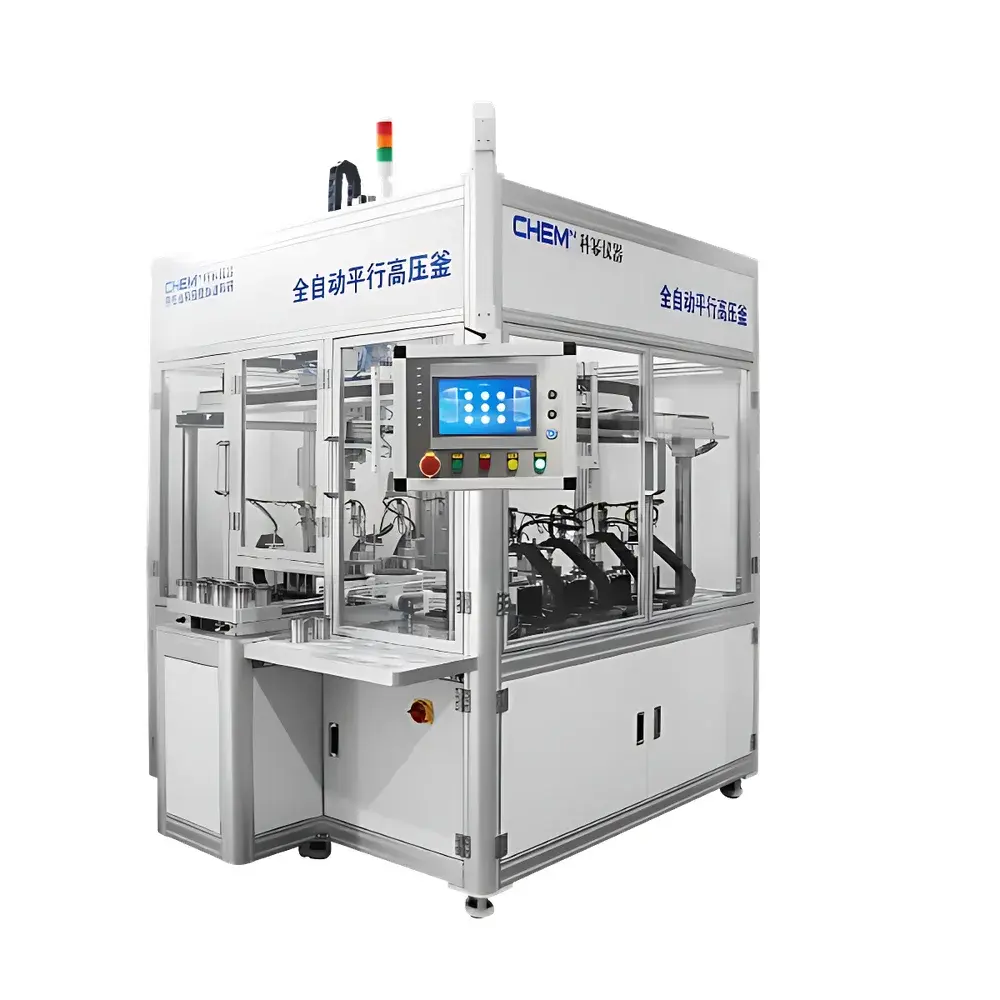
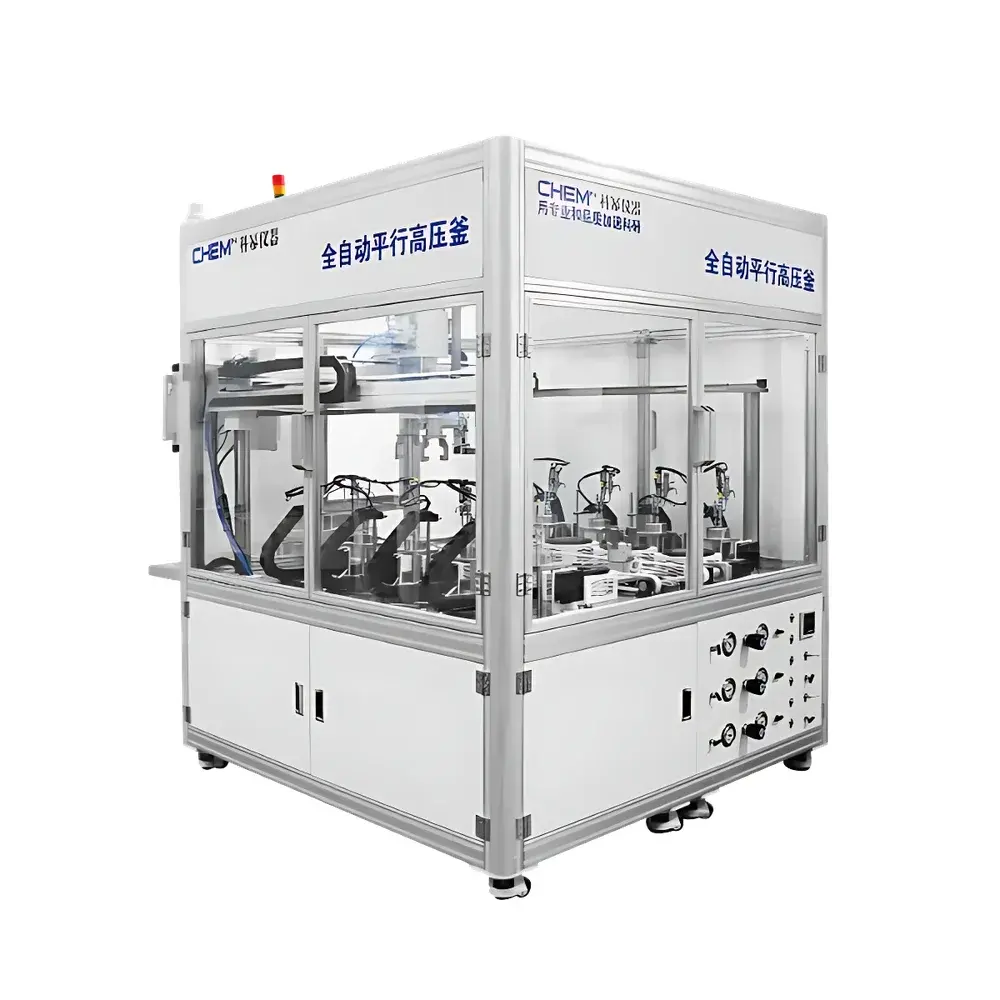
Chemn KMRA-8-NS100-C276-3G Automated Robotic Parallel High-Pressure Reaction System
| Brand | Chemn |
|---|---|
| Origin | Anhui, China |
| Manufacturer Type | Authorized Distributor |
| Country of Origin | China |
| Model | KMRA-8-NS100-C276-3G |
| Reactor Volume | 100 mL |
| Maximum Operating Pressure | 10 MPa |
| Design Temperature | 260 °C |
| Vessel Material | Hastelloy C-276 |
| Stirring | Magnetic Stirring or Magnetically Coupled Mechanical Stirring |
| Heating Method | Electric Heating or Integrated Jacket (High-Low Temperature) |
| Vacuum Level | ≤10 MPa (gauge, system-rated) |
| Gas Channels | 3 Process Gases + 1 Vacuum Line (expandable to 8) |
| Parallel Stations | 8 (configurable 1–12) |
| Overall Dimensions (8-station) | 2200 × 1850 × 2180 mm (L×W×H) |
| Weight (8-station) | ~1200 kg |
| Compliance | Designed per ASME BPVC Section VIII Div. 1 & ISO 4777 for high-pressure reactor systems |
| Software Control | Integrated PLC + HMI with audit trail and user-level access control |
Overview
The Chemn KMRA-8-NS100-C276-3G is an automated robotic parallel high-pressure reaction system engineered for reproducible, unattended synthesis under rigorously controlled thermal, pressure, and atmospheric conditions. Based on a modular robotic platform integrating precision motion control, pressure-tight sealing actuation, and real-time process monitoring, the system implements the fundamental principles of batch-controlled heterogeneous catalysis, hydrogenation, hydrothermal synthesis, and supercritical fluid reactions. Each reaction station employs a 100 mL Hastelloy C-276 reactor vessel—selected for exceptional resistance to chloride-induced stress corrosion cracking, oxidation at elevated temperatures, and compatibility with aggressive reagents such as HF, HCl, and wet Cl₂—ensuring long-term structural integrity under sustained 10 MPa operating pressure and up to 260 °C design temperature. The system architecture eliminates manual intervention in critical high-risk operations—including lid sealing, pressurization, thermal ramping, depressurization, and post-reaction venting—thereby conforming to laboratory safety protocols aligned with OSHA 1910.119 (Process Safety Management) and EU Directive 2014/68/EU (PED).
Key Features
- Fully automated robotic workflow: integrated 6-axis manipulator with force-sensing torque feedback for repeatable lid sealing (±0.5 N·m accuracy), leak-check sequence (pressure decay test per ISO 5208), and sequential station handling
- Hastelloy C-276 reactor vessels rated to 10 MPa and 260 °C, certified to ASME BPVC Section VIII Div. 1 with full material traceability (MTRs provided)
- Dual-mode thermal management: electric cartridge heating (±0.5 °C stability) or optional integrated jacket for ±0.3 °C uniformity across 100 mL volume
- Configurable gas delivery: 3 independent mass flow controllers (MFCs) for reactive gases (e.g., H₂, CO, NH₃) plus dedicated vacuum line (≤10⁻² mbar base) with digital pressure transducers (0.1% FS accuracy)
- Redundant safety architecture: dual pressure sensors, rupture disc (set at 12.5 MPa), emergency vent valve with fail-safe solenoid actuation, and interlocked access doors compliant with EN ISO 13857
- Modular scalability: base configuration supports 8 stations; expandable to 12 or custom 24-station layouts via standardized rail-mount interface and synchronized PLC coordination
Sample Compatibility & Compliance
The KMRA-8-NS100-C276-3G accommodates solid-liquid, liquid-liquid, and gas-liquid-solid multiphase reaction systems, including but not limited to Fischer-Tropsch catalysis, asymmetric hydrogenation, metal-organic framework (MOF) crystallization, and electrocatalyst precursor synthesis. Vessel compatibility extends to alternative alloys (Ti-6Al-4V, Zirconium 702, 316L SS) for application-specific chemical resistance validation. All pressure-containing components are manufactured and tested per ISO 4777 (reactor systems) and PED 2014/68/EU Annex I essential safety requirements. System software complies with FDA 21 CFR Part 11 for electronic records and signatures, featuring role-based user authentication, immutable audit trails, and configurable electronic signatures for SOP execution logs.
Software & Data Management
Control is executed via a deterministic real-time PLC (Siemens S7-1500) interfaced with a 15″ industrial HMI running Chemn’s proprietary SynthOS™ v4.2 firmware. The interface supports multi-step protocol programming (temperature ramps, pressure holds, gas switching sequences), real-time visualization of all process variables (T, P, stir speed, MFC flows), and automatic generation of CSV/Excel-compatible experiment reports. Data storage includes local SSD (256 GB) with RAID-1 redundancy and optional TLS 1.3-encrypted cloud backup. Raw data streams are timestamped with microsecond resolution and tagged with instrument ID, operator ID, and batch metadata—enabling traceability for GLP/GMP audits per ISO/IEC 17025:2017 Clause 7.5.
Applications
- Catalyst screening under industrially relevant conditions (e.g., 8–10 MPa H₂, 180–240 °C) for ammonia synthesis or CO₂ hydrogenation
- High-throughput optimization of MOF and covalent organic framework (COF) synthesis parameters (solvent ratio, modulator concentration, aging time)
- Safety-critical exploratory chemistry involving pyrophoric reagents (e.g., t-BuLi), toxic gases (H₂S, PH₃), or energetic intermediates
- Accelerated aging studies of battery electrolyte formulations under controlled O₂/H₂O partial pressures
- Development of continuous-flow precursors via discrete batch-to-batch parameter mapping prior to pilot-scale translation
FAQ
What pressure and temperature calibration standards are applied during factory acceptance testing (FAT)?
All pressure transducers are calibrated against a Fluke 754 Documenting Process Calibrator traceable to NIST SRM 2081; temperature sensors are verified using a Hart Scientific 1590 Black Body Calibrator with uncertainty < ±0.15 °C.
Can the system be integrated with third-party analytical instruments (e.g., online FTIR or GC-MS)?
Yes—via Modbus TCP or OPC UA interfaces; analog outputs (4–20 mA) are available for real-time T/P/stir speed streaming to external DAQ systems.
Is remote operation supported, and what cybersecurity measures are implemented?
Remote access is enabled through a hardened VPN gateway (Cisco ASA 5506-X); all communications use TLS 1.3 encryption, and firmware updates require signed packages verified via RSA-2048 PKI.
What maintenance intervals are recommended for the robotic arm and sealing actuators?
Robotic arm lubrication and belt tension verification every 1,000 operational hours; pneumatic sealing cylinders inspected and greased every 500 cycles per ISO 15243 bearing life guidelines.
Does the system support GLP-compliant electronic lab notebook (ELN) integration?
Yes—native export to major ELN platforms (e.g., LabArchives, Benchling) via ASTM E2880-21-compliant JSON-LD experiment descriptors with embedded metadata schemas.



