
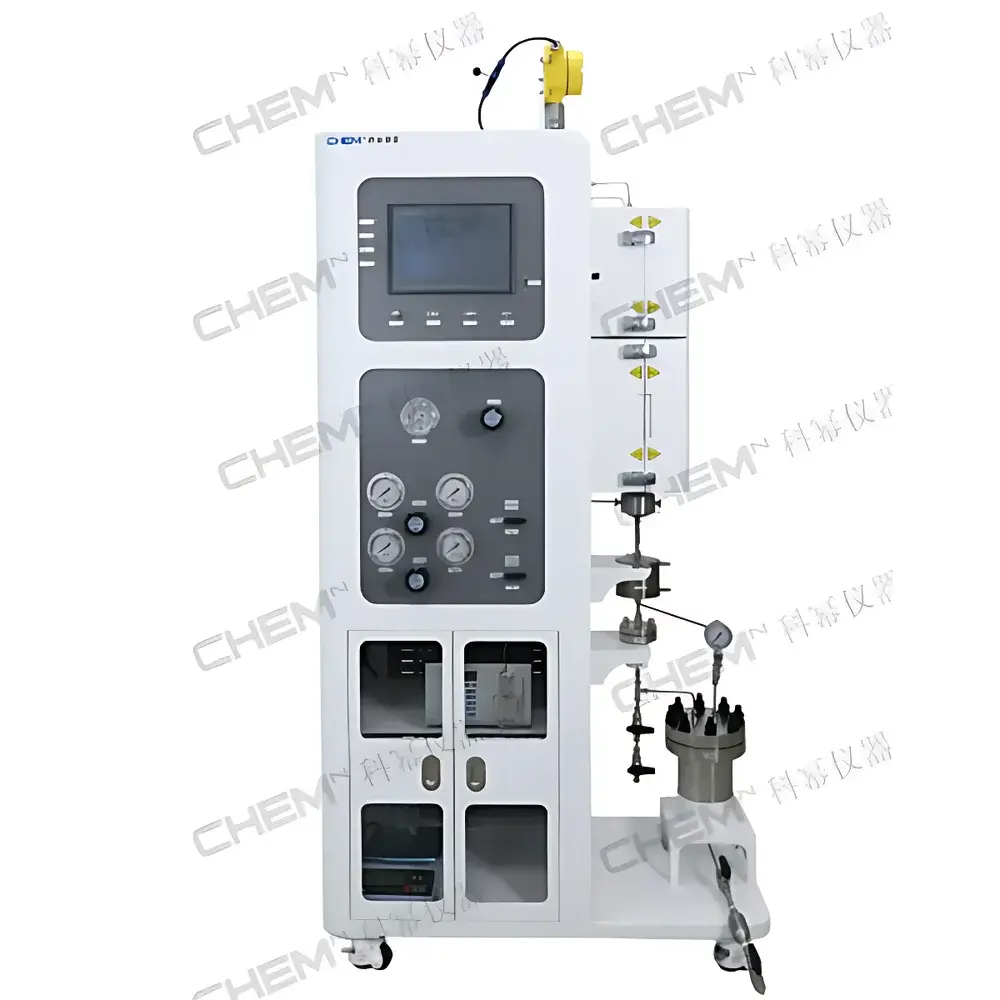
Chemn CFRF-L1G3-600-100 Liquid-Phase Hydrogenation Fixed-Bed Catalyst Evaluation System
| Brand | Chemn |
|---|---|
| Origin | Anhui, China |
| Manufacturer Type | Authorized Distributor |
| Country of Origin | China |
| Model | CFRF-L1G3-600-100 |
| Reaction Pressure | 10 MPa |
| Maximum Reaction Temperature | 800 °C |
| Catalyst Loading Capacity | 0.5–5 mL |
| Heating Configuration | Triple-Zone Electric Furnace (for floor-standing unit) / Oil-Jacketed Bath (for benchtop unit, max 300 °C) |
| Display | 10.1" TFT Touchscreen HMI |
| Remote Control | Yes, via PC-based SCADA software |
| Safety Features | Dual-stage over-temperature/over-pressure interlock, combustible gas monitoring, automatic shutdown |
Overview
The Chemn CFRF-L1G3-600-100 is a modular, dual-format catalyst evaluation system engineered for rigorous kinetic and stability assessment of heterogeneous catalysts under liquid-phase hydrogenation conditions. It supports both floor-standing and benchtop configurations—enabling operation across a broad parametric envelope: up to 10 MPa reaction pressure and 800 °C isothermal zone temperature (floor-standing), or up to 300 °C with oil-bath thermal management (benchtop). The system operates on fixed-bed reactor principles, where gaseous H₂ and liquid feedstock co-flow through a packed catalyst bed under precisely controlled residence time, pressure, and thermal gradient. Its low-dead-volume manifold design, coupled with integrated pre-vaporization and mixing modules (including vaporization canister and static mixer coil), ensures stoichiometric accuracy, minimizes mass transfer artifacts, and enhances reproducibility in CO₂ hydrogenation, CO hydrogenation, and fine-chemical selective hydrogenation studies.
Key Features
- Triple-zone electric furnace (floor-standing unit) delivering ±0.5 °C axial temperature uniformity across a 600 mm active heating length; independent PID control per zone enables precise thermal profiling and hot-spot mitigation.
- Benchtop variant employs thermostatically regulated oil-jacketed reactor housing (max 300 °C), optimized for rapid screening and ventilation-cabinet compatibility (unit height: 690 mm).
- Dual independent pressure systems—high-pressure (up to 10 MPa) and ambient-pressure—allow seamless transition between elevated and atmospheric hydrogenation protocols without hardware reconfiguration.
- Real-time online liquid sampling via septum-piercing needle valve and inert-gas-purged loop; maintains system integrity during extraction and prevents catalyst exposure to air or pressure perturbation.
- 10.1″ industrial-grade TFT touchscreen HMI with animated process visualization, intuitive parameter navigation, and embedded alarm history log (timestamped, with cause code and operator action trace).
- Redundant safety architecture: calibrated pressure transducers (0.1% FS), Class A RTD temperature sensors (IEC 60751), and catalytic-bead combustible gas detectors (0–100% LEL); all feed into a SIL2-rated safety PLC triggering staged shutdown (isolation, venting, cooling) upon threshold breach.
Sample Compatibility & Compliance
The CFRF-L1G3-600-100 accommodates catalyst forms including extrudates, pellets, spheres, and monoliths (diameter range: 1–5 mm; length ≤20 mm), with adjustable bed volume (0.5–5 mL) via interchangeable reactor tubes (SS316L or Inconel 600). All wetted components comply with ASTM A269/A270 standards for sanitary tubing; high-pressure fittings meet ISO 15848-1 leakage class A requirements. The system supports GLP-compliant operation through audit-trail-enabled software logging (user login, parameter changes, alarm events, manual overrides) aligned with FDA 21 CFR Part 11 data integrity principles. Pressure vessel design conforms to PED 2014/68/EU Annex I essential safety requirements; CE marking applies to the control cabinet and instrumentation subsystem.
Software & Data Management
Operation is managed via Chemn’s proprietary CatalystLab™ SCADA platform (Windows 10/11 compatible), offering remote supervision and closed-loop control over gas/liquid flow rates (via mass flow controllers and HPLC-grade syringe pumps), temperature setpoints, pressure ramping profiles, and sampling triggers. Raw sensor data (100 Hz sampling) is timestamped and stored in .csv and HDF5 formats, supporting post-run analysis in MATLAB, Python (Pandas/NumPy), or commercial kinetic modeling tools (e.g., gPROMS, Aspen Custom Modeler). The software includes built-in calculation modules for space-time yield (STY), turnover frequency (TOF), and deactivation rate constants (kdeact), referenced to internal standard calibration curves.
Applications
- Kinetic mapping of CO₂-to-methanol or CO-to-ethanol conversion over Cu/ZnO/Al₂O₃ catalysts under industrially relevant pressure-temperature windows.
- Stability benchmarking of Pd/C or Ru-Sn bimetallics in pharmaceutical intermediate hydrogenation (e.g., nitroarene → aniline, alkynes → cis-alkenes) under continuous liquid-phase operation.
- Diffusion-limited reaction studies using tailored pellet geometries and radial temperature profiling to decouple intrinsic kinetics from transport effects.
- Accelerated aging protocols involving cyclic pressure/temperature stress testing, monitored via periodic online GC/FID analysis of effluent composition.
- Method development for ASTM D7213 (standard test method for determining hydrodesulfurization catalyst activity) and ISO 11475 (catalyst performance evaluation under simulated refinery conditions).
FAQ
What catalyst forms are compatible with the CFRF-L1G3-600-100?
Extrudates, pellets, spheres, and monolithic substrates (1–5 mm diameter, ≤20 mm length) are supported; reactor tube inner diameters are customizable (range: 6–25 mm) to match catalyst geometry and desired WHSV.
Does the system support automated long-duration unattended runs?
Yes—scheduled sampling, multi-step temperature/pressure ramps, and fault-recovery logic (e.g., resume after power interruption) are fully programmable via CatalystLab™; runtime logs include checksum-verified sensor data streams.
Can the benchtop and floor-standing units share common software and spare parts?
CatalystLab™ software is unified across both platforms; consumables (fittings, seals, thermocouples) and core modules (HMI, safety PLC, MFCs) are cross-compatible, reducing inventory overhead and training complexity.
Is third-party instrument integration (e.g., online GC, FTIR) supported?
Yes—the system provides analog (4–20 mA) and digital (Modbus TCP, OPC UA) I/O interfaces for synchronized acquisition and trigger-based sampling coordination with external analyzers.
What documentation is provided for regulatory submissions?
Factory acceptance test (FAT) reports, calibration certificates (NIST-traceable), material compliance declarations (RoHS, REACH), and 21 CFR Part 11 validation packages (IQ/OQ protocols, risk assessments) are included upon request.



