
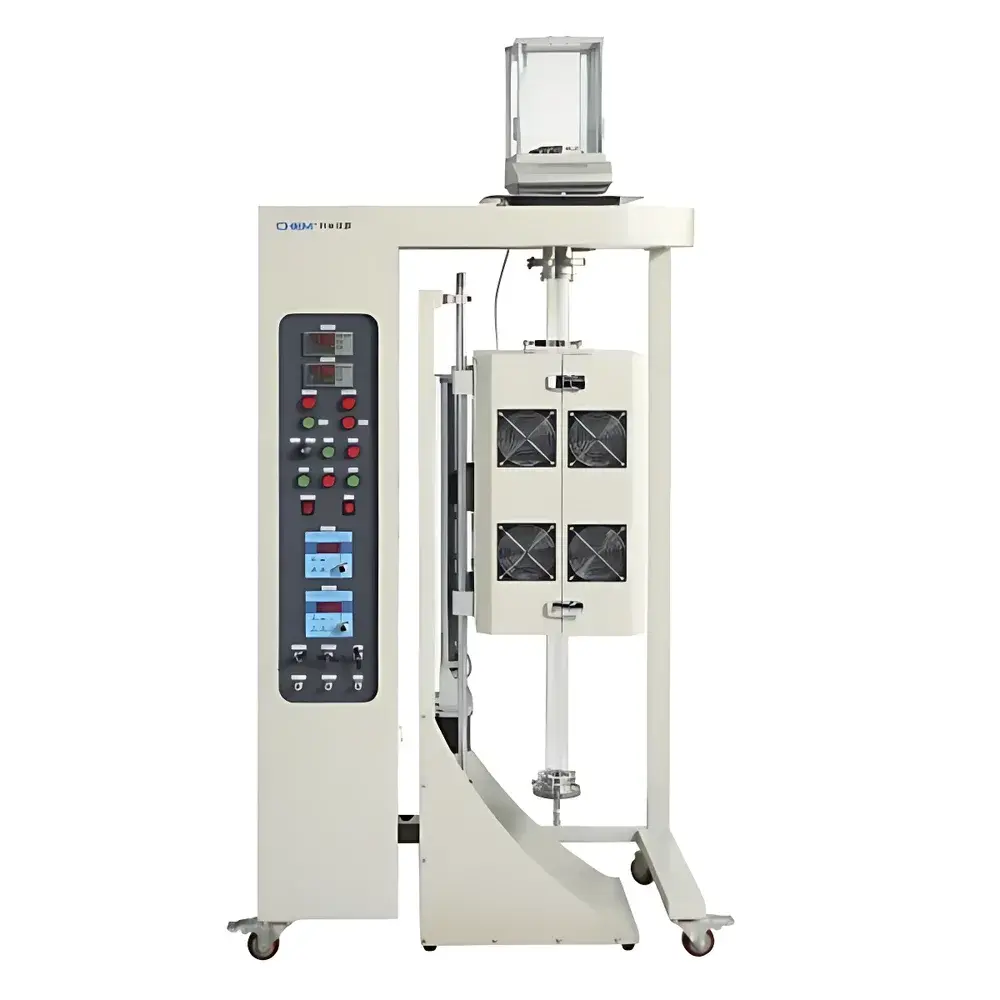
Ahkemi TFD-1100-70-RZ Vertical Thermogravimetric Tube Furnace
| Brand | Ahkemi |
|---|---|
| Origin | Anhui, China |
| Model | TFD-1100-70-RZ |
| Max Temperature | 1100 °C |
| Rated Temperature | 1000 °C |
| Temperature Control Accuracy | ±1 °C |
| Heating Rate (to max temp) | ≤10 °C/min |
| Heating Method | Resistive Wire Heating |
| Internal Dimensions | 800 × 500 × 1550 mm |
| Tube Dimensions | φ70 × φ50 × 350 mm (customizable) |
| Heating Zone Length | 220 mm |
| Rated Power | 3.5 kW |
| Dual-Zone Variant Power | 4.5 kW |
| Dual-Zone Heating Length | 2 × 200 mm |
| Gas Flow Control | Two Mass Flow Controllers (N₂ & CO₂, 0–2 SLM each) |
| Balance Range | 0–220 g |
| Balance Readability | 0.1 mg |
| Cooling | Dual-layer forced-air cooling |
| Surface Temperature | ≤60 °C |
| Temperature Programming | 30-segment programmable controller (Yudian PID with K-type thermocouple) |
Overview
The Ahkemi TFD-1100-70-RZ Vertical Thermogravimetric Tube Furnace is a precision-engineered thermal analysis system designed for controlled-atmosphere thermogravimetric studies under dynamic heating conditions. Unlike conventional horizontal tube furnaces, its vertical orientation enables gravity-assisted sample positioning and facilitates seamless integration with high-sensitivity analytical balances—critical for accurate real-time mass change detection during thermal decomposition, oxidation, reduction, or adsorption/desorption processes. The furnace operates on resistive wire heating embedded within a high-purity alumina microcrystalline fiber insulation matrix, vacuum-formed to ensure structural integrity and thermal uniformity across the active heating zone. Its dual-zone configuration (optional) supports differential thermal aging experiments, allowing sequential or simultaneous exposure of samples to two independently controlled temperature zones with up to 200 °C inter-zone differential—enabling kinetic pathway mapping and staged reaction profiling.
Key Features
- Vertical architecture with motorized lift mechanism for precise, repeatable sample positioning and automated multi-step thermal cycling.
- Dual-layer forced-air cooling system maintains external surface temperature at ≤60 °C even at 1100 °C operating temperature—ensuring operator safety and minimizing ambient thermal interference.
- 30-segment programmable temperature controller (Yudian PID) paired with calibrated K-type thermocouples delivers ±1 °C thermal stability and reproducible ramp/soak profiles.
- Integrated gas delivery subsystem with two independent mass flow controllers (MFCs), supporting N₂ and CO₂ at 0–2 standard liters per minute (SLM), fully software-addressable via RS485/USB interface.
- High-resolution analytical balance (0–220 g, 0.1 mg readability) mounted in vibration-isolated configuration, synchronized with temperature and gas flow data streams for time-correlated gravimetric analysis.
- Customizable quartz or ceramic tube geometry—including inner/outer diameters and length—to accommodate diverse sample forms (powders, pellets, fibers, thin films) and purge gas residence time requirements.
Sample Compatibility & Compliance
The TFD-1100-70-RZ accommodates solid and powdered samples up to 220 g in inert, oxidizing, or mildly reducing atmospheres. Compatible crucible materials include alumina, quartz, and silicon carbide—selected based on chemical compatibility with target reactions and upper temperature limits. The system meets fundamental design criteria aligned with ASTM E1131 (Standard Test Method for Compositional Analysis by Thermogravimetry) and ISO 11358-1 (Plastics — Thermogravimetry — Part 1: General Principles). All electrical components comply with IEC 61010-1 safety standards for laboratory equipment. Optional audit-trail-enabled software modules support GLP/GMP environments, providing electronic signatures, user access control, and 21 CFR Part 11-compliant data archiving when deployed with validated PC-based acquisition platforms.
Software & Data Management
Control and data acquisition are managed through a dedicated Windows-based application supporting real-time visualization of temperature, mass, and gas flow parameters. The software enables synchronized logging at user-defined intervals (down to 100 ms resolution), automatic baseline correction, derivative (DTG) calculation, and customizable report generation (PDF/CSV/XLSX). Raw datasets include timestamped metadata (operator ID, method name, instrument serial number, calibration dates), ensuring traceability. Exported files conform to ASTM E1512-compliant structure for interoperability with third-party thermal analysis suites (e.g., TA Instruments Universal Analysis, Netzsch Proteus). Firmware updates and parameter backups are performed via secure USB interface with version-controlled firmware signing.
Applications
- Quantitative decomposition kinetics of polymers, pharmaceuticals, and energetic materials under controlled purge gases.
- Carbon burn-off and catalyst regeneration studies in air/N₂/O₂ mixtures.
- Moisture and volatile content determination per USP <731> and ISO 527-2.
- Thermal stability assessment of battery electrode materials (e.g., cathode degradation in LiCoO₂, NMC, LFP).
- Calcination behavior of metal oxides, zeolites, and MOFs under variable heating rates and dwell times.
- Dual-zone cyclic aging of composite laminates or coating systems to simulate multi-stage thermal stress environments.
FAQ
What is the maximum recommended continuous operating temperature?
The rated continuous operating temperature is 1000 °C; 1100 °C is permissible for short-term (<2 h) experimental protocols.
Can the furnace be integrated with an existing lab automation framework?
Yes—RS485 Modbus RTU and optional Ethernet TCP/IP interfaces enable integration with PLCs, SCADA systems, or central LIMS via standard industrial protocols.
Is vacuum operation supported?
The base configuration is optimized for positive-pressure gas flow; vacuum compatibility requires optional flange upgrades, reinforced tube end caps, and vacuum-rated MFCs—available upon request.
How is temperature uniformity verified across the heating zone?
Uniformity is characterized per ASTM E220 using three-point axial and radial thermocouple mapping; typical deviation is ≤±3 °C over the 220 mm central zone at 1000 °C.
What maintenance intervals are recommended for the heating elements and insulation?
Resistive wire elements require no scheduled replacement under normal use; insulation integrity should be visually inspected before each high-temperature run—replacing fiber modules every 12–18 months in heavy-duty service.



