
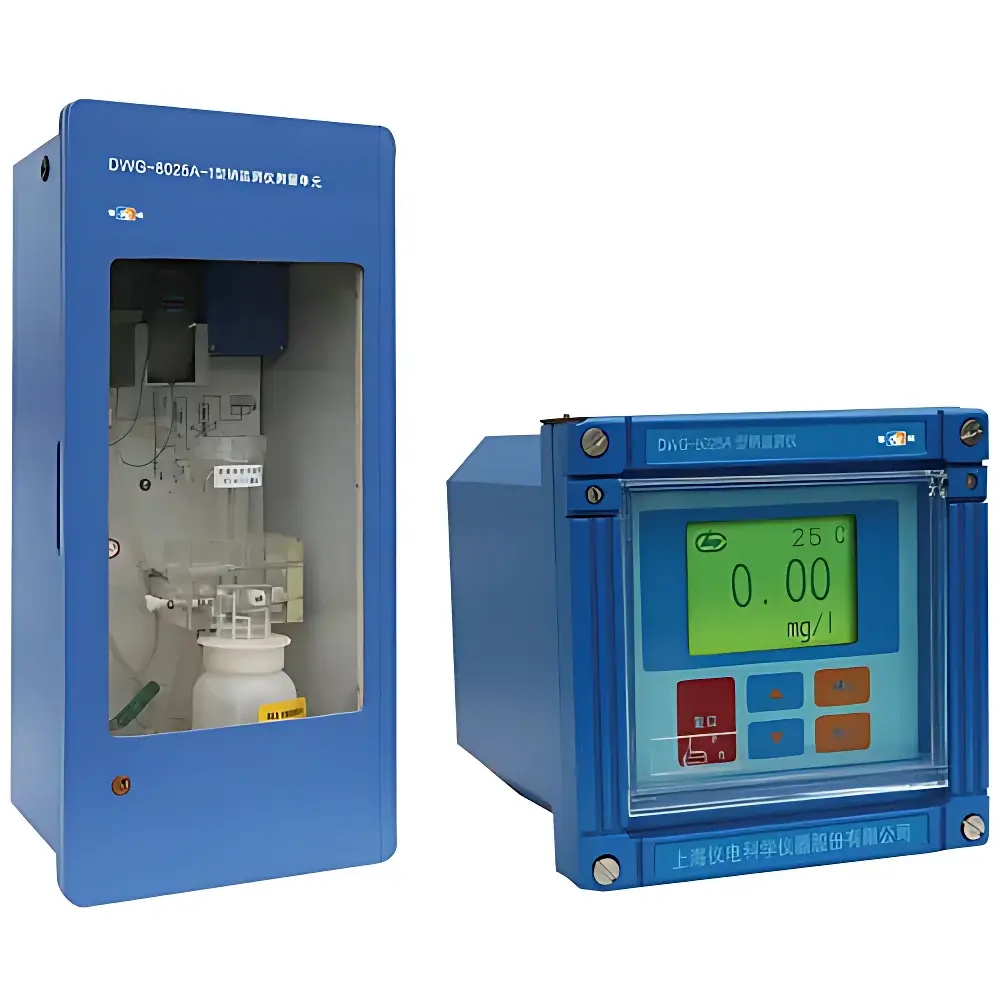
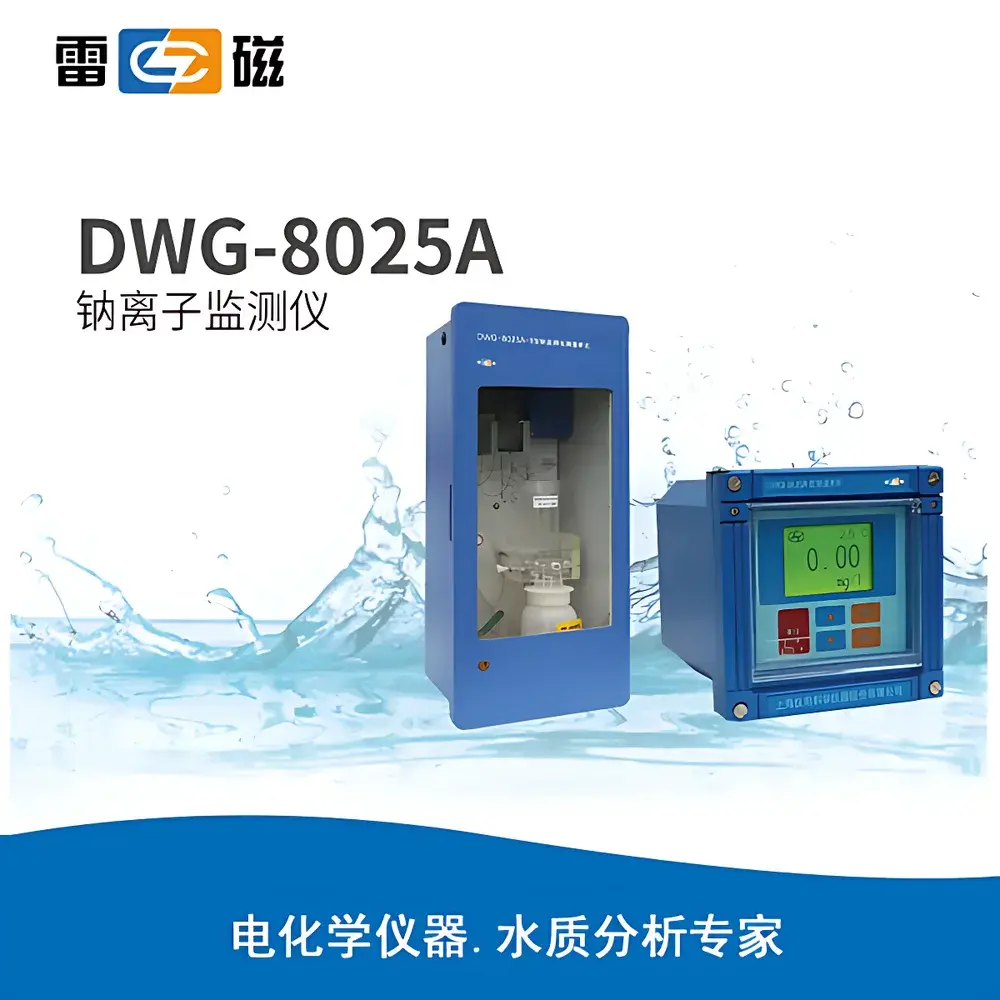
Leichi DWG-8025A Online Sodium Ion Analyzer
| Brand | Leichi |
|---|---|
| Origin | Shanghai, China |
| Manufacturer Type | Direct Manufacturer |
| Regional Classification | Domestic (China) |
| Model | DWG-8025A |
| Price Range | USD 2,800 – 7,000 (FOB Shanghai) |
| Instrument Category | Sodium Ion Analyzer |
| Instrument Type | Online Continuous Monitoring System |
| Measurement Range | 0.1–1000 µg/L Na⁺ |
| Resolution | 0.1 µg/L (≤10 µg/L), 1 µg/L (>10 µg/L) |
| Temperature Range | −10.0 to +120.0 °C |
| Temperature Resolution | 0.1 °C |
| Accuracy (Sodium) | ±10% of reading ±0.1 µg/L |
| Accuracy (Temperature) | ±0.5 °C (0.0–60.0 °C), ±1.0 °C (other) |
| Repeatability | ≤5% of reading |
| Drift Stability | ±10% of reading / 24 h (system), ±3% of reading / 24 h (electronic unit) |
| Enclosure Rating | IP65 |
| Power Supply | AC 220 V ±10%, 50 Hz ±1% |
| Output | Isolated 4–20 mA DC (configurable span), RS-232 or RS-485 (user-selectable) |
| Optional | Integrated pH auto-adjustment module |
Overview
The Leichi DWG-8025A Online Sodium Ion Analyzer is an industrial-grade, continuously operating electrochemical analyzer engineered for high-sensitivity detection of sodium ion concentration in ultrapure water streams. It operates on the principle of potentiometric measurement using a selective sodium ion electrode coupled with reference and auxiliary electrodes—forming a robust three-electrode configuration that minimizes junction potential drift and enhances long-term signal stability. Designed specifically for real-time monitoring in critical water loops—including turbine condensate, boiler feedwater, demineralized makeup water, and nuclear primary coolant—the DWG-8025A delivers trace-level quantification down to 0.1 µg/L Na⁺, meeting the stringent requirements of power generation facilities operating under IEC 60950-1, IEEE C37.90.2, and ISO/IEC 17025-accredited QA/QC protocols.
Key Features
- Triple-electrode architecture (sodium-selective, reference, and auxiliary) ensures stable baseline response and mitigates interference from ammonium, potassium, and hydrogen ions under controlled pH conditions;
- Integrated constant-pressure flow control system maintains consistent sample velocity across the measuring cell, reducing pulsation-induced noise and improving reproducibility;
- Automatic temperature compensation (ATC) algorithm applies Nernstian correction across the full −10.0 to +120.0 °C operational range, referenced to 25.0 °C;
- Dual-range resolution: 0.1 µg/L at sub-10 µg/L levels and 1 µg/L above—optimized for both ultra-trace and mid-range sodium quantification;
- Configurable alarm logic with independent high/low setpoints, latching/non-latching modes, and relay outputs compliant with SIL 2 functional safety principles;
- Isolated 4–20 mA analog output with user-defined zero/span mapping; supports HART-compatible configuration via handheld communicator or PC software;
- RS-232 or RS-485 serial interface (selectable at commissioning) enables Modbus RTU integration into DCS/SCADA platforms such as Siemens PCS7, Honeywell Experion PKS, and ABB 800xA;
- IP65-rated enclosure suitable for indoor panel-mount or outdoor sheltered installation; meets NEMA 4X environmental protection equivalency.
Sample Compatibility & Compliance
The DWG-8025A is validated for use with low-conductivity water matrices (<0.2 µS/cm), including ASTM D1193 Type I reagent water, EP/USP purified water, and nuclear-grade primary coolant. Its sodium-selective electrode exhibits minimal cross-sensitivity to K⁺ (<0.1% relative error at 10 mg/L K⁺) and NH₄⁺ (<0.3% at 5 mg/L) when operated within pH 10.5–11.5—achievable either manually or via optional integrated pH adjustment module (reagent dosing pump + glass pH electrode). The instrument conforms to ISO 5667-3 for sampling preservation, ASTM D4192 for online ion analysis validation, and supports audit-ready data integrity per FDA 21 CFR Part 11 when paired with Leichi’s L-DataPro software (electronic signature, change history, and role-based access control).
Software & Data Management
L-DataPro v3.2 firmware (embedded) provides local configuration, calibration logging, and trend visualization over 30 days of 1-minute interval data storage. Remote access is enabled via secure TLS 1.2 encrypted HTTP(S) interface, supporting browser-based diagnostics and firmware updates. All calibration events—including standard addition sequences, slope verification, and zero-point checks—are timestamped and stored with operator ID, electrode ID, and ambient temperature metadata. Raw sensor outputs (mV, temperature, flow status) are exportable in CSV format compliant with ASTM E2500-20 Annex B for statistical process control (SPC) integration. Audit trail records retain immutable entries for ≥18 months, satisfying GLP/GMP documentation requirements for regulated utilities and semiconductor fabs.
Applications
- Power generation: Real-time sodium monitoring in steam cycle condensate polishing systems to detect early-stage cation resin exhaustion or condenser tube leakage;
- Nuclear industry: Primary coolant surveillance per ANSI/ANS-18.2 guidelines to ensure fuel cladding integrity and prevent stress corrosion cracking;
- Semiconductor manufacturing: Ultrapure water (UPW) quality assurance in rinse and wafer cleaning stages where Na⁺ > 0.5 µg/L induces gate oxide defects;
- Pharmaceutical water systems: USP compliance verification for Water for Injection (WFI) distribution loop integrity testing;
- Automotive battery electrolyte production: Final rinse water validation prior to Li-ion cathode coating processes.
FAQ
What is the recommended sample pH range for accurate sodium measurement?
Optimal performance requires pH 10.5–11.5 to suppress H⁺ interference; the optional pH auto-adjustment module maintains this range using NaOH dosing.
Does the DWG-8025A support multi-point calibration?
Yes—it supports two-point standard addition calibration using certified Na⁺ standards traceable to NIST SRM 3194, with automatic slope calculation and acceptance criteria per ISO 8466-1.
Can the instrument operate unattended for extended periods?
With scheduled maintenance intervals (electrode cleaning every 72 hours, membrane replacement every 6 months), continuous operation exceeding 6 months without manual intervention is documented in field deployments at Tier-1 utility sites.
Is the 4–20 mA output intrinsically safe?
The output is isolated but not IS-certified; for hazardous area installation, it must be connected through an approved Zener barrier or galvanic isolator rated for Class I, Div 2 environments.
How does the system handle air bubbles in the sample stream?
The flow cell incorporates a bubble trap and pressure-differential detection; sustained bubble presence triggers a “flow fault” alarm and holds the last valid reading until recovery.
Related Products







