
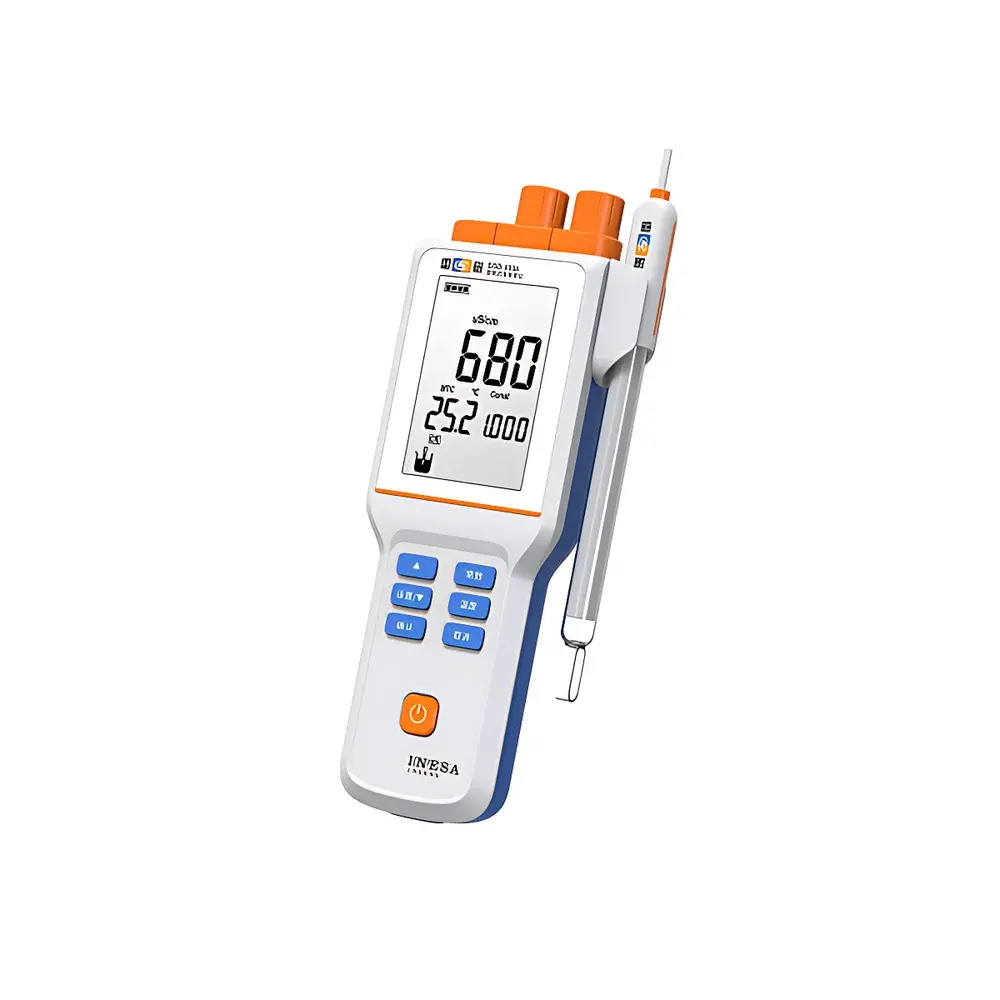
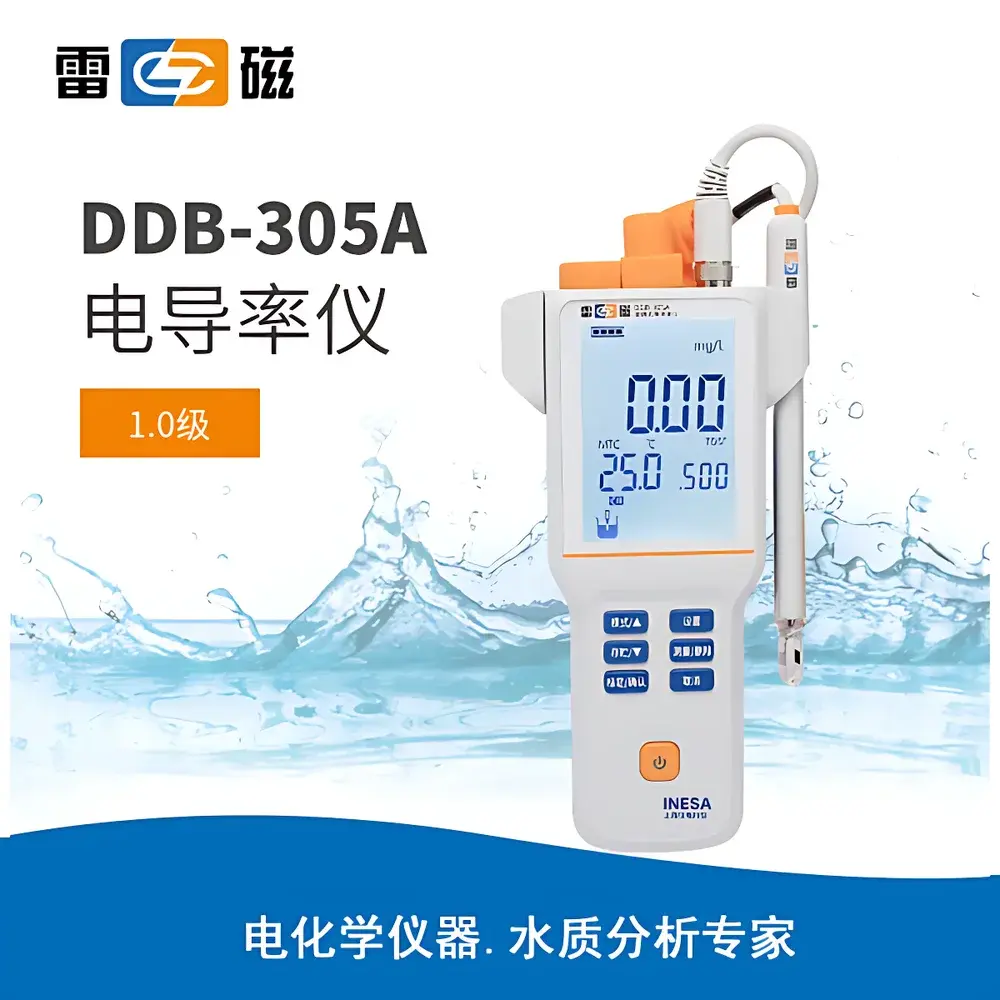
Leici DDB-305A Portable Conductivity Meter
| Brand | Leici |
|---|---|
| Origin | Shanghai, China |
| Manufacturer Type | Direct Manufacturer |
| Regional Origin | Domestic (China) |
| Model | DDB-305A |
| Price Range | USD 280–420 |
| Measured Parameters | Conductivity, TDS, Temperature |
| Portability | Handheld |
| Intended Use | Laboratory & Field |
| Conductivity Range | 0.00 µS/cm to 200 mS/cm |
| TDS Range | 0.00 mg/L to 100 g/L |
| Temperature Range | −5.0 to 110.0 °C (23.0 to 230.0 °F) |
| Accuracy | ±1.0% of Full Scale (FS) |
| Minimum Resolution | 0.01 µS/cm (auto-ranging), 0.01 mg/L (TDS), 0.1 °C/°F (temperature) |
Overview
The Leici DDB-305A Portable Conductivity Meter is a precision-engineered handheld instrument designed for reliable, field-deployable and laboratory-based measurement of electrical conductivity, total dissolved solids (TDS), and temperature in aqueous solutions. Based on the fundamental principle of two-electrode AC conductometric measurement—employing a constant-frequency alternating current to minimize polarization effects and electrode fouling—the DDB-305A delivers stable, reproducible readings across a wide dynamic range. Its dual-range capability (from ultra-low 0.00 µS/cm to high-conductivity 200 mS/cm) enables consistent performance in diverse applications, including freshwater quality assessment, industrial process water monitoring, boiler feedwater analysis, and educational laboratory instruction. The meter complies with Chinese national standard JJG 376–2007 for conductivity meters and aligns with international metrological practices for portable electrochemical instrumentation.
Key Features
- High-contrast LCD display with adjustable backlight for optimal readability under variable ambient lighting conditions
- IP65-rated enclosure ensuring dust-tight operation and protection against low-pressure water jets—suitable for humid or splash-prone environments
- Integrated rechargeable lithium-ion battery (USB-C compatible charging) supporting >15 hours of continuous operation; includes low-battery alert and real-time charging status feedback
- Smart electrode recognition and auto-detection of endpoint stability—supports both equilibrium (single-point hold) and continuous (real-time streaming) measurement modes
- Automatic temperature compensation (ATC) using integrated NTC thermistor; manual temperature input also supported for non-ATC calibration verification
- Pre-programmed recognition of four standard GB-conforming KCl reference solutions (e.g., 1413 µS/cm, 12.88 mS/cm) enabling rapid, traceable one-point calibration
- Auto-frequency switching algorithm ensures optimal excitation frequency selection per conductivity range—maximizing signal-to-noise ratio when used with the included 1.0 cm⁻¹ composite electrode
Sample Compatibility & Compliance
The DDB-305A is optimized for aqueous electrolyte solutions with conductivity values typical of natural waters, wastewater effluents, cooling tower fluids, and dilute chemical process streams. It is not intended for non-aqueous solvents, highly viscous media, or suspensions containing particulates >50 µm. The instrument meets IP65 environmental protection requirements per IEC 60529 and conforms to electromagnetic compatibility (EMC) standards GB/T 18268.1–2010 (equivalent to IEC 61326-1). While not certified for GMP or FDA-regulated environments out-of-the-box, its data integrity features—including timestamped storage, no overwrite policy, and user-accessible calibration logs—support GLP-aligned workflows in academic and industrial QA/QC laboratories.
Software & Data Management
The meter stores up to 200 complete measurement records locally, each comprising conductivity, TDS, temperature, date/time stamp, and calibration ID. Data can be exported via USB connection to a host PC using Leici’s proprietary LeiciLink software (Windows-compatible), which supports CSV export, trend plotting, and batch report generation. All stored entries are immutable post-acquisition—no editing or deletion is permitted without full memory reset. Audit trail functionality includes automatic logging of calibration events, parameter changes, and system resets, facilitating traceability in regulated environments requiring documentation per ISO/IEC 17025 or internal SOPs.
Applications
- Environmental monitoring: Surface water, groundwater, and wastewater conductivity profiling per EPA Method 120.1 and ISO 7888
- Pharmaceutical water systems: USP compliant resistivity screening of purified water (PW) and water for injection (WFI) at 25 °C
- Food & beverage production: Monitoring rinse water conductivity during CIP cycles and verifying cleaning agent concentration
- Academic teaching labs: Quantitative demonstration of ion mobility, electrolyte dissociation, and temperature dependence of conductivity
- Power generation: Feedwater and condensate purity checks in thermal power plants per ASTM D1125 and IAPWS guidelines
FAQ
Does the DDB-305A support multi-point calibration?
No—it supports only single-point calibration with automatic recognition of four GB-standard KCl solutions. Multi-point calibration requires external reference standards and manual entry.
Can the instrument measure resistivity directly?
No—resistivity must be calculated manually from conductivity values (ρ = 1/σ), as the device does not implement inverse computation or unit toggling.
Is the included electrode suitable for high-salinity seawater measurements?
Yes—the supplied 1.0 cm⁻¹ composite electrode is rated for full-range use up to 200 mS/cm, making it appropriate for undiluted seawater (~50 mS/cm at 25 °C) and brine solutions.
Does the meter comply with FDA 21 CFR Part 11?
No—while data export and audit logging are supported, the device lacks electronic signature capability, role-based access control, or system validation documentation required for Part 11 compliance.
What is the recommended recalibration interval?
Leici recommends recalibration before each daily use in critical applications or after exposure to extreme pH, high organic load, or precipitating ions; otherwise, weekly verification against a certified standard is sufficient for routine monitoring.




