
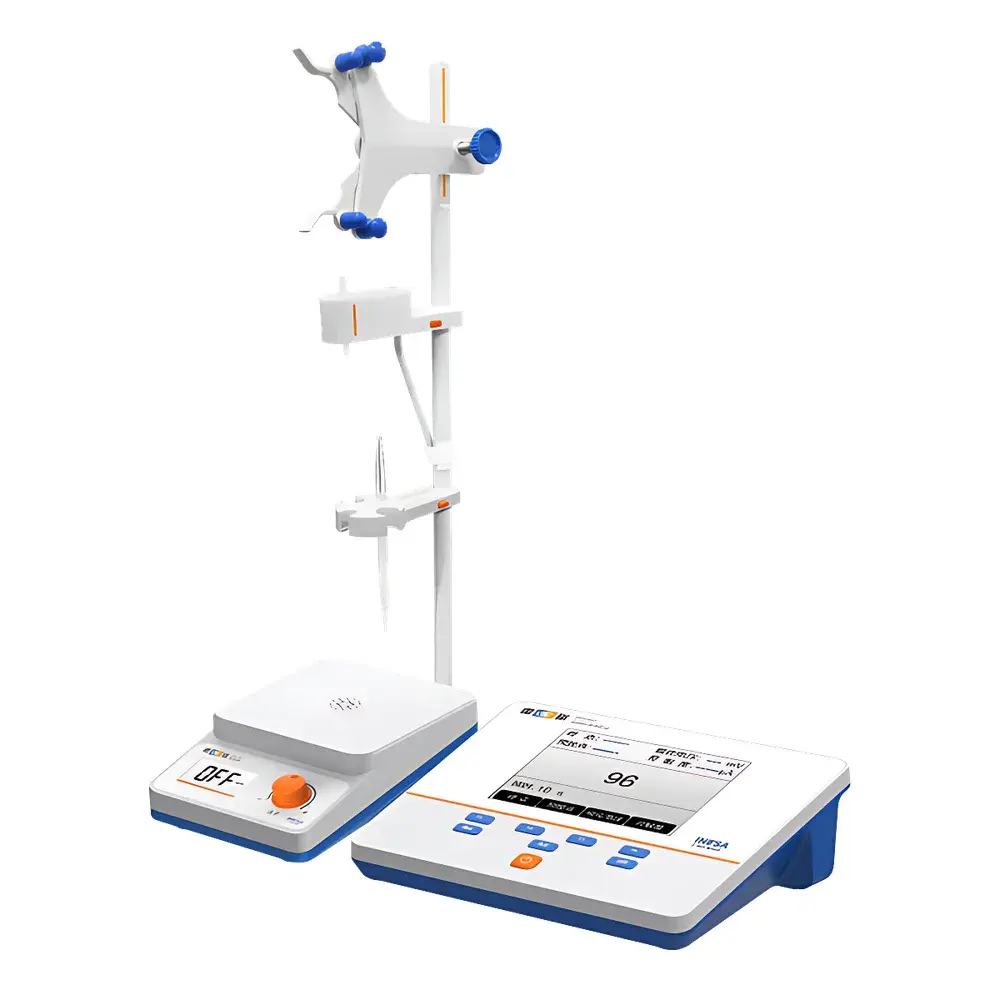
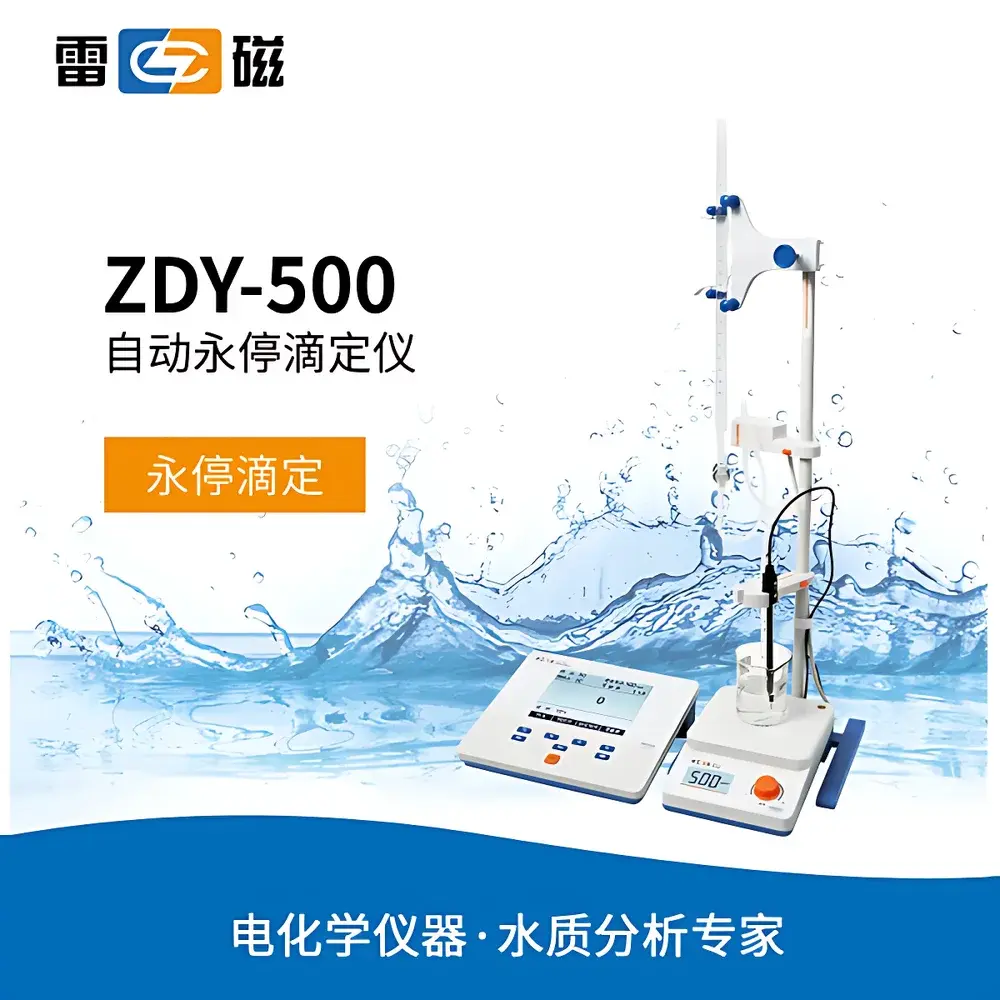
Leici ZDY-500 Automatic Dead-Stop Titration System
| Brand | Leici |
|---|---|
| Origin | Shanghai, China |
| Manufacturer Type | Direct Manufacturer |
| Product Category | Domestic |
| Model | ZDY-500 |
| Price Range | USD 700–1,400 (FOB) |
| Instrument Type | General-Purpose Potentiometric Titrator |
| Application Scope | Universal |
| Burette Capacity Options | 0–10 mL, 0–25 mL |
| Meter Reading Accuracy | ±0.2% of reading |
| Polarization Current Detection Error | ±2% FS |
| Repeatability of Volumetric Analysis | ±0.2% FS |
| Polarization Voltage Settings | 30 mV, 50 mV, 100 mV |
| Sensitivity Settings | 0.001 µA, 0.01 µA, 0.1 µA, 1 µA |
| Endpoint Threshold Range | 0–100 (arbitrary unit) |
| Pre-Control Point Range | 0–100 |
| Delay Time Setting | 0–200 s |
| Operating Temperature | 5–30 °C |
| Power Supply | AC 100–240 V → DC 24 V adapter |
| Dimensions (W×D×H) | 218 × 180 × 66 mm |
| Net Weight | 0.7 kg |
Overview
The Leici ZDY-500 Automatic Dead-Stop Titration System is a dedicated electrochemical titration instrument engineered for precision endpoint detection in redox and precipitation titrations where a reversible dual-platinum electrode pair serves as the current-sensing element. Unlike potentiometric or conductometric titrators, the ZDY-500 operates on the principle of dead-stop (biamperometric) titration: a constant low polarization voltage is applied across two identical platinum electrodes immersed in the analyte solution; at the equivalence point, a sharp, transient increase in diffusion-controlled current occurs due to the abrupt change in electroactive species concentration—this current surge triggers automatic termination of titrant delivery. The system is optimized for applications including Karl Fischer water determination (with appropriate reagent compatibility), iodometric titrations (e.g., ascorbic acid, copper), and argentometric methods (e.g., chloride analysis), where high reproducibility of endpoint discrimination is critical under ambient laboratory conditions (5–30 °C).
Key Features
- High-resolution monochrome LCD interface with intuitive menu navigation, supporting both English and metric unit display modes
- Selectable polarization voltage (30 mV / 50 mV / 100 mV) to minimize overpotential effects and optimize signal-to-noise ratio for diverse redox couples
- Four-step current sensitivity adjustment (0.001–1 µA full scale), enabling precise endpoint resolution across wide dynamic ranges—from trace-level analytes to concentrated standards
- Programmable endpoint threshold (0–100), pre-control point (0–100), and post-threshold delay (0–200 s) to suppress false triggering from transient current spikes
- Intelligent titration logic: automatic transition from fast-dose to slow-dose mode upon detection of rapid current rise (>90% FS/s), ensuring volumetric accuracy within ±0.2% FS repeatability
- Modular hardware design compatible with standard 10 mL or 25 mL glass burettes (not included); integrated control of external peristaltic or piston-driven dispensing units via TTL-level I/O
- Built-in JB-11 magnetic stirrer with speed regulation (0–1200 rpm), paired with capillary-tipped delivery tubing and dual-platinum microelectrodes (Pt–Pt, 0.3 mm wire diameter)
Sample Compatibility & Compliance
The ZDY-500 supports aqueous and mixed-solvent systems compatible with classical dead-stop titration chemistry, including but not limited to: iodine/iodide redox couples, Fe²⁺/Ce⁴⁺, Ag⁺/Cl⁻, and hydrazine-based assays. Electrode compatibility extends to non-aqueous media when using anhydrous solvents (e.g., glacial acetic acid, methanol) with appropriate reference compensation. While the instrument itself does not carry CE, UKCA, or FDA 510(k) certification, its operational parameters align with ASTM E202–22 (Standard Test Methods for Water in Organic Liquids by Karl Fischer Titration) and ISO 8587:2010 (Sensory analysis — Methodology — Ranking tests) for endpoint consistency validation. Data acquisition meets basic GLP documentation requirements when paired with external audit-trail-enabled lab notebooks.
Software & Data Management
The ZDY-500 operates as a standalone embedded system without proprietary PC software. All method parameters—including polarization settings, sensitivity levels, endpoint thresholds, and delay times—are stored in non-volatile memory (EEPROM) with retention >10 years. Each titration cycle logs timestamp, final volume delivered, detected current peak value, and endpoint confirmation status to internal flash storage (up to 200 records). Raw current vs. time traces are not retained; however, users may manually record intermediate readings during manual mode via front-panel hold function. For regulatory environments requiring electronic records, integration with LIMS or ELN platforms is achievable through RS-232 serial output (ASCII protocol, 9600 bps, N-8-1), supporting CSV-formatted export of final results only.
Applications
- Pharmaceutical QC labs: assay of sodium thiosulfate, potassium iodide, and chlorhexidine gluconate per USP and EP 2.2.20
- Food & beverage testing: quantification of residual sulfites in wine and dried fruits via iodometric back-titration
- Environmental analysis: determination of cyanide in wastewater following APHA 4500-CNB (silver nitrate titration)
- Electroplating bath monitoring: free cyanide and carbonate content in alkaline zinc plating solutions
- Academic teaching laboratories: demonstration of amperometric principles, Faraday’s laws, and stoichiometric equivalence concepts
FAQ
Does the ZDY-500 support GLP-compliant data archiving?
No—data storage is limited to summary results (volume, endpoint flag, timestamp). Full audit trails, user authentication, or electronic signatures require external documentation systems.
Can the instrument be used with non-platinum electrodes?
No—the dead-stop method relies on symmetric, diffusion-controlled current response; only matched Pt–Pt electrodes (JB-11 supplied) ensure valid polarization behavior.
Is calibration traceable to NIST standards?
The device does not perform electrical calibration; however, volumetric accuracy is verified using certified Class A burettes and gravimetric water delivery protocols per ISO 648 and ISO 1042.
What maintenance is required for long-term stability?
Regular cleaning of Pt electrodes with alumina slurry and ultrasonic rinsing; periodic verification of stirrer speed linearity using a tachometer; annual inspection of burette tip seal integrity.
Can the ZDY-500 operate continuously for unattended batch analysis?
Not natively—it lacks sample changer integration or auto-refill capability. Sequential analysis requires manual sample replacement and electrode rinsing between runs.





