
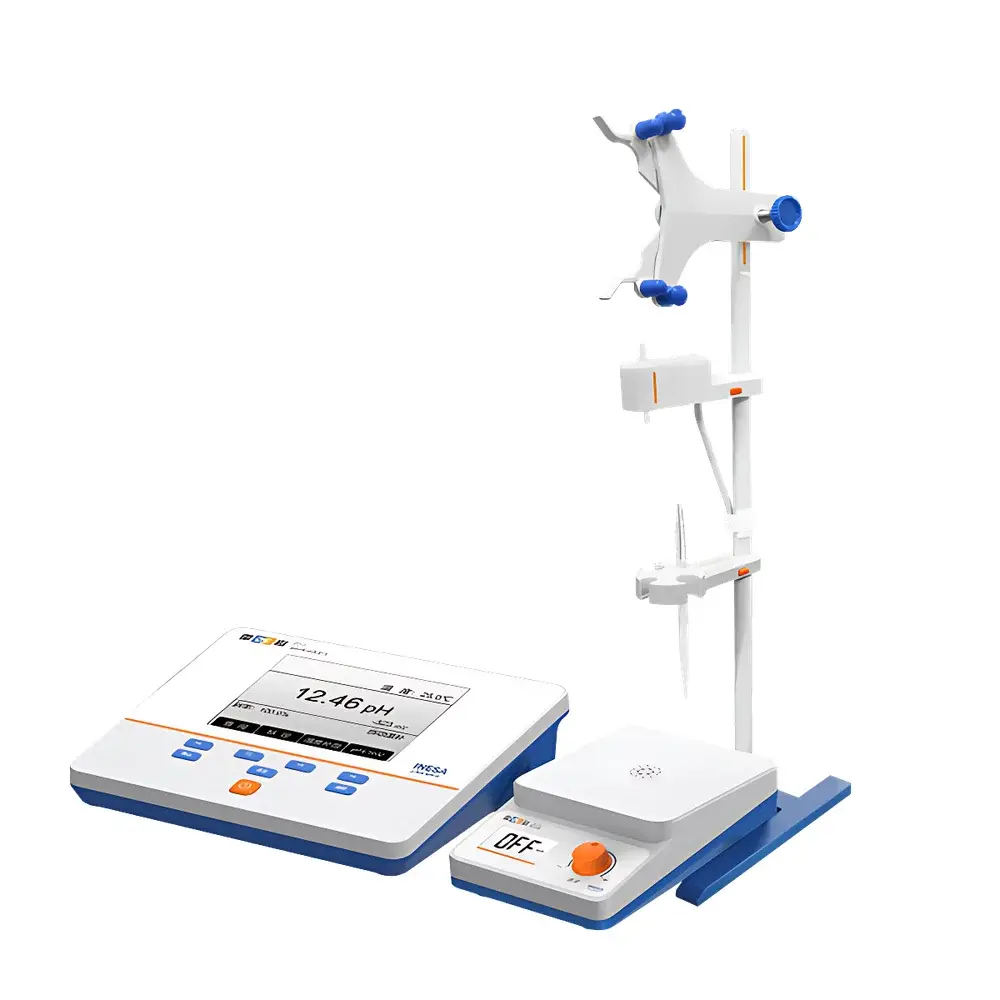
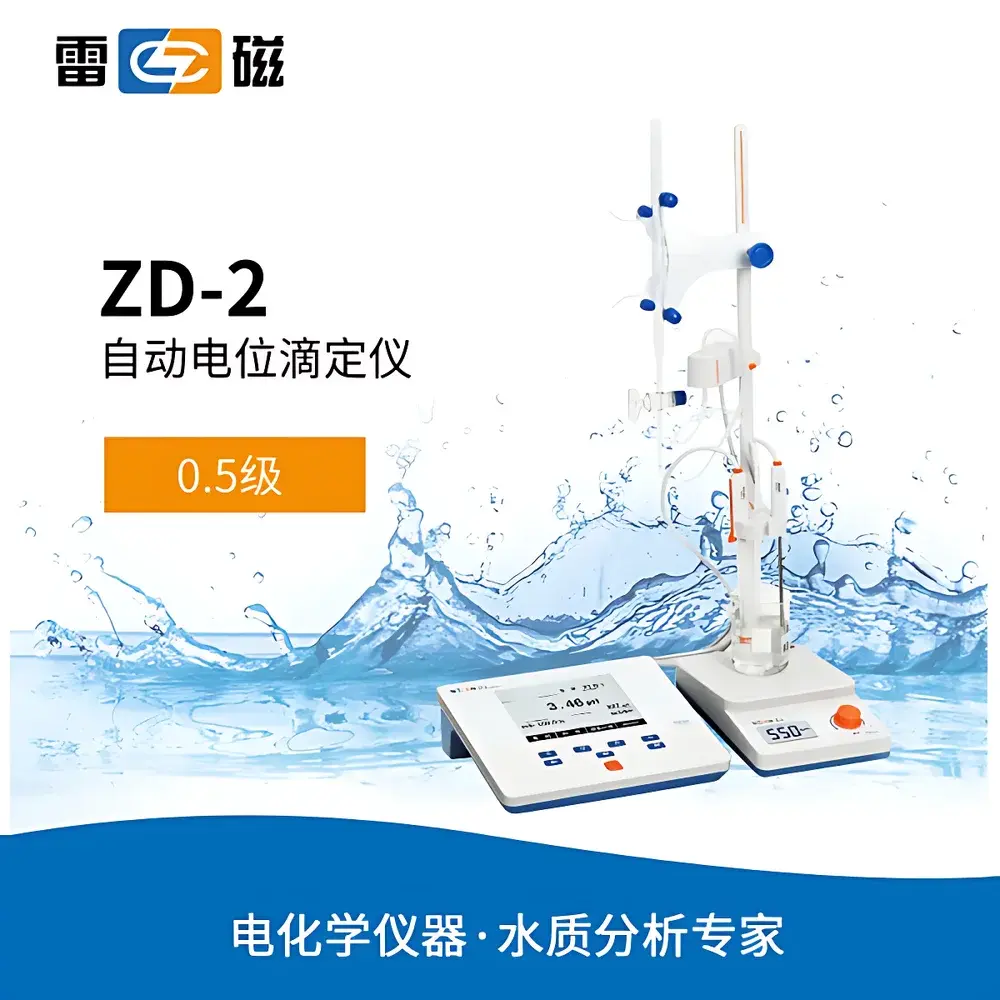
Leici ZD-2 Automatic Potentiometric Titrator
| Brand | Leici |
|---|---|
| Origin | Shanghai, China |
| Manufacturer Type | Original Equipment Manufacturer (OEM) |
| Country of Origin | China |
| Model | ZD-2 |
| Pricing | Available Upon Request |
| Display | High-Resolution LCD |
| Measurement Modes | Manual Titration, Automatic Endpoint Titration, Controlled-Drop Titration |
| Measurable Parameters | mV (–1400 to +1400 mV, 1 mV resolution), pH (0.00–14.00, 0.01 pH resolution), Temperature (0–100 °C, 0.1 °C resolution) |
| Electrode Support | pH composite electrode, Ag electrode, reference electrode, temperature sensor |
| Calibration | Up to 2-point manual or automatic pH calibration |
| Compensation | Automatic/manual temperature compensation |
| Interface | RS-232 for printer output |
| Stirring | Integrated JB-11 magnetic stirrer |
| Burette Compatibility | External 10 mL or 25 mL burettes |
| Accuracy | ±0.35% FS for mV (±4.9 mV), ±0.03 pH, ±0.5 °C (0–60 °C), ±2.5% volumetric error, 0.3% repeatability |
| Endpoint Detection Sensitivity | ±5 mV or ±0.1 pH |
| Endpoint Delay Adjustment | Adjustable (±2 s error) |
| Power | AC 100–240 V input, DC 20 V output |
| Dimensions & Weight | 218 × 180 × 66 mm, ~0.7 kg |
| Operating Environment | 0–40 °C, ≤85% RH |
Overview
The Leici ZD-2 Automatic Potentiometric Titrator is a benchtop analytical instrument engineered for precision acid-base, redox, precipitation, and complexometric titrations in academic, quality control, and routine industrial laboratories. It operates on the fundamental principle of potentiometric endpoint detection—measuring the potential difference (in mV) or hydrogen ion activity (pH) between a working indicator electrode (e.g., pH composite or silver electrode) and a stable reference electrode as titrant is incrementally added. The system identifies stoichiometric endpoints by detecting inflection points in the titration curve, either via fixed-pH/mV thresholds or dynamic slope-based algorithms. Designed with modular electrode compatibility and external burette integration, the ZD-2 supports flexible method development while maintaining compliance with foundational electrochemical measurement standards including ISO 8655-6 (volumetric instruments), ASTM E2087 (potentiometric titration), and USP (acid–base titrimetry). Its compact footprint and low-power DC architecture make it suitable for shared lab environments where space and energy efficiency are constrained.
Key Features
- High-resolution LCD interface with intuitive menu navigation—optimized for glove-compatible operation and multi-language support (English default)
- Triple-mode titration control: manual (continuous or dropwise), automatic endpoint (programmable mV or pH threshold), and controlled-drop (user-adjustable delivery rate and post-endpoint delay)
- Dual-parameter measurement engine: simultaneous real-time acquisition of mV (–1400 to +1400 mV, 1 mV resolution) and pH (0.00–14.00, 0.01 pH resolution) with independent calibration pathways
- Integrated JB-11 magnetic stirrer with variable speed control ensures homogeneous mixing without vortexing or splashing—critical for reproducible endpoint detection
- Comprehensive electrode management: supports pH composite, Ag, double-junction reference, and Pt or glass electrodes; includes 2-point pH calibration with slope and offset verification
- Temperature compensation: both automatic (via integrated Pt100 sensor) and manual modes, aligned with NIST-traceable thermal response curves for aqueous systems
- RS-232 serial port enables direct connection to dot-matrix or thermal printers for GLP-compliant hardcopy reporting (time-stamped, method-ID tagged)
- Robust mechanical design: aluminum alloy chassis, shielded analog signal paths, and EMI-resistant power supply (IEC 61326-1 compliant)
Sample Compatibility & Compliance
The ZD-2 accommodates standard aqueous and mildly polar non-aqueous matrices (e.g., glacial acetic acid, ethanol–water mixtures) typical in pharmaceutical assay validation, food acidity testing (AOAC 940.04), and water hardness analysis (ISO 6059). It interfaces with industry-standard 10 mL and 25 mL Class A glass burettes (ISO 385), enabling volumetric accuracy within ±0.02 mL per delivery cycle. Electrode inputs conform to DIN 19262 and ASTM D1129 pin configurations. While not certified for 21 CFR Part 11 electronic records, its print-log functionality satisfies basic audit-trail requirements under ISO/IEC 17025:2017 Clause 7.7 (result reporting) and supports laboratory adherence to GMP Annex 11 principles when paired with controlled documentation workflows.
Software & Data Management
The ZD-2 operates autonomously without PC dependency—method parameters (endpoint value, delay time, stirring speed, calibration coefficients) are stored in non-volatile memory (EEPROM) with retention >10 years. All measurements include timestamp, operator ID field (manual entry), and method name. Raw mV/pH vs. volume data can be exported via RS-232 in ASCII CSV format for downstream analysis in Excel, MATLAB, or LIMS platforms. No proprietary software installation is required; however, optional terminal-emulation tools (e.g., Tera Term, PuTTY) may be used for batch export scripting. Firmware updates are performed via USB-to-serial adapter (not included); revision history and calibration logs are retained internally for traceability.
Applications
- Pharmaceutical QC: assay of active ingredients (e.g., aspirin hydrolysis, amine salt quantification) per USP monographs
- Food & Beverage: titratable acidity (TA) in wines and dairy products (AOAC 942.15), chloride determination in processed meats
- Environmental Testing: alkalinity and hardness profiling in surface water per EPA Method 310.1
- Chemical Manufacturing: concentration verification of NaOH/KOH stock solutions, HCl standardization
- Academic Teaching: foundational electrochemistry labs covering Nernst equation validation, equivalence point theory, and electrode kinetics
FAQ
Does the ZD-2 support GLP-compliant data integrity?
Yes—when used with RS-232-connected printers, all reports include date/time stamps, operator entries, and method identifiers. Internal memory retains calibration history and last-used parameters for review.
Can I use non-Leici electrodes with this titrator?
Yes—any electrode with standard BNC or DIN connectors and compatible output impedance (<100 MΩ for pH, <1 kΩ for redox) functions reliably.
Is temperature compensation mandatory during pH titrations?
Not mandatory, but strongly recommended; the instrument applies the Nernstian temperature coefficient (–0.198 mV/°C per pH unit) to correct theoretical endpoint shifts in non-ambient conditions.
What maintenance is required for long-term accuracy?
Monthly verification using certified buffer solutions (NIST-traceable pH 4.01/7.00/10.01) and KCl standard solutions for mV linearity; annual inspection of burette tip seal integrity and stir bar magnetization.
How is endpoint delay time utilized in practice?
It allows equilibration after each micro-addition—especially critical in slow-reacting systems (e.g., EDTA complexation of Ca²⁺ in hard water) to prevent overshoot and improve volumetric precision.



