
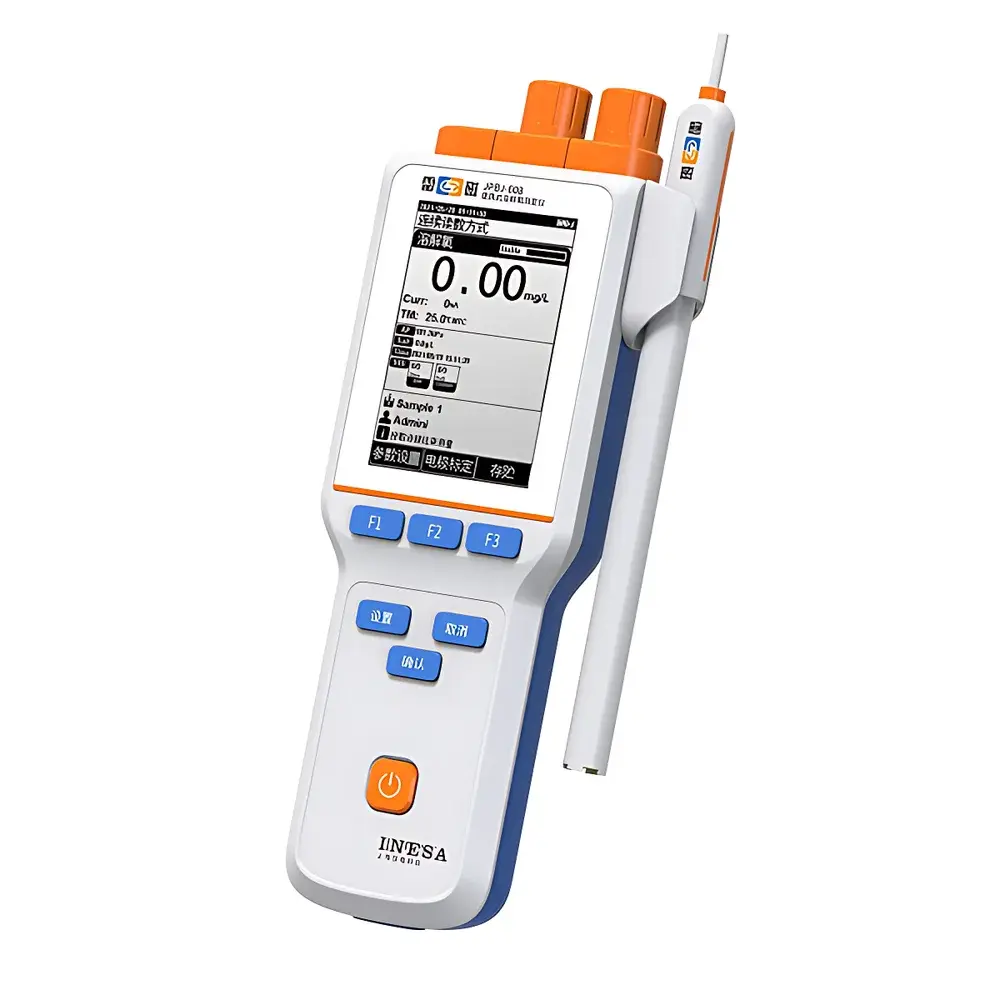
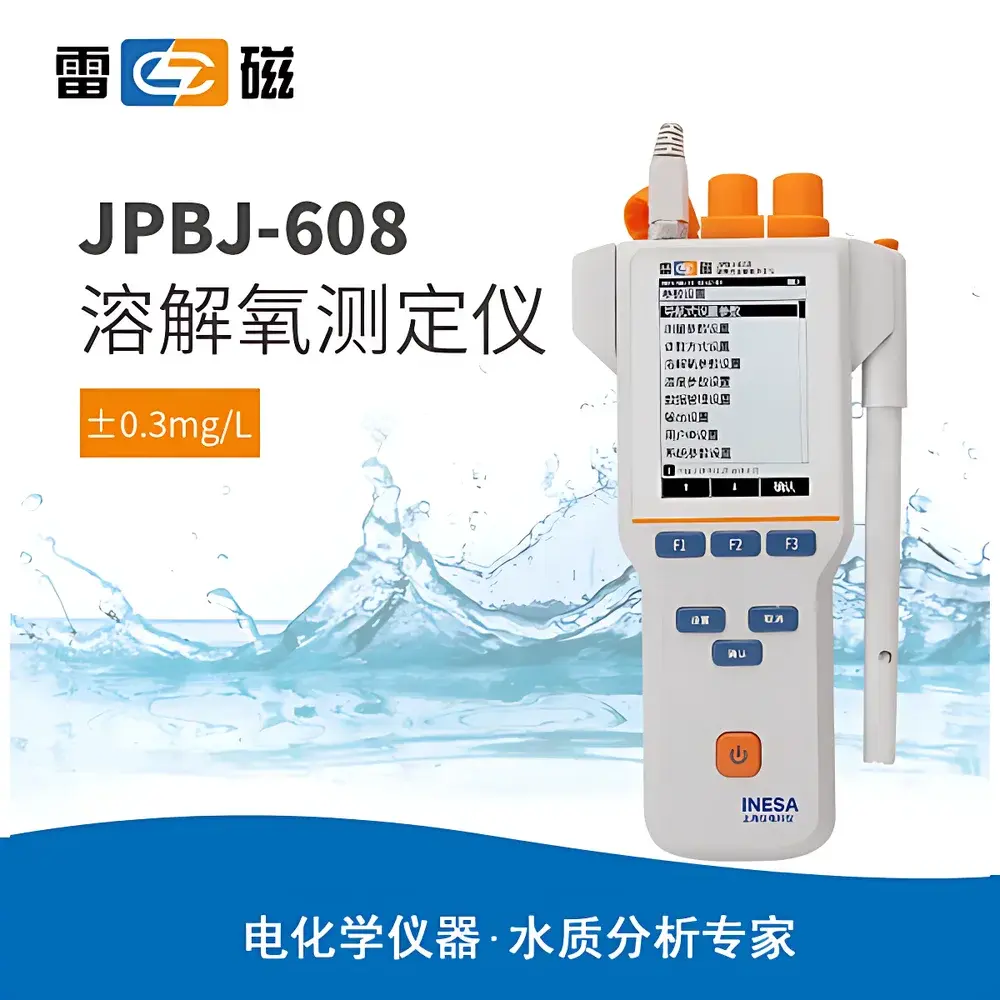
Leici JPBJ-608 Portable Dissolved Oxygen Meter
| Brand | Leici |
|---|---|
| Origin | Shanghai, China |
| Manufacturer Type | Direct Manufacturer |
| Regional Classification | Domestic (China) |
| Model | JPBJ-608 |
| Instrument Type | Portable |
| Measurement Principle | Electrochemical Probe — Clark-type Polarographic Sensor |
| DO Range | (0.00–50.00) mg/L |
| Accuracy | ±0.30 mg/L for ≤20.00 mg/L |
| Resolution | 0.01 mg/L (DO), 0.1 °C / 0.1 °F (Temperature), 0.1% (Saturation) |
| Response Time | ≤45 s (90% response at 20.0 °C) |
| Temperature Compensation | Automatic, with manual salinity compensation |
| Atmospheric Pressure Compensation | kPa, mmHg, atm selectable |
| IP Rating | IP65 |
| Data Storage | 500 sets |
| Power | Rechargeable Li-ion battery |
| Dimensions | 80 × 225 × 35 mm |
| Weight | 0.4 kg |
| Compliance | GLP-compliant data logging with audit trail support |
Overview
The Leici JPBJ-608 Portable Dissolved Oxygen Meter is a field-deployable electrochemical analyzer engineered for precise, real-time measurement of dissolved oxygen (DO) concentration in aqueous environmental samples. It employs a Clark-type polarographic sensor—comprising a noble metal cathode (typically gold or platinum), silver/silver chloride reference electrode, and oxygen-permeable membrane—to generate a diffusion-limited reduction current proportional to the partial pressure of molecular oxygen in solution. This principle ensures high specificity, minimal interference from common ions, and stable baseline performance across variable salinity and temperature gradients. Designed for regulatory field surveys, wastewater effluent monitoring, aquaculture management, and surface water quality assessment, the JPBJ-608 delivers laboratory-grade accuracy in a rugged, handheld platform compliant with international field instrumentation standards.
Key Features
- High-resolution 2.8-inch TFT LCD display with adjustable backlight for legibility under diverse ambient lighting conditions
- Automatic endpoint detection with multiple read modes: continuous auto-read, timed interval acquisition (1–999 s), and manual hold
- Integrated dual-compensation algorithms: automatic temperature compensation (−5.0 to 110.0 °C) and configurable atmospheric pressure compensation (kPa, mmHg, or atm)
- Manual salinity compensation (0–50 g/L) to correct for ionic strength effects on oxygen solubility
- Onboard zero-oxygen and full-scale (air-saturated water) calibration routines with real-time status feedback
- IP65-rated enclosure ensuring dust-tight operation and resistance to low-pressure water jets—suitable for outdoor deployment in rain, humidity, or splashing environments
- Dual-power architecture: long-life rechargeable lithium-ion battery (≥100 hours typical runtime) with USB-C and DC5V adapter charging; battery-level indicator and low-voltage warning
Sample Compatibility & Compliance
The JPBJ-608 is validated for use with freshwater, seawater, wastewater, groundwater, and process water matrices. Its polarographic probe design minimizes fouling sensitivity compared to galvanic sensors and supports routine cleaning and membrane replacement per ASTM D888-22 (Standard Test Methods for Dissolved Oxygen in Water). The instrument conforms to Good Laboratory Practice (GLP) requirements through timestamped, operator-ID-tagged data storage (500 measurement records), automatic metadata capture (temperature, pressure, salinity, calibration history), and tamper-resistant internal memory. While not certified for FDA 21 CFR Part 11 compliance out-of-the-box, its data export protocol supports integration into validated LIMS environments where electronic signatures and audit trails are externally managed.
Software & Data Management
Data transfer is enabled via USB interface using Leici’s proprietary PC communication software (Windows-compatible), supporting CSV export for statistical analysis in Excel, R, or Python-based QA/QC workflows. The meter supports direct printing via RS-232–enabled thermal printers with user-selectable report formats—including single-point readings, calibration logs, and batch summaries. All stored entries include DO value (mg/L and % saturation), temperature (°C/°F), atmospheric pressure, salinity input, calibration date/time, and operator ID if configured. Firmware updates are performed via USB, allowing periodic enhancements to measurement algorithms, language localization, or regulatory reporting templates without hardware modification.
Applications
- Regulatory compliance monitoring per EPA Method 360.1 and ISO 5814:2012 (Electrochemical determination of dissolved oxygen)
- Routine DO profiling in rivers, lakes, reservoirs, and estuaries during seasonal water quality assessments
- Aquaculture site management—optimizing aeration efficiency and detecting hypoxic stress thresholds in fish ponds or hatcheries
- Wastewater treatment plant (WWTP) process control—monitoring aeration basin DO levels to maintain optimal nitrification/denitrification kinetics
- Field validation of online DO analyzers and cross-calibration against Winkler titration reference methods
- Educational use in environmental science laboratories for hands-on sensor calibration, error propagation analysis, and method comparison studies
FAQ
What type of sensor technology does the JPBJ-608 employ?
It uses a Clark-type polarographic dissolved oxygen sensor with a Teflon membrane, silver/silver chloride reference, and gold cathode—requiring polarization time (~30 s) prior to measurement.
Does the instrument support automatic barometric pressure correction?
Yes—it accepts manual entry or external Bluetooth barometer input (via optional accessory) and applies real-time compensation using the Bunsen solubility coefficient.
Can the JPBJ-608 measure dissolved oxygen in high-salinity seawater?
Yes, provided user-input salinity values (0–50 g/L) are entered to adjust oxygen solubility models per UNESCO 1983 equations.
Is the data storage compliant with audit trail requirements for regulated labs?
Each record includes immutable timestamps, calibration verification flags, and operator identifiers—meeting core GLP traceability expectations for field data.
How often should the DO membrane and electrolyte be replaced?
Recommended every 2–3 months under daily use; more frequently in turbid or organic-rich waters—replacement kits are available as Leici OEM accessories (Cat. No. DO-MEM-KIT-JPBJ).







