
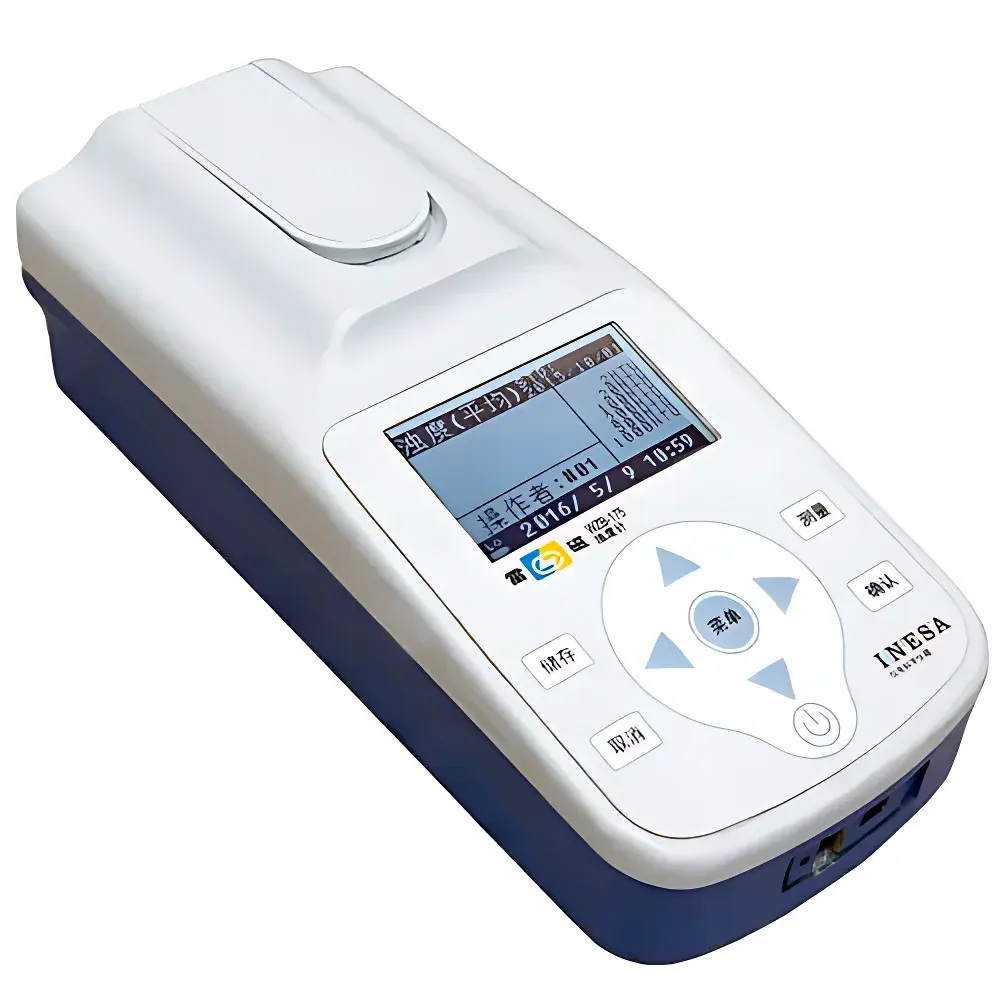
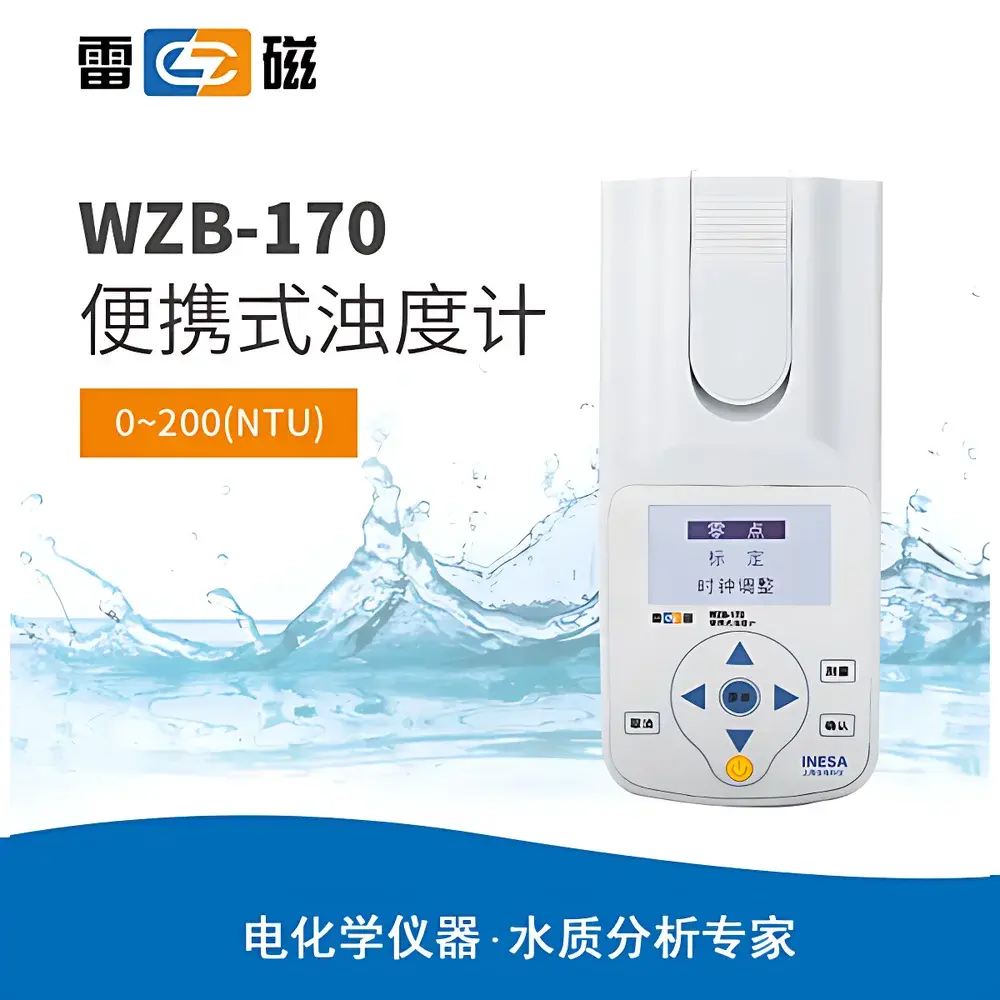
Leici WZB-170 Portable Turbidimeter
| Brand | Leici |
|---|---|
| Origin | Shanghai, China |
| Manufacturer Type | Direct Manufacturer |
| Regional Classification | Domestic (China) |
| Model | WZB-170 |
| Product Type | Portable |
| Measurement Range | 0.00–20.00 NTU, 20.0–200.0 NTU, 200–1000 NTU (auto-ranging) |
| Resolution | 0.01 / 0.1 / 1 NTU (auto-selected) |
| Operating Temperature | 5–35 °C |
| Accuracy | ±8 % FS |
| Repeatability | ≤1.0 % |
| Zero Drift | ±1.0 % FS / 30 min |
| Stability | ±0.5 % FS / 30 min |
| Light Source | Infrared LED (860 nm), compliant with ISO 7027 and HJ 1075 |
| Calibration Points | Zero + up to three standard points (2, 20, 200 NTU) |
| Display | Monochrome LCD |
| Power Supply | 4 × AA batteries or DC 5 V adapter (AC 200–240 V input) |
| Dimensions | 100 × 220 × 80 mm |
| Weight | ~0.8 kg |
| Protection Rating | IP65 |
| Included Accessories | Standard turbidity bottles, protective carrying case, 400 NTU calibration standard solution |
Overview
The Leici WZB-170 Portable Turbidimeter is an engineered optical measurement instrument designed for field-deployable and routine laboratory quantification of turbidity in water and aqueous solutions. It operates on the principle of near-infrared (NIR) nephelometry—measuring the intensity of light scattered at 90° by suspended particles—using a stable 860 nm infrared LED source. This wavelength minimizes interference from sample coloration and reduces sensitivity to particle absorption, ensuring improved measurement fidelity across diverse natural and treated waters. The instrument complies fully with ISO 7027:2016 (Water quality — Determination of turbidity) and China’s environmental monitoring standard HJ 1075–2019 (Determination of turbidity in water — Nephelometric method), making it suitable for regulatory reporting in municipal water supply, wastewater treatment, environmental monitoring, and drinking water safety verification.
Key Features
- Auto-ranging optical detection system covering three dynamic ranges: 0.00–20.00 NTU (high-resolution low-range), 20.0–200.0 NTU (mid-range), and 200–1000 NTU (high-range), eliminating manual range selection errors
- Infrared LED light source (860 nm) with calibrated spectral output, providing long-term photometric stability and immunity to chromatic interference
- Integrated zero-point correction and multi-point calibration capability (up to three reference standards: 2, 20, and 200 NTU), supporting traceable calibration workflows aligned with ISO/IEC 17025 internal quality requirements
- IP65-rated enclosure ensures dust-tight operation and resistance to low-pressure water jets—enabling reliable use in outdoor sampling sites, pump stations, and industrial process environments
- Monochrome LCD display with high-contrast segmentation for legibility under variable ambient lighting, including direct sunlight and low-light field conditions
- Battery-powered operation (4 × AA cells) with optional DC 5 V external adapter, delivering >12 hours of continuous measurement runtime and enabling uninterrupted deployment during extended site surveys
- Automatic power-off and non-volatile memory retention preserve calibration settings and last-measured values after battery replacement or accidental shutdown
Sample Compatibility & Compliance
The WZB-170 is validated for use with clear to moderately turbid aqueous samples—including raw surface water, clarified effluent, filtered potable water, and process rinse solutions. Its optical path design accommodates standard 25 mm round glass turbidity vials (supplied), minimizing cell-to-cell variability. Sample volume requirement is 30 mL per measurement. The instrument does not support viscous, highly absorbing, or emulsified matrices without dilution or pretreatment. All performance specifications—including repeatability (≤1.0 %), zero drift (±1.0 % FS / 30 min), and stability (±0.5 % FS / 30 min)—are verified under controlled laboratory conditions per ISO 7027 Annex B protocols. Documentation supports audit readiness for GLP-compliant environmental labs and municipal utilities adhering to China’s HJ/T 91–2019 and US EPA Method 180.1 equivalency frameworks.
Software & Data Management
The WZB-170 operates as a standalone field instrument with no embedded Bluetooth or USB data export functionality. All measurements are displayed in real time and retained in volatile session memory only; final values must be manually recorded. While no proprietary software suite is provided, its calibration protocol and measurement logic are fully transparent and compatible with external LIMS or QA/QC spreadsheet templates. Users may document calibration events—including date, operator ID, standard lot number, and measured deviation—using standardized log sheets aligned with ISO/IEC 17025 Clause 7.7 (Ensuring validity of results). For regulated environments requiring electronic records, integration is achieved via manual transcription into validated systems compliant with FDA 21 CFR Part 11 (where applicable) or local data integrity guidelines.
Applications
- Field verification of filtration efficiency in drinking water treatment plants
- Routine monitoring of influent and effluent turbidity in municipal and industrial wastewater facilities
- Environmental compliance sampling for rivers, lakes, reservoirs, and stormwater outfalls
- Validation of membrane integrity in pilot-scale desalination and reuse projects
- Educational laboratory instruction in environmental science and analytical chemistry curricula
- Emergency response assessment following sediment disturbance events (e.g., construction runoff, flood resuspension)
FAQ
What standards does the WZB-170 comply with?
The instrument conforms to ISO 7027:2016 and HJ 1075–2019 for optical design, wavelength specification, and performance validation.
Can the WZB-170 measure samples below 0.01 NTU?
No—the minimum detectable value is 0.01 NTU in the lowest range; sub-NTU precision requires benchtop instruments with enhanced signal-to-noise architecture.
Is the 400 NTU calibration standard traceable to NIST or equivalent national standards?
The supplied 400 NTU standard is manufactured to certified formulation protocols; users requiring metrological traceability must obtain and validate against accredited reference materials (e.g., StablCal® or AMCO AEPA standards).
Does the device support user-defined calibration curves?
No—it implements fixed 2-, 20-, and 200-NTU calibration points per HJ 1075; non-standard curves are not programmable.
How often should zero and span calibration be performed?
Zero calibration is recommended before each measurement session; multi-point calibration is required daily for critical applications or after every 10 samples in high-variability field campaigns.





