
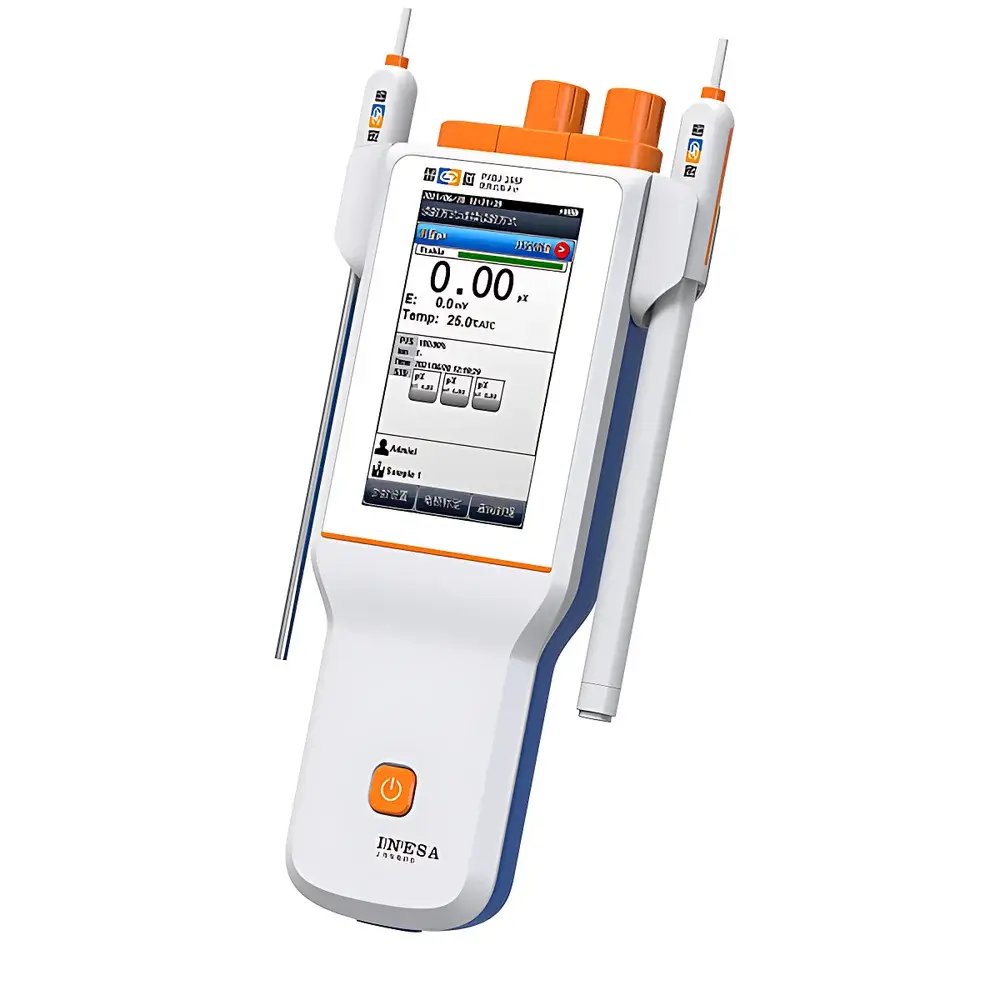
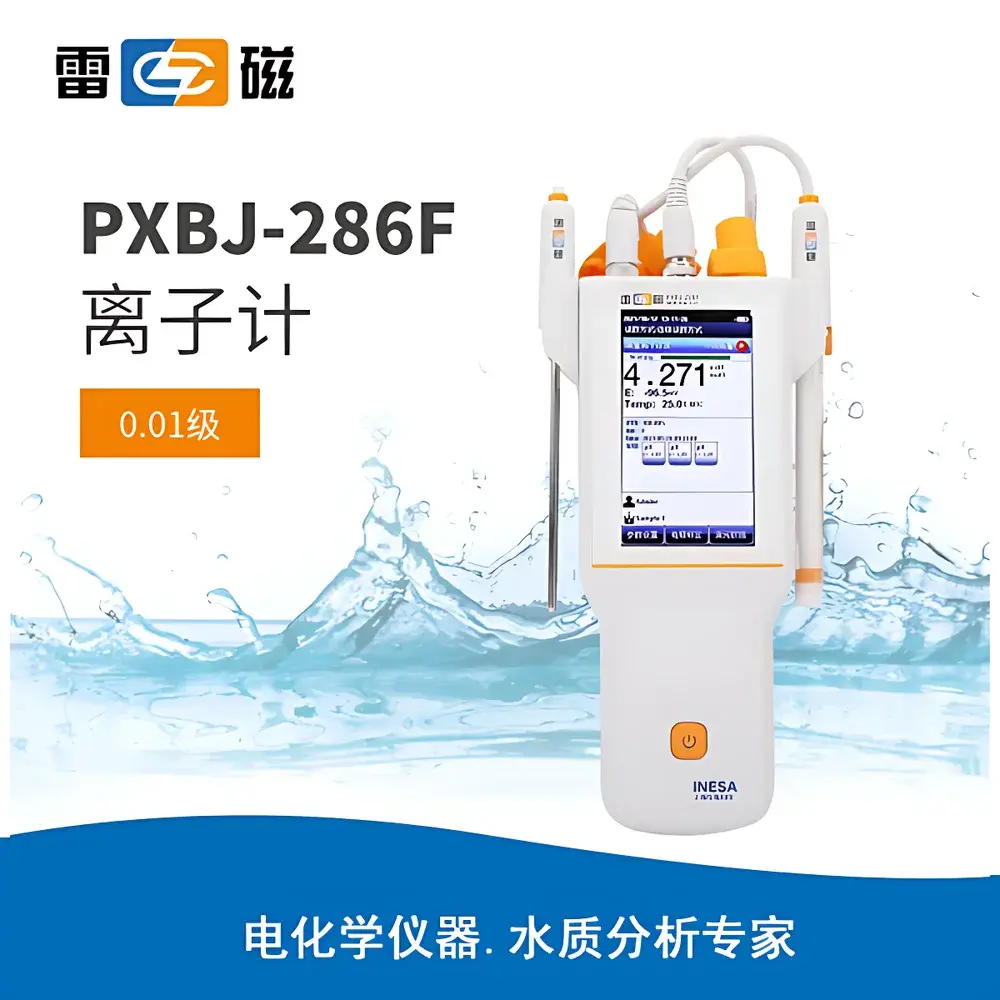
Leici PXBJ-286F Portable Ion Meter
| Brand | Leici |
|---|---|
| Origin | Shanghai, China |
| Manufacturer Type | Manufacturer |
| Origin Category | Domestic (China) |
| Model | PXBJ-286F |
| Price Range | USD 1–700 (est.) |
| Instrument Type | Portable |
| Ion Measurement Range | (−2.00 to 20.00) pX |
| Measurement Accuracy | ±0.01 pX |
| Temperature Range | (−5.0 to 110.0) °C / (23.0 to 230.0) °F |
| pH Range | (−2.00 to 20.00) pH |
| mV Range | (−2000.0 to 2000.0) mV |
| Temperature Resolution | 0.1 °C / 0.1 °F |
| IP Rating | IP65 |
| Battery | Rechargeable Li-ion |
| Dimensions | 90 × 255 × 40 mm |
| Weight | 0.5 kg |
Overview
The Leici PXBJ-286F Portable Ion Meter is a high-precision, field-deployable electrochemical analyzer engineered for quantitative determination of specific ion activities in aqueous solutions using potentiometric measurement principles. Based on the Nernst equation, the instrument measures the potential difference between an ion-selective electrode (ISE) and a reference electrode under controlled temperature conditions, converting the measured electromotive force (EMF) into pX (negative logarithm of ion activity) or concentration units. Designed for environmental monitoring, wastewater treatment, drinking water safety verification, and field-based hydrogeological surveys, the PXBJ-286F supports rigorous regulatory workflows while maintaining laboratory-grade accuracy in non-laboratory settings. Its compact form factor, robust mechanical architecture, and sealed electronics meet international requirements for mobile analytical instrumentation used in variable ambient conditions.
Key Features
- High-resolution 4.3-inch color TFT touchscreen with intuitive icon-driven interface supporting both English and Chinese languages
- Selectable resolution modes: 0.01 pX / 0.1 pX for ion activity; 0.1 mV / 1 mV for potential readings
- Configurable temperature units (°C or °F) and automatic/manual temperature compensation (ATC/MTT)
- IP65-rated enclosure ensuring dust-tightness and protection against low-pressure water jets — suitable for outdoor deployment and humid environments
- Integrated intelligent endpoint detection algorithm enabling auto-read, timed-read, interval-read, and manual sampling protocols
- Multi-point calibration support (1–5 points) for pH electrodes with automatic recognition of GB, DIN, and NIST standard buffer sets
- Built-in ion mode library covering Na⁺, K⁺, NH₄⁺, Cl⁻, F⁻, and customizable user-defined ion configurations
- Concentration unit flexibility: seamless switching among μg/L, mg/L, g/L, mol/L, mmol/L, and pX
- Advanced measurement methodologies including direct concentration mode, standard addition, sample addition, and Gran plot analysis
Sample Compatibility & Compliance
The PXBJ-286F is optimized for aqueous samples with total dissolved solids (TDS) ≤ 5000 mg/L and conductivity < 20 mS/cm. It accommodates standard ISEs (e.g., fluoride, chloride, ammonium) and combination electrodes with BNC or mini-DIN connectors. The included fluorine composite electrode and TISAB II buffer ensure reliable F⁻ quantification in compliance with EPA Method 300.0 and ISO 10304-1 for ion chromatography validation support. The instrument conforms to GLP data integrity standards: all measurements are timestamped, operator-ID tagged (where enabled), and stored with full audit trail metadata. Data files include electrode ID, calibration history, temperature logs, and measurement mode parameters — facilitating traceability per ISO/IEC 17025 and USP analytical instrument qualification guidelines.
Software & Data Management
The device stores up to 1000 complete measurement records locally, each containing raw EMF, compensated pX, temperature, electrode status, and calibration coefficients. Data can be reviewed numerically or graphically (e.g., time-series concentration trends, calibration curves). Export is supported via USB 2.0 to PC using Leici’s proprietary communication software (Windows-compatible), enabling CSV/Excel conversion and LIMS integration through configurable ASCII or HL7-compliant output templates. RS-232 serial output allows direct connection to certified thermal printers; print formats include minimal report, full calibration log, or GLP-compliant certificate-of-analysis layout. Firmware updates are performed over USB, preserving user-configured methods and calibration data during version upgrades.
Applications
- Field monitoring of fluoride in groundwater and drinking water supplies per WHO guideline values (1.5 mg/L)
- Wastewater effluent testing for chloride and ammonium ions prior to discharge compliance verification
- Soil leachate analysis in environmental site assessments (ESA) and brownfield remediation projects
- Educational laboratories requiring portable, multi-ion capability for undergraduate electrochemistry instruction
- Emergency response scenarios where rapid on-site assessment of toxic anions (e.g., CN⁻, NO₂⁻ with appropriate electrodes) is required
- Calibration verification of fixed online ISE sensors deployed in municipal water distribution networks
FAQ
What ion-selective electrodes are compatible with the PXBJ-286F?
The meter accepts any BNC- or mini-DIN–terminated ISE meeting standard potentiometric impedance specifications (≤ 10¹² Ω input impedance). Leici-supplied F⁻, Cl⁻, and NH₄⁺ electrodes are pre-validated; third-party electrodes require manual slope and offset verification.
Does the PXBJ-286F support FDA 21 CFR Part 11 compliance?
While the device itself does not implement electronic signatures or role-based access control, its audit-trail–enabled data export format and immutable timestamping align with Part 11 Annex A expectations when integrated into validated LIMS or ELN systems.
Can the instrument perform temperature-compensated measurements below 0 °C?
Yes — the calibrated operating range extends to −5.0 °C, provided the sample remains liquid and the electrode junction remains hydrated; use of antifreeze-compatible reference electrolytes is recommended for extended sub-zero operation.
Is the battery replaceable by the end user?
No — the lithium-ion battery is sealed within the housing and must be replaced only by authorized Leici service centers to maintain IP65 integrity and calibration stability.
How is calibration validity verified during field use?
The instrument logs calibration date, slope (%/decade), offset (mV), and R² value for each session; deviations beyond ±5% slope or >±15 mV offset trigger advisory alerts during subsequent measurements.







