
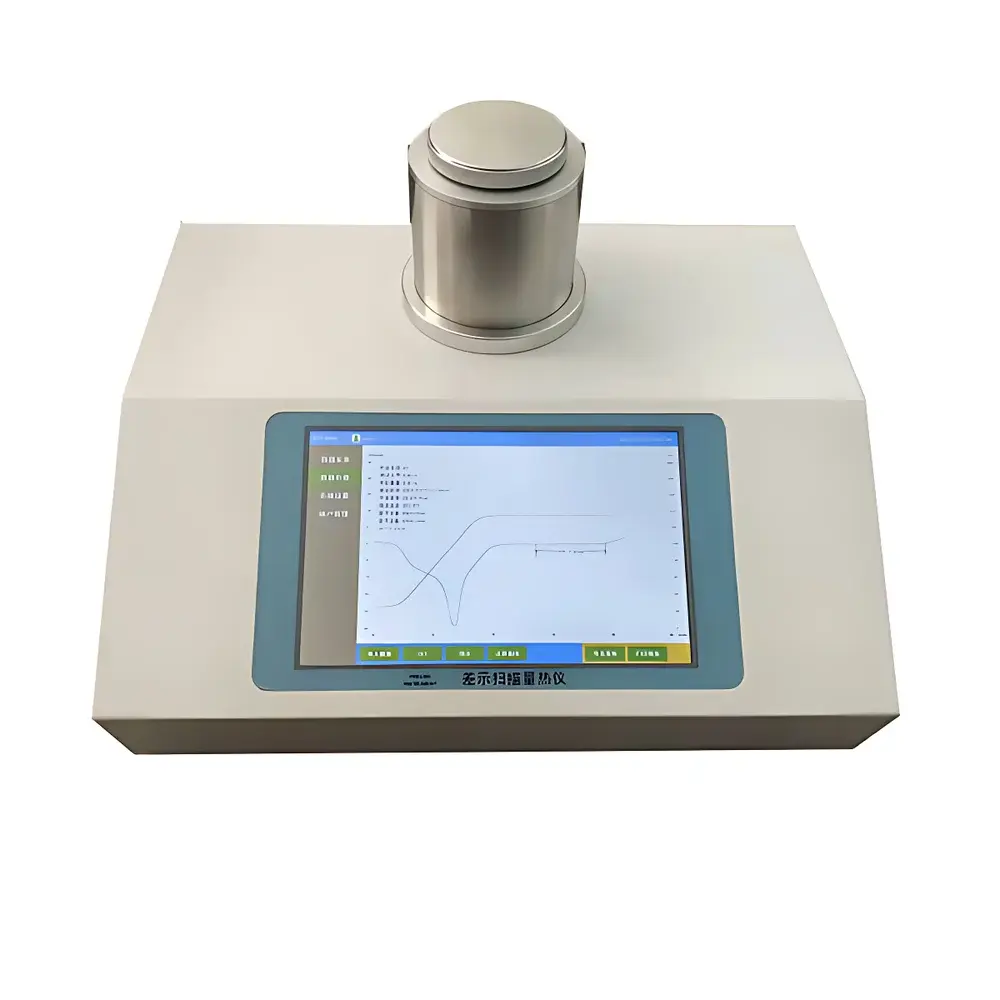
Zhonglu DSC-500ARD Digital Microcomputer-Controlled Differential Scanning Calorimeter
| Brand | Zhonglu |
|---|---|
| Origin | Shanghai, China |
| Manufacturer Type | Direct Manufacturer |
| Model | DSC-500ARD |
| Price | USD 4,200 (approx.) |
| Temperature Range | Ambient to 500 °C |
| Heating Rate | 0.1–80 °C/min |
| Temperature Repeatability | ±0.1 °C |
| Temperature Accuracy | ±0.1 °C |
| Sample Capacity | 1 |
| Temperature Resolution | 0.01 °C |
| DSC Signal Range | 0 to ±200 mW / 0 to ±500 mW |
| Atmosphere Control | Dual-gas automatic switching |
| Display | 10.1-inch 24-bit color industrial touchscreen PC |
| Data Interfaces | USB 2.0, RS-232 |
| Calibration Standards | Indium (In) and Tin (Sn), certified reference materials included |
| Compliance | ISO 11357, GB/T 19466, ASTM D3417 |
Overview
The Zhonglu DSC-500ARD is a high-precision, microcomputer-controlled differential scanning calorimeter engineered for quantitative thermal transition analysis of solid-phase organic and polymeric materials. Operating on the fundamental principle of heat flux DSC, the instrument measures the difference in heat flow between a sample and an inert reference (α-Al2O3) as both are subjected to a controlled, linear temperature program. This enables accurate determination of endothermic events—including melting onset (Tonset), peak melting temperature (Tpeak), and endset (Tend)—as well as enthalpy of fusion (ΔHfus). Designed for routine quality control and R&D laboratories, the DSC-500ARD integrates a compact, mechanically stabilized furnace with dual platinum resistance thermometers, eliminating adhesive-based mounting that may introduce thermal lag or signal drift. Its ambient-to-500 °C operational range and programmable heating rates from 0.1 to 80 °C/min support broad material characterization—from low-melting pharmaceuticals to high-temperature engineering thermoplastics.
Key Features
- Integrated 10.1-inch industrial-grade touchscreen PC with real-time plotting of heat flow vs. temperature curves, enabling immediate visual assessment of melting behavior and melt range.
- Dual high-stability Pt100 temperature sensors ensure measurement reproducibility within ±0.1 °C across repeated runs—critical for GLP-compliant batch release testing.
- Furnace assembly secured exclusively via mechanical fastening (no adhesives), eliminating contamination risks to differential thermal signals and improving long-term baseline stability.
- Automated calibration routine using supplied certified In (156.6 °C) and Sn (231.9 °C) standards; one-touch execution with auto-compensation for rate-dependent thermal lag.
- Three-tier user account system (Operator / Supervisor / Administrator) with timestamped audit trail for all method edits, calibration events, and data exports—fully aligned with FDA 21 CFR Part 11 requirements for electronic records.
- Programmable dual-gas atmosphere control (e.g., N2/O2 switching) to isolate oxidative effects during thermal decomposition or stabilize reactive samples.
- Native data export via USB flash drive (CSV, PNG, native .dsc binary) and optional RS-232 serial communication for integration into LIMS or centralized QC databases.
Sample Compatibility & Compliance
The DSC-500ARD accommodates standard 6.7 mm × 3 mm aluminum crucibles and accepts opaque, translucent, or highly pigmented samples—including polymer granules, crystalline APIs, food additives, dyes, and composite resins—without optical transmission constraints. Its hardware and firmware architecture comply with international thermal analysis standards: ISO 11357-1/3 (general principles and melting characterization), GB/T 19466.3 (Chinese national standard for DSC), and ASTM D3417 (standard test method for heat of fusion of poly(ethylene terephthalate)). All calibration procedures follow traceable reference material protocols, and the instrument supports full documentation of uncertainty budgets per ISO/IEC 17025 requirements for accredited testing laboratories.
Software & Data Management
Embedded firmware provides full-cycle thermal analysis workflow control: method definition (ramp/hold steps, gas selection, purge flow), real-time curve overlay, automated peak detection (onset, peak, endset), and enthalpy integration using baseline subtraction algorithms. Exported datasets include raw thermogram traces, processed results tables (Tonset, ΔHfus, width at half-height), and metadata (operator ID, calibration date, instrument serial). Optional Windows-based desktop software extends functionality with multi-curve comparison, kinetic modeling (e.g., Ozawa-Flynn-Wall), and PDF report generation with embedded digital signatures. All data files carry immutable timestamps and checksums to satisfy GMP audit readiness criteria.
Applications
- Pharmaceutical QC: Polymorph screening, purity assessment (van’t Hoff method), excipient compatibility studies, and stability-indicating assay development.
- Polymer manufacturing: Melt temperature verification of PE, PP, PET, and PA grades; crystallinity estimation; degradation onset detection under inert or oxidative atmospheres.
- Chemical synthesis: Reaction monitoring of esterification, condensation, or crosslinking; identification of eutectic mixtures in fine chemical intermediates.
- Food science: Fat crystallization profiling, cocoa butter polymorphism analysis, and starch gelatinization enthalpy quantification.
- Academic research: Thermodynamic parameter extraction for metal-organic frameworks (MOFs), phase-change materials (PCMs), and biodegradable polymer blends.
FAQ
Does the DSC-500ARD support modulated DSC (MDSC) or only conventional heat-flux DSC?
The DSC-500ARD operates exclusively in conventional (non-modulated) heat-flux DSC mode. It is optimized for high-reproducibility melting point and enthalpy measurements—not dynamic frequency-resolved thermal analysis.
Can I perform isothermal holds or multi-step temperature programs?
Yes. The instrument supports up to 10 programmable segments, including ramps, isothermal holds, and cooling steps—enabling complex protocols such as melt-recrystallization-remelt sequences.
Is the software validated for use in regulated environments (e.g., FDA-regulated facilities)?
While the embedded firmware includes audit trail, electronic signature, and role-based access controls compliant with 21 CFR Part 11 Annex 11, formal validation documentation (IQ/OQ/PQ protocols) must be performed by the end user or qualified third party per site-specific SOPs.
What maintenance is required for long-term accuracy?
Annual recalibration using certified In/Sn standards is recommended. Regular cleaning of the furnace cavity and sensor surfaces with lint-free swabs and isopropanol ensures optimal thermal contact and signal fidelity.
Are custom crucibles or high-pressure cells supported?
The system is designed for standard open/crimped Al crucibles. Sealed or high-pressure cells are not compatible due to mechanical and safety constraints of the fixed-furnace geometry.



