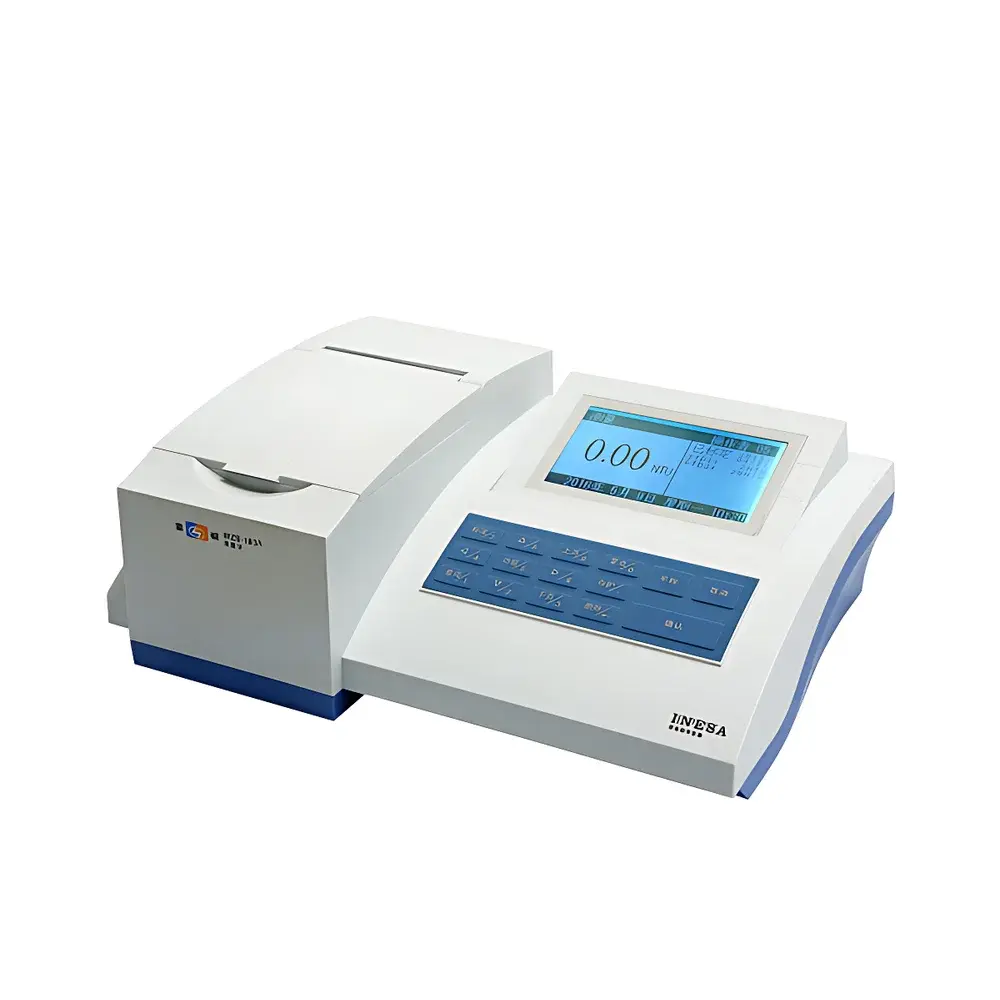
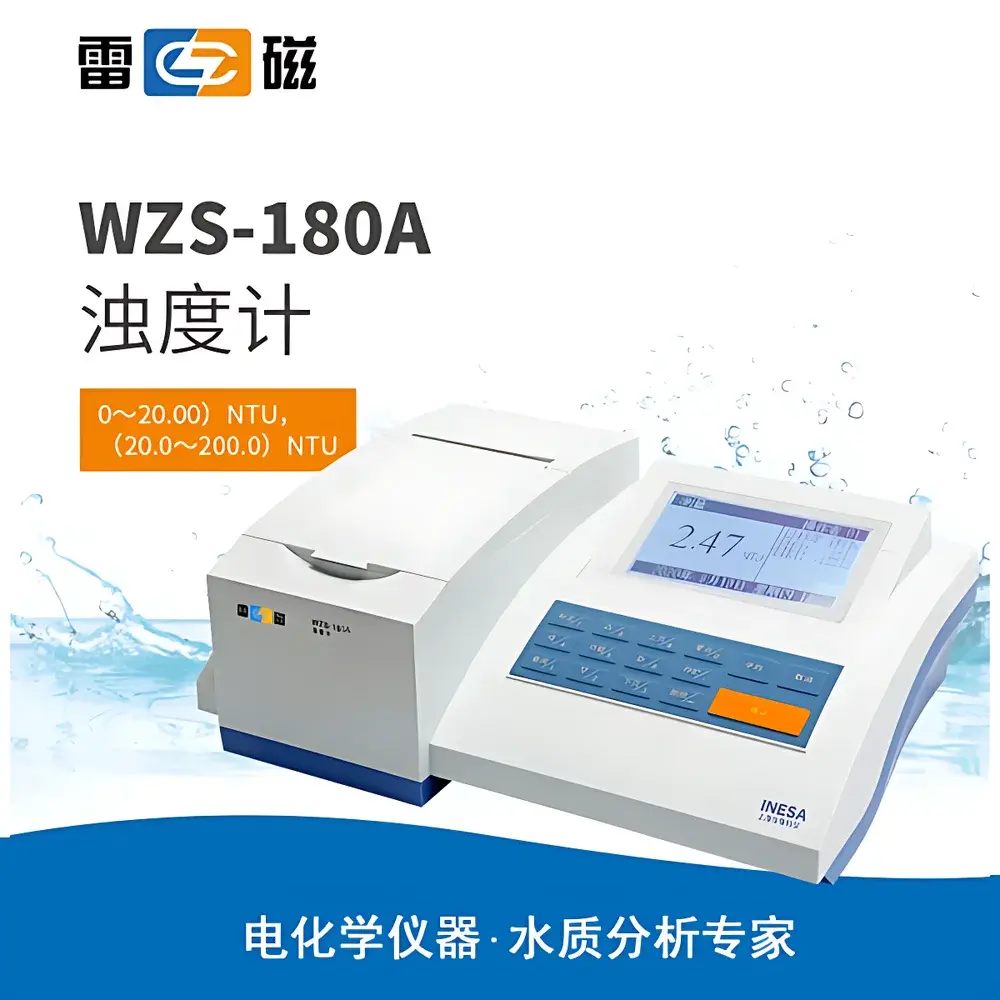
Leici WZS-180A Benchtop Turbidimeter
| Brand | Leici |
|---|---|
| Origin | Shanghai, China |
| Manufacturer Type | Direct Manufacturer |
| Regional Classification | Domestic (China) |
| Model | WZS-180A |
| Price Range | USD 1–720 (FOB) |
| Form Factor | Benchtop / Laboratory |
| Measurement Ranges | (0.00–20.00) NTU, (20.0–200.0) NTU, (200–1000) NTU |
| Resolution | 0.01 NTU (low range), 0.1 NTU (mid range), 1 NTU (high range) |
| Accuracy | ±8% FS |
| Repeatability | ≤1.0% |
| Zero Drift | ±1.0% FS / 30 min |
| Stability | ±0.5% FS / 30 min |
| Light Source | 860 nm Infrared LED, compliant with ISO 7027 and HJ 1075 |
| Calibration Options | Zero-point correction + up to 3-point calibration (2, 20, 200 NTU) |
| Display | Monochrome LCD |
| Power Supply | AC 220 V ±10%, 50 Hz ±1 Hz |
| IP Rating | IP65 |
| Dimensions (L×W×H) | 330 × 250 × 130 mm |
| Weight | ~2.5 kg |
| Standard Accessories | Certified 400 NTU turbidity standard solution, calibrated turbidity vials |
Overview
The Leici WZS-180A Benchtop Turbidimeter is an ISO 7027-compliant optical instrument engineered for precise, traceable turbidity measurement in environmental monitoring, drinking water treatment, wastewater laboratories, and quality control environments. It operates on the principle of 90° infrared light scattering, utilizing a stable 860 nm LED source to minimize interference from sample coloration and reduce spectral sensitivity to particulate composition. This wavelength selection aligns with international metrological requirements for standardized turbidity assessment, ensuring compatibility with regulatory reporting frameworks including China’s HJ 1075–2019 and global ISO 7027:2016 protocols. The instrument features automatic range switching across three decades—0.00–20.00 NTU, 20.0–200.0 NTU, and 200–1000 NTU—enabling seamless transition between low-turbidity potable water analysis and high-turbidity industrial effluent characterization without manual gain adjustment.
Key Features
- Triple-range auto-ranging detection system with dynamic gain optimization for consistent signal-to-noise ratio across all turbidity levels
- 860 nm infrared LED light source with certified spectral output and long-term intensity stability (>10,000 hours MTBF)
- Monochrome LCD display with high-contrast, wide-view-angle rendering for clear readability under laboratory lighting conditions
- IP65-rated enclosure providing dust-tight construction and protection against low-pressure water jets—suitable for humid or splash-prone lab environments
- Zero-point drift compensation algorithm with real-time baseline tracking over 30-minute intervals (±1.0% FS/30 min)
- Integrated power-loss memory retention: retains calibration coefficients, measurement history, and user settings after unexpected shutdown
- Three-point calibration capability (2, 20, and 200 NTU) using NIST-traceable standards, supporting both single-point verification and multi-point linearity validation
Sample Compatibility & Compliance
The WZS-180A accepts standard 25-mm round glass turbidity vials (included) and supports routine analysis of aqueous samples including raw surface water, clarified drinking water, membrane filtrate, activated sludge supernatants, and pharmaceutical process rinse waters. Its optical path design minimizes wall-scatter artifacts and accommodates samples with moderate absorbance (up to 0.5 AU at 860 nm). The instrument complies with ISO 7027:2016 (turbidimetry using infrared scatter), HJ 1075–2019 (Chinese EPA method for water quality—turbidity determination), and supports documentation practices aligned with GLP and ISO/IEC 17025 requirements. While not inherently 21 CFR Part 11 compliant, audit-ready calibration logs and timestamped measurement records can be exported manually for internal QA review and regulatory submission preparation.
Software & Data Management
The WZS-180A operates as a standalone, embedded-system instrument with no external PC dependency. All calibration data—including zero offset, span factors, and multi-point response curves—are stored in non-volatile memory with write-protection logic. Measurement results include date/time stamps, range identifier, and operator-defined sample IDs. Data export is supported via optional RS-232 interface (not included by default), enabling integration with LIMS or custom data acquisition software using ASCII-based command-response protocol. Internal storage retains up to 200 measurement records with cyclic overwrite; users may manually clear memory prior to critical batch testing to ensure data integrity and chain-of-custody clarity.
Applications
- Drinking water utilities: compliance monitoring per GB 5749–2022 (Sanitary Standard for Drinking Water)
- Environmental labs: surface water quality assessment under national monitoring programs (e.g., China’s National Surface Water Quality Assessment Scheme)
- Wastewater treatment plants: clarifier performance evaluation, filter backwash optimization, and effluent discharge verification
- Pharmaceutical manufacturing: rinse water clarity checks during equipment cleaning validation (per USP particulate matter guidance)
- Educational institutions: undergraduate analytical chemistry and environmental engineering laboratory instruction on optical sensing principles
FAQ
What turbidity standards are compatible with the WZS-180A?
The instrument is calibrated using formazin-based or equivalent polymer standards traceable to NIST SRM 2134 series. The included 400 NTU standard is certified per HJ 1075–2019 and suitable for mid- to high-range verification.
Can the WZS-180A measure samples with strong coloration?
Yes—the 860 nm infrared source significantly reduces chromatic interference compared to visible-light turbidimeters, making it appropriate for mildly colored samples such as peat-stained river water or certain industrial process streams.
Is temperature compensation built-in?
No. The WZS-180A does not include automatic temperature compensation; users must equilibrate samples to 20–25 °C prior to measurement in accordance with ISO 7027 procedural recommendations.
How often should zero-point calibration be performed?
Zero calibration is recommended before each measurement session and after any significant ambient temperature shift (>5 °C) or optical path cleaning event.
Does the device support GLP-compliant record keeping?
While lacking electronic signature or audit trail functionality, its timestamped internal log and persistent calibration memory meet minimum GLP documentation expectations when paired with controlled lab notebooks and SOP-defined operating procedures.