
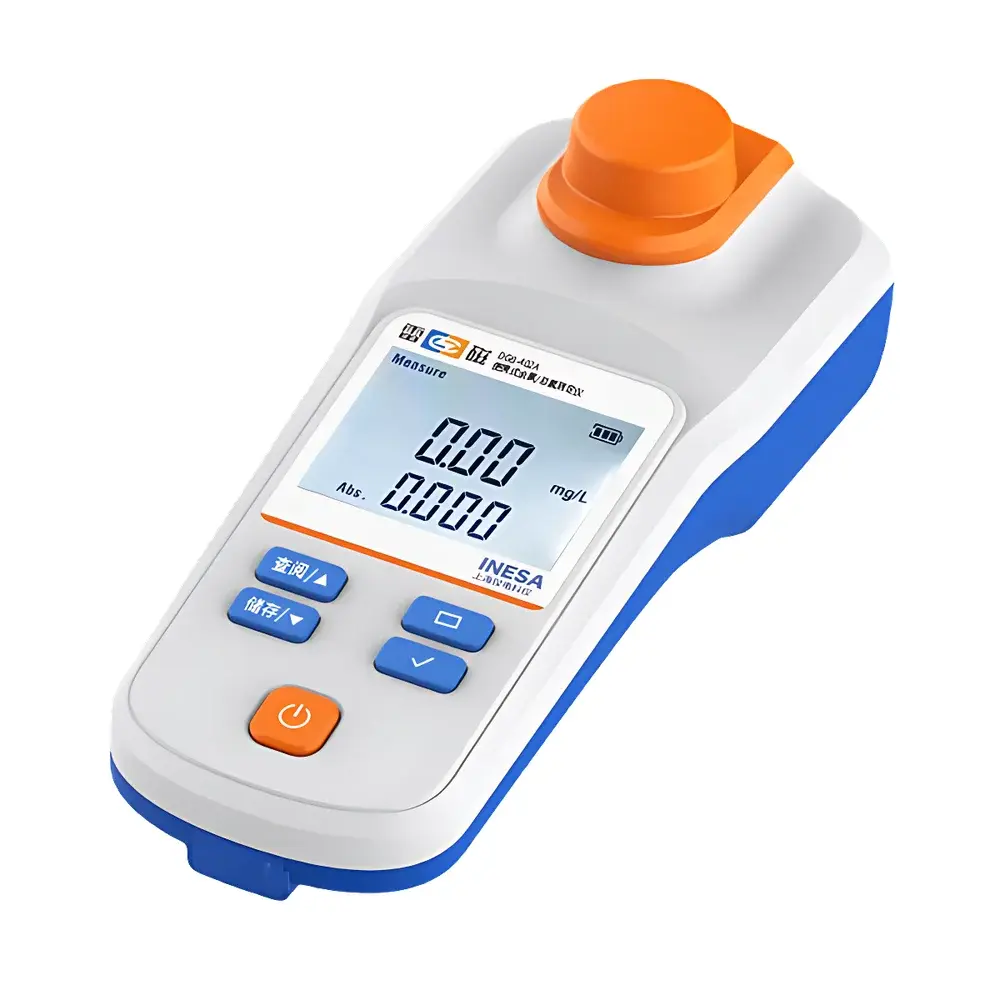
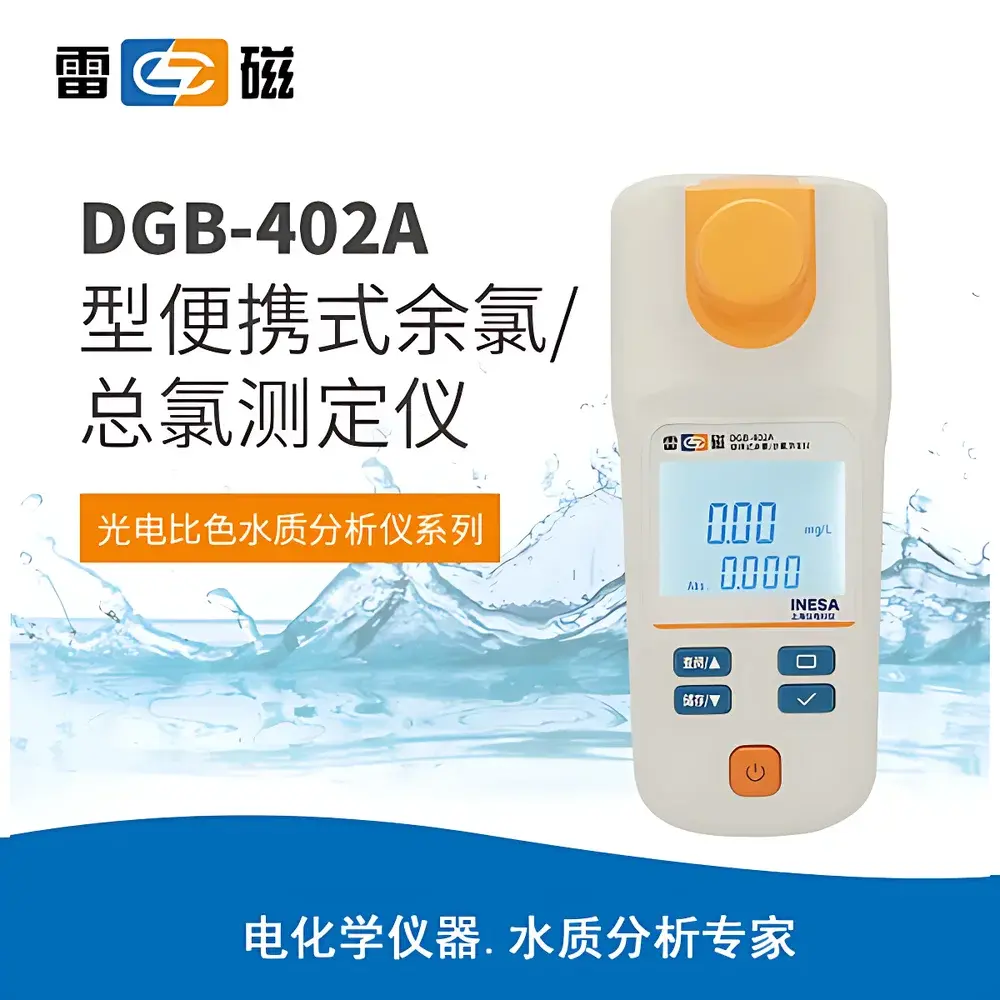
Leici DGB-402A Portable Residual and Total Chlorine Analyzer
| Brand | Leici |
|---|---|
| Origin | Shanghai, China |
| Manufacturer Type | Direct Manufacturer |
| Regional Classification | Domestic (China) |
| Model | DGB-402A |
| Instrument Type | Portable |
| Measurement Principle | DPD Colorimetric Spectrophotometry (515 nm LED) |
| Measured Parameters | Residual Chlorine, Total Chlorine |
| Range | (0.02–3.00) mg/L |
| Accuracy | ±3% or ±0.02 mg/L |
| Repeatability | ≤1% RSD |
| Resolution | 0.01 mg/L (concentration), 0.001 ABS (absorbance) |
| LOD | ≤0.02 mg/L |
| Light Source | Long-life 515 nm LED |
| Calibration | Single-point calibration with built-in standard curves and user-defined calibration support |
| Data Storage | 200 measurement records with review/delete functions |
| Power Supply | Rechargeable Li-ion battery |
| Dimensions & Weight | 80 × 200 × 75 mm, 0.4 kg |
| Enclosure Rating | IP65 |
| Accessories Included | DPD reagent kits for residual/total chlorine, portable protective carrying case, USB cable, AC adapter, and calibration standards |
Overview
The Leici DGB-402A Portable Residual and Total Chlorine Analyzer is a field-deployable, benchtop-grade colorimetric instrument engineered for rapid, reliable quantification of free residual chlorine and total chlorine in drinking water, wastewater effluent, swimming pools, cooling towers, and disinfection validation processes. It operates on the standardized N,N-diethyl-p-phenylenediamine (DPD) method—recognized by ISO 7393-2, APHA Standard Methods 4500-Cl G, and EPA Method 334.0—where chlorine species oxidize DPD to form a stable pink-colored quinoneimine dye, proportional to concentration. Absorbance is measured at 515 nm using a precision-stabilized LED photometer, eliminating drift associated with tungsten lamps and enabling consistent performance across ambient temperature fluctuations (10–40 °C operational range). The analyzer’s optical architecture features fixed-wavelength detection, optimized pathlength (25 mm cuvette), and temperature-compensated signal processing to maintain metrological integrity without requiring frequent recalibration.
Key Features
- High-contrast backlit LCD display with adjustable brightness for outdoor and low-light operation
- Stable 515 nm LED light source with >100,000-hour lifetime and <0.5 nm spectral bandwidth
- Built-in method library pre-programmed for residual chlorine (free Cl₂) and total chlorine (Cl₂ + chloramines)
- Integrated calibration management: supports factory-loaded reference curves and one-point user calibration using certified standards
- IP65-rated enclosure ensures dust-tight and low-pressure water jet resistance—suitable for humid or splash-prone environments
- Rechargeable lithium-ion battery providing up to 12 hours of continuous operation; supports USB-C charging from power banks or lab adapters
- Real-time battery level indicator and charging status feedback via icon-based UI
- On-device data handling: store, recall, sort, and delete up to 200 measurement records with timestamp, sample ID, and operator tag fields
Sample Compatibility & Compliance
The DGB-402A accepts standard 25 mm round glass or disposable plastic cuvettes, compatible with commercially available DPD reagents (including EPA-compliant kits). It meets functional requirements outlined in ISO/IEC 17025 for field instrumentation used in accredited environmental testing laboratories. While not a GLP/GMP-certified system per se, its audit-ready data logging (with immutable timestamps and no post-hoc editing capability) aligns with routine QA/QC protocols under US EPA Safe Drinking Water Act (SDWA) monitoring frameworks. The instrument’s ±3% accuracy and ≤0.02 mg/L LOD satisfy Class II analytical sensitivity thresholds defined in WHO Guidelines for Drinking-water Quality (4th ed.) and EU Directive 98/83/EC for routine distribution system surveillance.
Software & Data Management
Data export is performed via micro-USB interface using Leici’s proprietary PC utility software (Windows-compatible), which enables CSV export, report generation (PDF/Excel), and batch traceability logs. Each stored record includes measurement date/time, operator ID (manually entered), parameter type (residual or total), raw absorbance, calculated concentration, and calibration status flag. The software enforces write-once data integrity—records cannot be altered post-acquisition—and maintains an internal event log tracking power cycles, calibration events, and firmware updates. No cloud connectivity or remote access functionality is implemented, preserving data sovereignty and simplifying regulatory compliance in controlled environments.
Applications
- Routine verification of chlorine residuals at water treatment plant exit points and distribution network sampling stations
- Swimming pool and spa facility compliance checks per CDC Model Aquatic Health Code (MAHC) requirements
- Validation of chlorine contact time (CT) calculations during disinfection process optimization
- Field audits of point-of-use (POU) and point-of-entry (POE) disinfection systems
- Educational use in environmental engineering labs for method validation and inter-laboratory comparison exercises
- Emergency response deployments following natural disasters or infrastructure failures where rapid chlorine decay assessment is critical
FAQ
Does the DGB-402A comply with US EPA Method 334.0?
Yes—the instrument implements the DPD colorimetric procedure as described in EPA Method 334.0, including specified reagent concentrations, reaction timing (2 min for residual, 5 min for total), and 515 nm photometric detection.
Can I use third-party DPD reagents with this analyzer?
Yes, provided they conform to APHA-recommended formulations and are supplied in stable, light-protected formats; however, Leici-supplied reagent kits are pre-validated for optimal linearity and LOD performance.
Is firmware upgrade supported in the field?
Yes—firmware updates are delivered via USB and require Leici-provided update files; no internet connection is needed during installation.
What is the recommended maintenance schedule?
Optical path cleaning every 3 months using lens-grade tissue and isopropyl alcohol; annual verification against NIST-traceable chlorine standards is advised for regulated applications.
Does the device support GLP audit trails?
It provides timestamped, non-editable measurement records and calibration logs—but lacks electronic signature or multi-user role-based access control required for full 21 CFR Part 11 compliance.







