
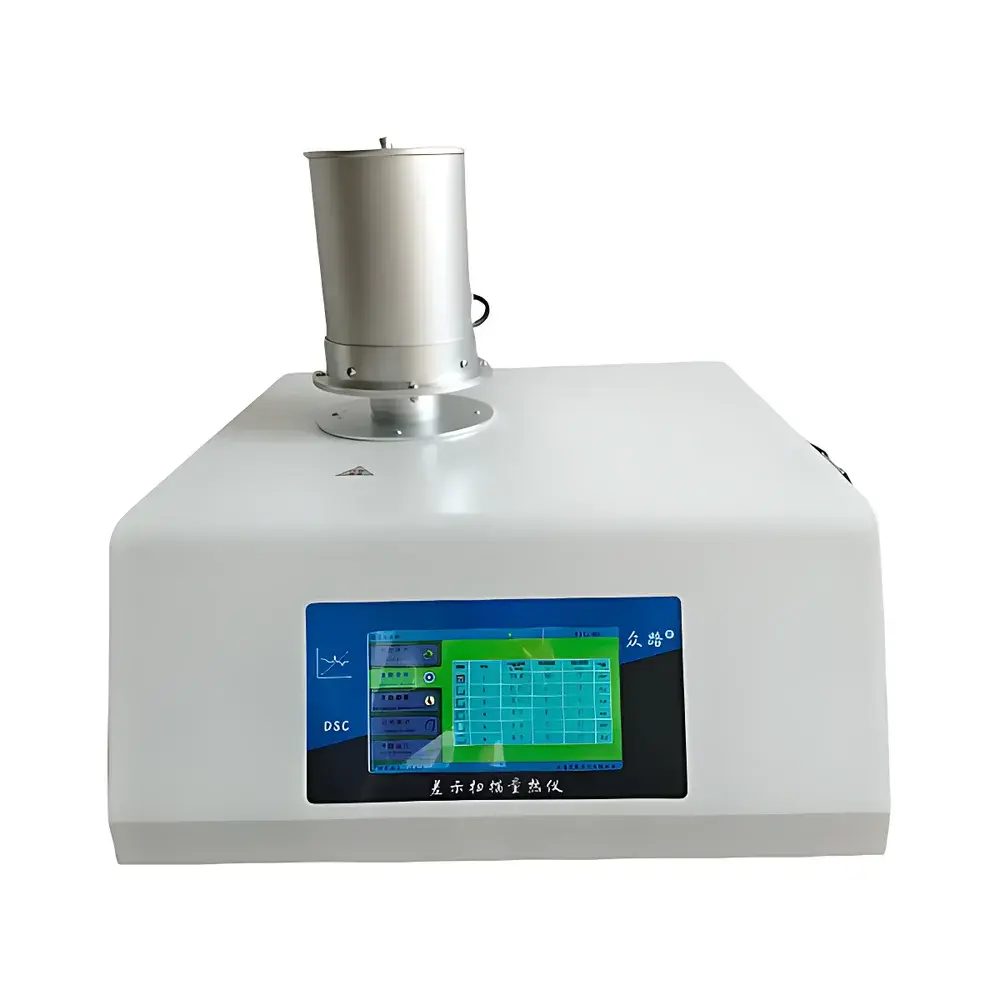
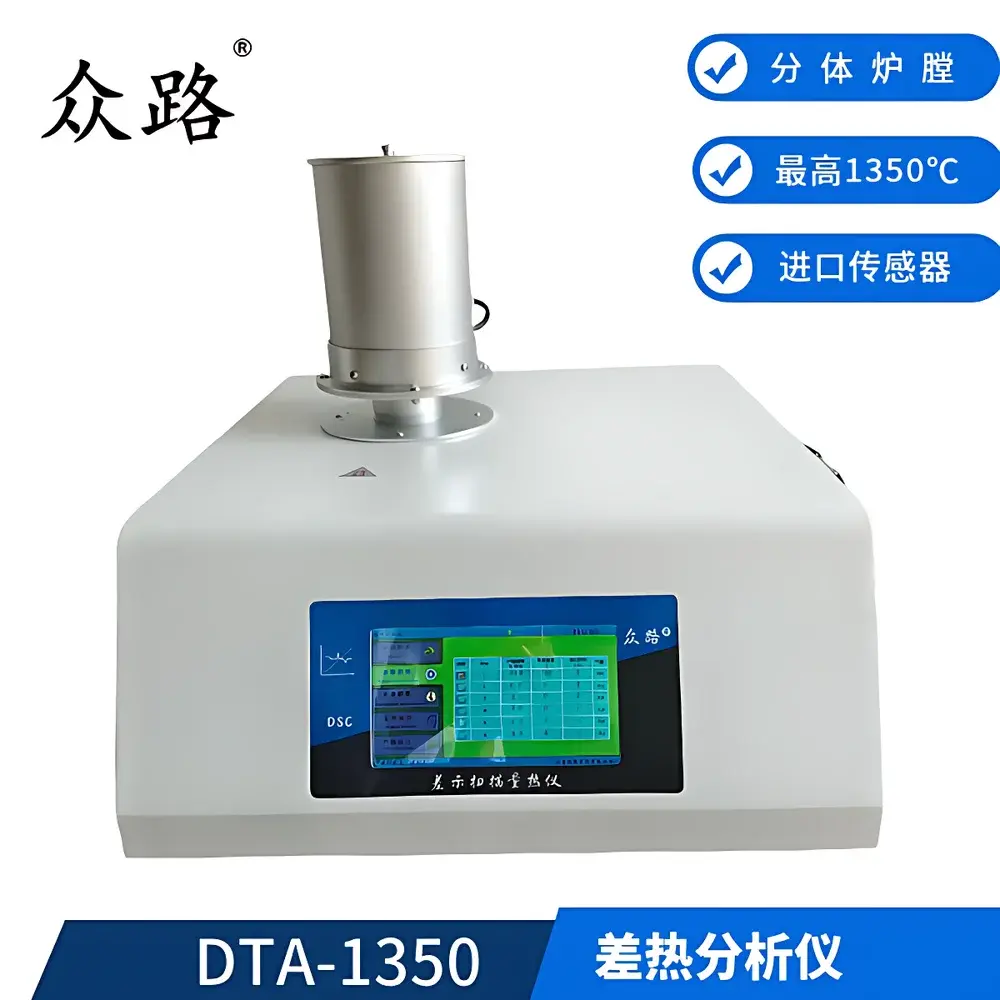
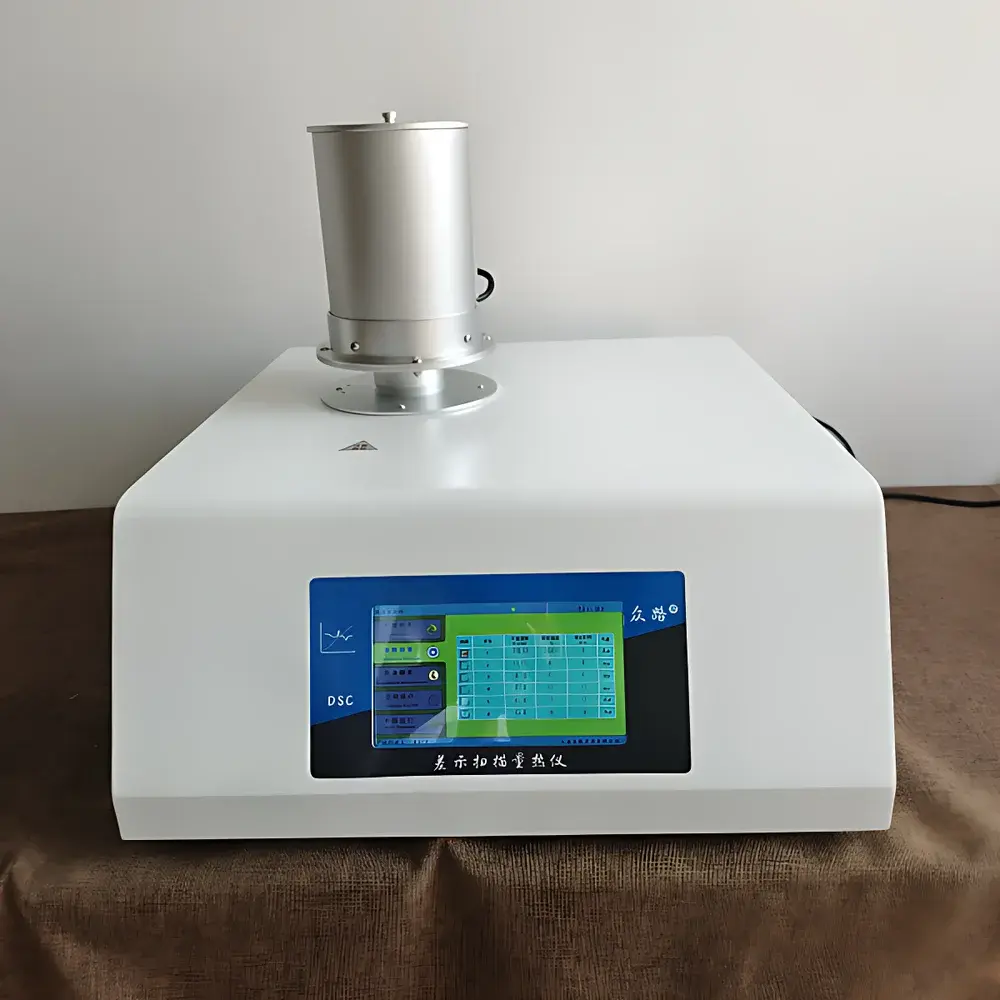
Zhonglu DTA-1350 Inorganic Melting Point Analyzer
| Brand | Zhonglu |
|---|---|
| Origin | Shanghai, China |
| Manufacturer Type | Direct Manufacturer |
| Instrument Type | Differential Thermal Analysis (DTA) |
| Model | DTA-1350 |
| Temperature Range | RT to 1350 °C |
| Temperature Accuracy | ±0.1 °C |
| Temperature Precision | ±0.1 °C |
| Temperature Stability | ±0.1 °C |
| Heating/Cooling Rate | 0.1–100 K/min |
| DTA Signal Range | 0–±2000 µV |
| DTA Sensitivity | 0.01 µV |
| Temperature Resolution | 0.01 °C |
| Control Method | PID-based Programmable Temperature Control |
| Data Interface | USB 2.0 |
| Display | 7-inch 24-bit color capacitive touchscreen |
| Sensor Material | Corrosion- and oxidation-resistant alloy |
| Atmosphere Control | Automated internal gas switching |
| Calibration Standard | Certified Sn reference material included |
| Compliance | ASTM E794, ISO 11357-1, GB/T 19466.1–2004 |
Overview
The Zhonglu DTA-1350 Inorganic Melting Point Analyzer is a high-stability differential thermal analysis (DTA) instrument engineered for precise detection of endothermic and exothermic transitions in inorganic materials under controlled temperature programs. Operating on the fundamental principle of DTA—measuring the temperature difference (ΔT) between a sample and an inert reference material as both are subjected to identical heating or cooling profiles—the system delivers quantitative thermal event data critical for phase identification, melting point determination, decomposition onset, polymorphic transition analysis, and thermal stability assessment. Designed specifically for inorganic compounds—including metal oxides, ceramics, refractories, slag systems, phosphate glasses, and high-melting-point salts—the DTA-1350 maintains rigorous thermal fidelity across its full operating range (room temperature to 1350 °C), making it suitable for R&D laboratories, quality control departments in metallurgical and refractory manufacturing, and academic research groups focused on solid-state chemistry and materials thermodynamics.
Key Features
- Upward-opening furnace architecture: Eliminates vertical lift mechanisms, improving thermal symmetry, reducing mechanical drift, and enhancing long-term baseline stability.
- Dual-control operation: Fully functional via embedded 7-inch 24-bit color capacitive touchscreen or external PC software—enabling seamless method setup, real-time monitoring, and post-run analysis.
- Advanced thermal management: PID-controlled programmable temperature ramping with user-defined multi-segment profiles, including isothermal holds up to 999 minutes and reversible heating/cooling cycles.
- Digital mass flow control: Integrated digital gas flowmeter enables precise, logged regulation of purge gases (N₂, Ar, O₂, or synthetic air) with automated switching between atmospheres per test protocol.
- High-fidelity signal acquisition: Low-noise, corrosion-resistant alloy thermocouple sensors coupled with 24-bit analog-to-digital conversion ensure DTA sensitivity down to 0.01 µV and signal linearity across the full ±2000 µV range.
- Onboard calibration suite: Includes certified pure tin reference standard (melting point 231.928 °C) and one-click auto-calibration routine compliant with ISO 11357-1 traceability requirements.
- Robust embedded controller: ARM Cortex-M3 microcontroller provides deterministic real-time thermal regulation, fast USB 2.0 bidirectional communication, and secure firmware update capability.
Sample Compatibility & Compliance
The DTA-1350 accommodates standard crucible formats—including aluminum (for low-temperature screening), high-purity alumina, and silicon carbide crucibles—supporting sample masses from 1 mg to 100 mg depending on thermal inertia and reaction enthalpy. Its optimized furnace geometry ensures uniform heat distribution and minimal radial thermal gradients, critical for reproducible detection of subtle transitions such as solid–solid polymorphic shifts or incongruent melting events. The instrument complies with key international standards for thermal analysis instrumentation and data reporting, including ASTM E794 (Standard Test Method for Melting Points of Materials by Thermal Analysis), ISO 11357-1 (Plastics — Differential Scanning Calorimetry — Part 1: General Principles), and GB/T 19466.1–2004 (Chinese national standard equivalent). All thermal data files include embedded metadata (time stamps, operator ID, instrument serial number, calibration status) to support GLP/GMP audit readiness and FDA 21 CFR Part 11–compliant electronic record workflows when used with validated software configurations.
Software & Data Management
The included Windows-compatible analysis software provides full instrument control, real-time ΔT vs. T and ΔT vs. t visualization, peak integration with baseline correction (slope and intercept adjustment), derivative thermogram generation (dT/dt), and customizable report templates. Raw data is saved in ASCII-delimited format (.txt) and proprietary binary (.dtf) files, both fully exportable to third-party platforms (OriginLab, MATLAB, Excel) without proprietary codec dependencies. The software supports multi-curve overlay, kinetic analysis (Ozawa-Flynn-Wall method), and comparative analysis against reference libraries. Audit trail functionality logs all method modifications, calibration actions, and data export events with time/date stamps and user authentication—meeting essential requirements for regulated environments requiring documented data integrity.
Applications
- Determination of melting onset, peak, and offset temperatures for inorganic salts, eutectics, and composite ceramics.
- Identification and quantification of polymorphic transitions (e.g., α→β quartz, anatase→rutile TiO₂).
- Analysis of thermal decomposition pathways in carbonates, hydroxides, nitrates, and sulfates.
- Evaluation of oxidation induction time (OIT) and thermal oxidative stability in refractory matrix systems.
- Characterization of glass transition behavior in borosilicate and aluminosilicate glasses.
- Support for ASTM C1039 (Standard Test Method for Thermal Conductivity of Refractories) and ISO 22007-4 (Thermal conductivity of plastics and elastomers) preparatory thermal profiling.
- Quality assurance in production of catalyst supports, battery cathode precursors, and nuclear fuel matrix materials.
FAQ
What types of inorganic samples are compatible with the DTA-1350?
The system is optimized for non-volatile, thermally stable inorganic solids—including oxides, silicates, phosphates, halides, and intermetallics—with recommended crucible selection based on chemical compatibility and maximum service temperature.
Can the DTA-1350 perform simultaneous DTA-TG measurements?
No—the DTA-1350 is a dedicated differential thermal analyzer. For combined DTA-TG capability, please refer to our ZL-TGA-DTA series instruments.
Is the instrument compliant with FDA 21 CFR Part 11 requirements?
The hardware and firmware meet foundational technical controls; full Part 11 compliance requires implementation of validated software, electronic signatures, and procedural SOPs within the user’s quality management system.
How often does the system require recalibration?
Annual calibration using certified reference materials (e.g., Sn, Zn, Al) is recommended; however, daily verification with Sn standard is advised before critical measurements.
Does the DTA-1350 support custom atmosphere programming?
Yes—gas type, flow rate, and switching timing can be defined per segment within multi-step temperature programs via the software interface.
Related Products



