
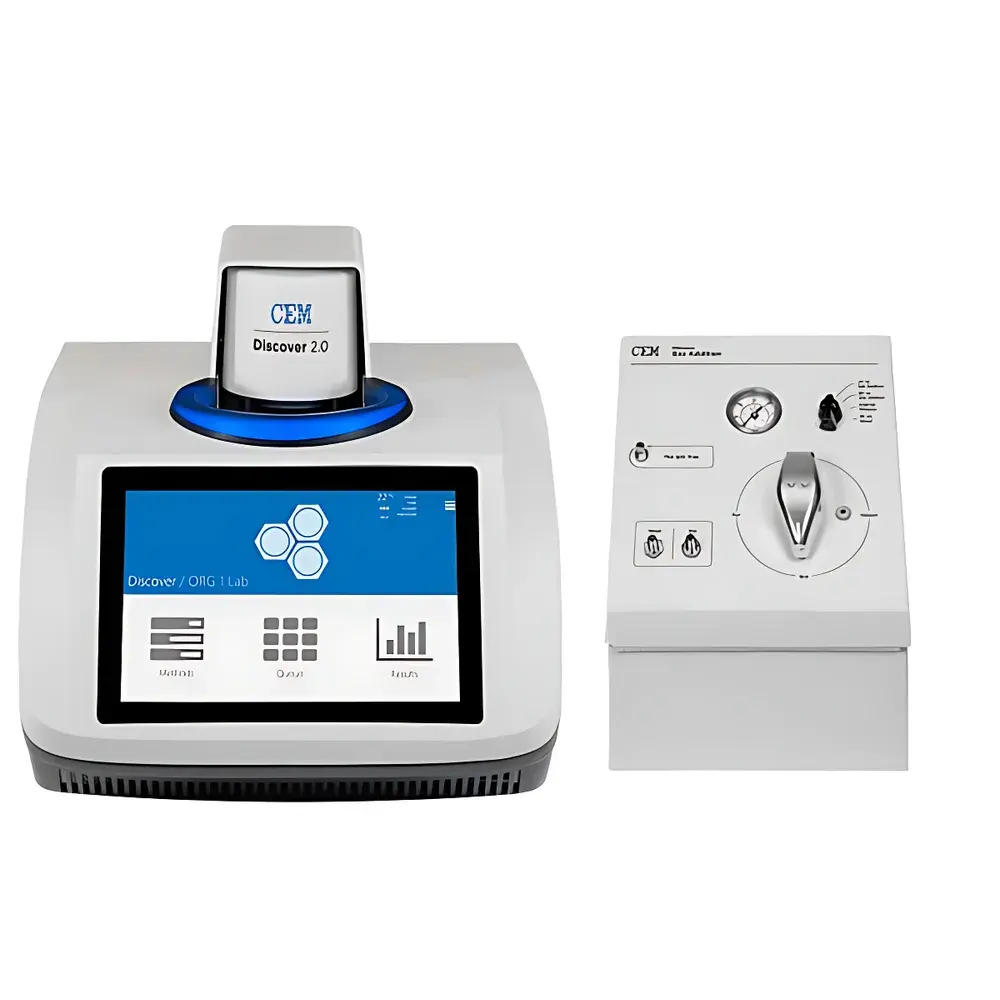
CEM DISCOVER 2.0 Gas-Phase Microwave Synthesis System
| Brand | CEM |
|---|---|
| Origin | USA |
| Model | DISCOVER 2.0 |
| Temperature Range | Up to 200 °C |
| Pressure Range | Up to 200 psi (13.8 bar) |
| Microwave Power | 900 W |
| Magnetron Frequency | 2450 MHz |
| Stirring Method | Electromagnetic Stirring |
| Reaction Vessel Capacity | 10 mL |
| Gas Compatibility | H₂, O₂, CO₂, CO, N₂, Ar (non-corrosive only) |
| Temperature Monitoring | Fiber-Optic Probe |
| Pressure Monitoring & Control | Real-time digital pressure sensor with vacuum purge and vent capability |
| Gas Dosing | Programmable mass-flow-controlled gas introduction |
| System Integration | Fully compatible with CEM DISCOVER modular platform |
Overview
The CEM DISCOVER 2.0 Gas-Phase Microwave Synthesis System is an engineered single-mode microwave reactor designed for precise, reproducible, and safe execution of gas-involved synthetic transformations under controlled thermal and pressure conditions. Unlike conventional multimode reactors, the DISCOVER 2.0 employs a focused, high-field-strength single-mode cavity that delivers spatially uniform microwave energy directly into the reaction zone—enabling rapid, volumetric heating of small-volume samples (2–10 mL) with exceptional thermal accuracy and kinetic control. This architecture supports gas-phase reactions—including hydrogenation, carbonylation, hydroformylation, and oxidative coupling—without requiring external high-pressure autoclaves or oil-bath heating. The system operates within a validated envelope of 200 °C and 200 psi, with real-time fiber-optic temperature measurement and digital pressure feedback, ensuring strict adherence to thermodynamic and kinetic boundary conditions essential for mechanistic studies and scalable process development.
Key Features
- Single-mode microwave cavity optimized for field homogeneity and energy coupling efficiency in low-volume (<10 mL) sealed-vessel reactions
- Integrated gas-handling module supporting programmable, mass-flow-regulated introduction of non-corrosive gases (H₂, O₂, CO₂, CO, N₂, Ar)
- Fiber-optic temperature probe enabling non-metallic, intravessel thermal monitoring with ±0.5 °C accuracy and sub-second response time
- Digital pressure transducer with active vacuum purge, inert gas blanketing, and controlled venting—fully traceable and logged
- Electromagnetic stirring mechanism ensuring homogeneous mixing without mechanical shaft penetration or seal degradation
- Modular design compliant with CEM DISCOVER platform standards—interoperable with automated liquid handling, cooling, and spectroscopic add-ons
- Embedded safety interlocks including overtemperature cutoff, overpressure rupture disc, and microwave leakage monitoring per IEC 61000-3-2
Sample Compatibility & Compliance
The DISCOVER 2.0 accommodates standard 10 mL quartz or reinforced PTFE-lined reaction vessels rated for 200 psi at 200 °C. Vessel geometry is optimized for single-mode resonance, minimizing standing-wave artifacts and hot-spot formation. All gas pathways utilize electropolished 316 stainless steel tubing with VCR fittings and helium-leak-tested joints. The system conforms to ASTM E2877-22 (Standard Guide for Microwave-Assisted Chemical Synthesis), ISO/IEC 17025:2017 (for method validation in accredited labs), and supports GLP/GMP documentation requirements via audit-trail-enabled software logging. It meets FDA 21 CFR Part 11 criteria for electronic records and signatures when operated with validated firmware and networked data archiving.
Software & Data Management
The intuitive TouchControl™ interface provides full parameter scripting—including ramp-hold profiles, multi-step gas dosing sequences, and conditional logic triggers (e.g., “inject H₂ upon reaching 80 °C”). All temperature, pressure, microwave power, and gas flow data are acquired at 10 Hz and stored in timestamped, encrypted .csv and .xml formats. Raw datasets include metadata on vessel ID, operator login, calibration status, and hardware revision. Exported files are compatible with MATLAB, Python (pandas), and industry-standard LIMS platforms. Optional IQ/OQ/PQ documentation packages support installation and operational qualification per GAMP 5 guidelines.
Applications
- Catalytic hydrogenation of unsaturated substrates (alkenes, alkynes, nitroarenes) under mild conditions (≤50 psi H₂, 10 min, quantitative yield)
- CO-mediated carbonylation and hydrocarboxylation in pharmaceutical intermediate synthesis
- Oxidative C–H activation using O₂ or air as terminal oxidant—eliminating stoichiometric metal oxides
- Gas-liquid phase transfer catalysis with immobilized Pd/C or Ru-phosphine complexes
- High-throughput screening of gas-dependent reaction kinetics for catalyst structure–activity relationship (SAR) modeling
- Development of continuous-flow hybrid protocols where DISCOVER 2.0 serves as a high-fidelity batch optimization engine
FAQ
Can the DISCOVER 2.0 handle corrosive gases such as HCl or Cl₂?
No. The gas-handling module is certified only for non-corrosive, non-oxidizing gases per ASME B31.3 process piping standards. Corrosive or highly reactive gases require custom engineering and third-party hazard review.
Is fiber-optic temperature measurement validated against NIST-traceable references?
Yes. Each probe undergoes factory calibration against a NIST-traceable platinum resistance thermometer (PRT) at three points (25 °C, 100 °C, 200 °C), with certificate provided per unit.
Does the system support remote operation and monitoring via Ethernet or Wi-Fi?
Ethernet connectivity is standard for secure LAN-based control and data streaming; Wi-Fi is not supported due to electromagnetic interference concerns in microwave environments.
What is the maximum allowable gas flow rate during reaction?
The integrated mass flow controller supports up to 50 sccm for H₂ and N₂; lower limits apply for heavier gases (e.g., 20 sccm for CO₂) to maintain laminar flow and accurate dosing precision.
Are vessel cleaning and maintenance procedures documented per ISO 15190?
Yes. The User Manual includes SOPs for decontamination, visual inspection, torque verification of sealing threads, and periodic leak testing—aligned with ISO 15190:2022 laboratory safety management requirements.
Related Products



