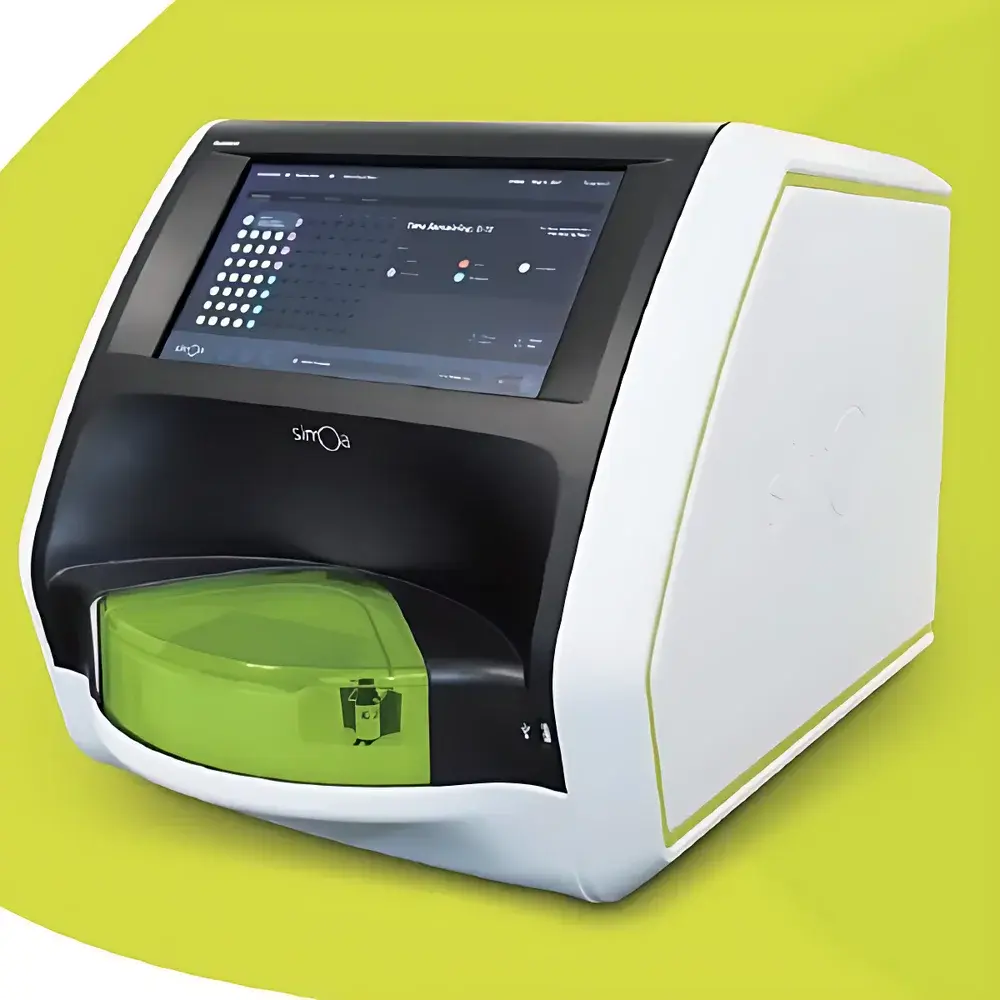
Quanterix SR-X Desktop Single-Molecule Immunoassay Analyzer
| Brand | Quanterix |
|---|---|
| Origin | USA |
| Manufacturer Type | Authorized Distributor |
| Origin Category | Imported |
| Model | SR-X |
| Price Range | USD 250,000–350,000 (FOB) |
| Sample Types | Serum, Plasma, Cerebrospinal Fluid (CSF), Tear, Urine, and Other Biological Fluids |
| Sample Volume | 1–100 µL |
| Dynamic Detection Range | <1 fg/mL to >100 pg/mL |
| Sensitivity | Sub-femtogram per mL (fg/mL) |
| Assay Time | ≥45 minutes |
| Multiplex Capability | Up to 4-plex (simultaneous analyte detection) |
Overview
The Quanterix SR-X Desktop Single-Molecule Immunoassay Analyzer is an engineered platform for ultra-sensitive, quantitative detection of low-abundance protein biomarkers in complex biological matrices. It leverages Single Molecule Array (Simoa) technology—a digital immunoassay methodology based on enzymatic amplification and single-molecule fluorescence imaging within femtoliter-sized wells. Unlike conventional ELISA or chemiluminescent platforms, Simoa isolates individual immunocomplexes onto paramagnetic beads, partitions them into arrays of ~200,000 microwells (~2.3 fL volume each), and digitally counts enzyme-labeled events via high-resolution CCD imaging. This approach enables quantification at sub-femtogram per milliliter (fg/mL) concentrations—up to 1,000× more sensitive than standard ELISA—while maintaining assay robustness and reproducibility across clinical and translational research workflows.
Key Features
- Desktop footprint with integrated fluidics, thermal control, and automated imaging—designed for benchtop deployment in core labs and regulated environments.
- Sub-fg/mL limit of detection (LOD) validated for neurofilament light chain (NfL), tau, amyloid-β, IL-6, and other clinically relevant analytes in human serum, plasma, CSF, and tear fluid.
- Automated sample processing from loading to final concentration calculation; minimal hands-on time post-setup.
- Four-plex capability via spatially resolved bead sets and spectrally distinct fluorophores, enabling concurrent quantification of up to four biomarkers in a single run without cross-reactivity.
- Onboard calibration curve generation using serially diluted reference standards; supports both internal and external standardization protocols.
- Compliant architecture with audit trail logging, user access controls, and electronic signature support aligned with FDA 21 CFR Part 11 and GLP/GMP documentation requirements.
Sample Compatibility & Compliance
The SR-X accepts native, minimally processed biological fluids—including serum, EDTA/K2EDTA plasma, cerebrospinal fluid (CSF), ocular tear samples, and urine—without requirement for pre-concentration or affinity enrichment. Sample volumes range from 1 µL (high-concentration analytes) to 100 µL (low-abundance targets), optimizing sensitivity while conserving precious clinical specimens. All assays are developed and verified per ISO 13485–compliant manufacturing practices. Method validation reports—including precision (intra- and inter-assay CV ≤8%), accuracy (recovery 85–115%), linearity (R² ≥0.995), and specificity (interference testing per CLSI EP7-A2)—are available for all CE-IVD and RUO kits. The system meets ASTM E2500-21 guidelines for analytical instrument qualification in life science applications.
Software & Data Management
Simoa Navigator™ v5.2 software provides full lifecycle data management—from assay design and run scheduling to raw image analysis, concentration interpolation, and export-ready reporting. Image processing algorithms apply adaptive thresholding, background subtraction, and Poisson-based digital counting correction to ensure traceable, bias-minimized quantitation. Data files adhere to vendor-neutral formats (e.g., .csv, .xlsx) and support integration with LIMS via HL7 or API-driven interfaces. Audit trails record all user actions—including parameter edits, reanalysis events, and result approvals—with immutable timestamps and operator identification. Software validation packages—including IQ/OQ/PQ documentation and change control records—are provided for regulatory submissions.
Applications
- Neurodegenerative disease monitoring (e.g., Alzheimer’s, Parkinson’s, ALS) via ultrasensitive NfL, p-tau181, GFAP, and Aβ42 quantification in CSF and blood.
- Oncology biomarker profiling—including PD-L1, HER2, PSA, and cytokine panels—in liquid biopsies for early recurrence detection and therapy response assessment.
- Inflammatory and autoimmune disease research (e.g., TNF-α, IL-17A, IFN-γ) in small-volume pediatric or longitudinal cohort samples.
- Vaccine immunogenicity studies requiring precise measurement of low-titer neutralizing antibodies post-immunization.
- Preclinical toxicology and PK/PD modeling where traditional assays lack resolution at pharmacologically relevant exposure levels.
FAQ
What sample preparation is required prior to SR-X analysis?
Minimal preparation is needed: samples are typically diluted in assay-specific buffer and centrifuged (10,000 × g, 10 min) to remove particulates. No immunoprecipitation, ultrafiltration, or concentration steps are required.
Can the SR-X be integrated into a GxP-compliant laboratory environment?
Yes—the system supports 21 CFR Part 11 compliance through role-based access control, electronic signatures, and full audit trail functionality. IQ/OQ/PQ documentation and change control templates are included.
Is method transfer possible between SR-X and other Simoa platforms (e.g., HD-X)?
Assay protocols and calibration curves are fully portable across Quanterix platforms. Cross-platform precision and recovery data are documented in technical bulletins for validated kits.
How does multiplexing affect sensitivity in 4-plex mode?
Each target retains its individual LOD—no compromise in sensitivity occurs due to multiplexing—because bead sets are spectrally and spatially resolved during imaging and analysis.
What maintenance is required for long-term operational reliability?
Scheduled maintenance includes quarterly optical alignment verification, annual fluidic path inspection, and biannual calibration with traceable reference standards—all supported by remote diagnostics and on-site service contracts.