
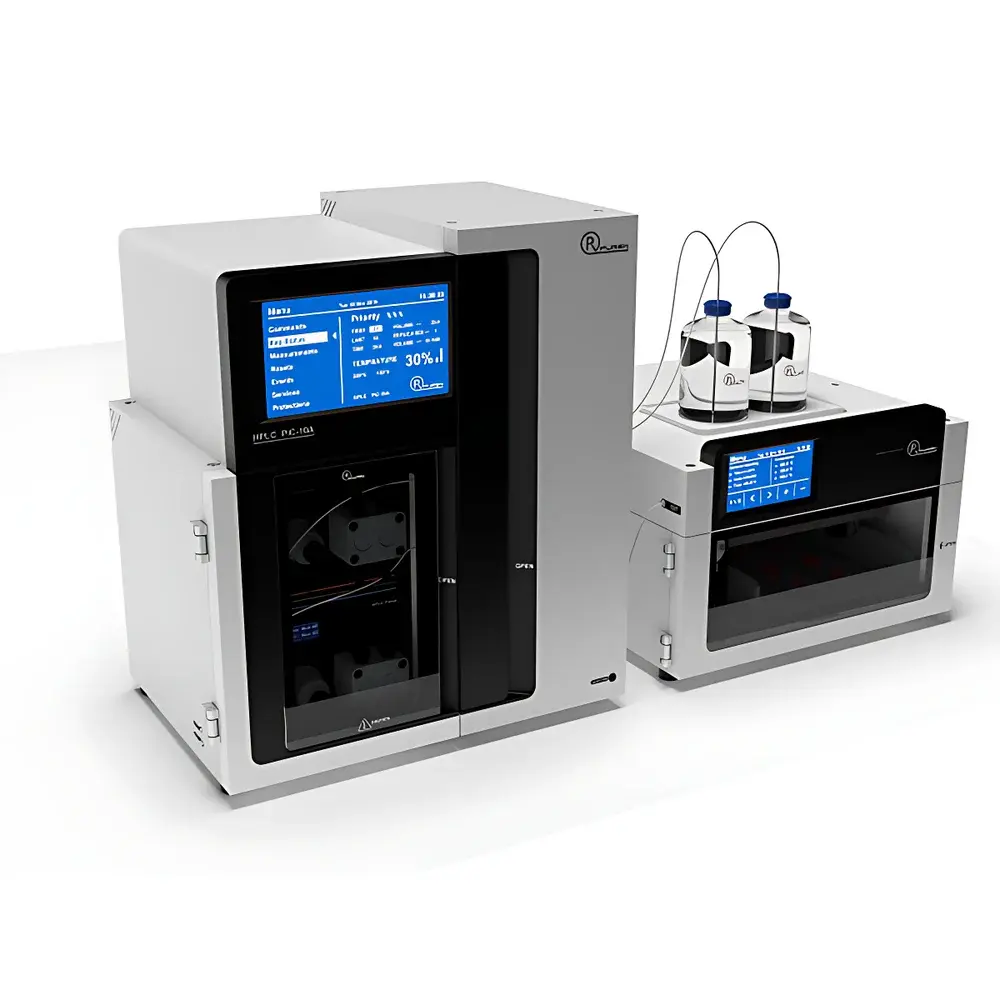
PUREN PIC-80 Dual-System Fully Automated Ion Chromatograph
| Brand | PUREN |
|---|---|
| Origin | Shandong, China |
| Manufacturer Type | Direct Manufacturer |
| Product Category | Domestic |
| Model | PIC-80 |
| Instrument Type | Laboratory Benchtop |
| Application Scope | General-Purpose |
| Pump Max Pressure | 0–42.0 MPa (Stainless Steel) / 0–36 MPa (PEEK) |
| Flow Rate Range | 0.001–9.999 mL/min |
| Eluent Flow Rate | 0.7–1.5 mL/min |
| Maximum Operating Pressure | 10 MPa (1500 psi) |
| Operating Temperature Range | 5–65 °C |
| Temperature Reproducibility | ±0.004 °C |
| Eluent Concentration Range | 1.92–4.8 mM |
Overview
The PUREN PIC-80 Dual-System Fully Automated Ion Chromatograph is an integrated benchtop analytical platform engineered for high-precision, simultaneous quantitative analysis of anions and cations in diverse aqueous matrices. Built upon suppressed conductivity detection principles—compliant with ISO 10304-1:2012 and ASTM D4327—this system employs dual independent flow paths, each equipped with a high-stability electrochemical suppression module and temperature-controlled conductivity cell. Its architecture supports both isocratic and gradient elution modes, enabling robust separation of common inorganic ions (e.g., F⁻, Cl⁻, NO₂⁻, Br⁻, NO₃⁻, PO₄³⁻, SO₄²⁻, Li⁺, Na⁺, NH₄⁺, K⁺, Mg²⁺, Ca²⁺) as well as low-molecular-weight organic acids and amines. The system’s core design emphasizes analytical reproducibility, long-term baseline stability, and minimal carryover—critical for regulated environments requiring adherence to GLP and ISO/IEC 17025 quality frameworks.
Key Features
- Dual independent chromatographic channels: Enables concurrent anion and cation analysis without cross-contamination or method reconfiguration.
- Integrated auto-dilution and auto-standard preparation module: Programmable dilution ratios (1:2 to 1:1000) and standard series generation directly from stock solutions, reducing manual error and improving calibration traceability.
- Full non-metallic fluidic path: PEEK pump heads, Rheodyne PEEK six-port valves, fluoropolymer tubing (PTFE, PFA), and polypropylene solvent reservoirs ensure compatibility with acidic, basic, and weakly organic eluents while eliminating metal ion leaching—a prerequisite for ultra-trace ion quantification.
- Monolithic thermostatic chamber: Houses the conductivity detector cell, analytical column, suppressor, and injection valve within a single temperature-controlled enclosure (5–65 °C, ±0.004 °C stability). Includes pre-heated eluent delivery to minimize thermal dispersion and improve peak symmetry.
- Dual high-pressure, pulseless dual-piston pumps: Stainless steel and PEEK variants support pressure ranges up to 42 MPa and 36 MPa respectively; flow accuracy ±0.1% RSD across 0.001–9.999 mL/min.
- Embedded 7-inch high-brightness LCD touchscreen interface: Local real-time control, method storage, and diagnostic monitoring without external PC dependency.
Sample Compatibility & Compliance
The PIC-80 accommodates liquid samples with total dissolved solids (TDS) ≤ 100 ppm and particulate content < 0.45 µm (pre-filtered). It complies with key regulatory requirements for environmental, pharmaceutical, and food testing laboratories—including US EPA Methods 300.0, 300.1, and 317.0; ISO 10304 series; and Chinese Standard HJ 1041-2019. All hardware and software components are designed to support audit-ready data integrity: electronic signatures, user access levels (admin/operator/visitor), and full audit trail logging per FDA 21 CFR Part 11 guidelines. Column oven and detector temperature logs, method parameters, and raw chromatogram metadata are automatically timestamped and archived.
Software & Data Management
The proprietary IC Workstation v3.2 provides real-time instrument control, sequence management, peak integration (with customizable baselines and retention time windows), and automated report generation in PDF, Excel (.xlsx), and Word (.docx) formats. Raw data files (.icd) are stored locally on encrypted internal SSD and synchronized via TLS 1.2–secured cloud backup—enabling remote access, multi-site data review, and version-controlled method sharing. Data export includes full metadata (instrument ID, operator, date/time, calibration history, QC check results), supporting ISO/IEC 17025 clause 7.7 traceability requirements. Optional LIMS integration is available via ASTM E1467-compliant API.
Applications
- Environmental monitoring: Quantification of anions/cations in drinking water, wastewater, rainwater, and soil leachates per ISO 10304-1 and EPA 300.1.
- Pharmaceutical quality control: Testing of residual chloride, acetate, or sodium in APIs and excipients per USP and EP 2.2.38.
- Food & beverage safety: Determination of nitrate/nitrite in dairy products, phosphate additives in soft drinks, and ammonium in brewing wort.
- Battery electrolyte analysis: Trace fluoride and sulfate in Li-ion battery catholytes using specialized hydroxide-selective columns.
- Power plant chemistry: Monitoring of chloride, sulfate, and cation impurities in boiler feedwater and steam condensate per ASTM D4582.
FAQ
Can the PIC-80 operate under GLP-compliant conditions?
Yes—the system supports user authentication, electronic signatures, audit trails, and secure data archiving aligned with OECD GLP Principles and ISO/IEC 17025:2017 clause 7.5.
Is PEEK-compatible eluent delivery validated for long-term use with 100 mM KOH?
Yes—PEEK pump heads, valves, and fluidic manifolds are rated for continuous operation with hydroxide-based eluents up to 100 mM at ≤36 MPa and 45 °C.
Does the system support external autosamplers?
Yes—it features RS-232, USB, and Ethernet interfaces compatible with third-party autosamplers meeting IEC 61000-4-3 EMC standards.
What is the minimum detectable concentration for chloride using the standard anion column?
Under optimized conditions (25 µL loop, 1.0 mL/min OH⁻ eluent, suppressed conductivity detection), the typical LOD is 0.05 µg/L (S/N = 3).
How is data integrity ensured during power failure or network interruption?
All method parameters and raw chromatograms are written to non-volatile memory prior to acquisition; cloud sync resumes automatically upon network recovery without data loss.






