
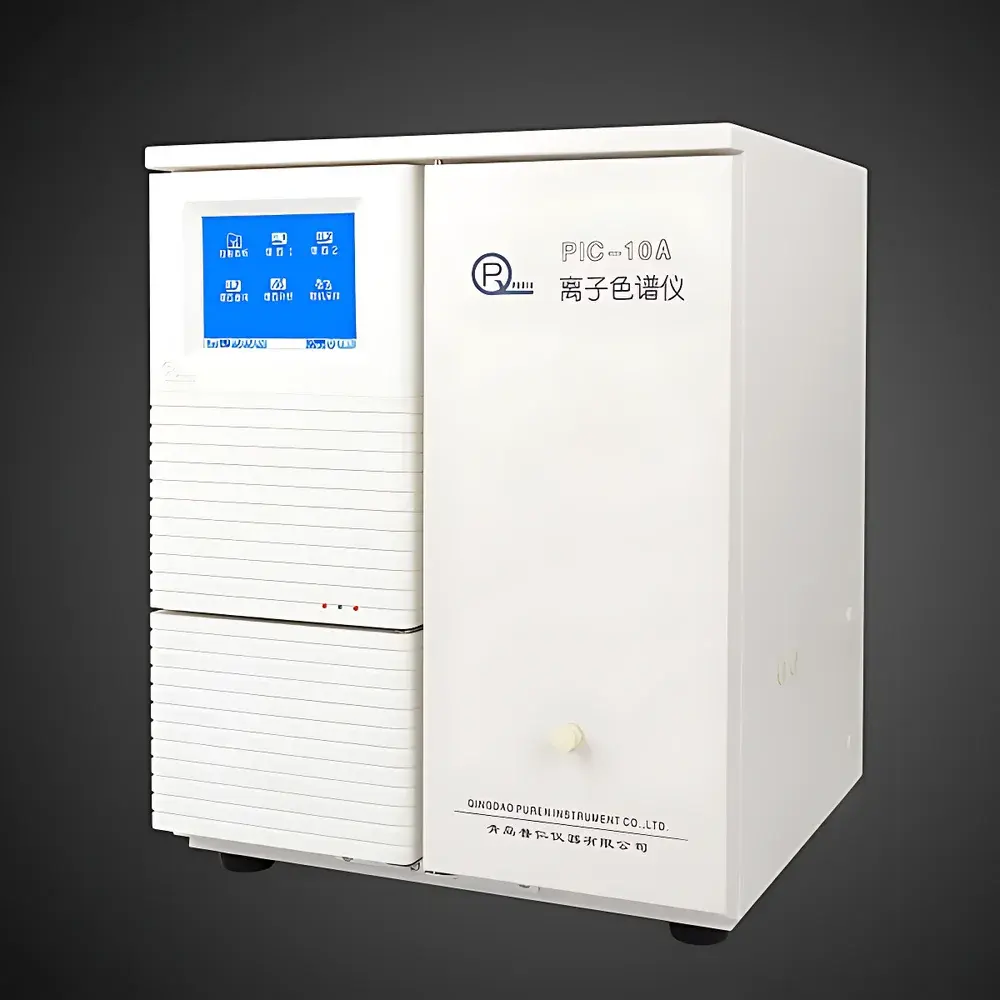
PUREN PIC-10A Dual-System Ion Chromatograph
| Brand | PUREN |
|---|---|
| Origin | Shandong, China |
| Manufacturer Type | Direct Manufacturer |
| Instrument Type | Laboratory Benchtop IC System |
| Configuration | Dual-Channel Simultaneous Anion/Cation Analysis |
| Pump Material Options | Stainless Steel (Max. 42.0 MPa) / PEEK (Max. 35 MPa) |
| Flow Rate Range | 0.001–9.999 mL/min (0.001 mL/min increments) |
| Eluent Flow Rate | 0.7–1.5 mL/min |
| Max. Operating Pressure | 10 MPa (1500 psi) |
| Column & Detector Oven Temperature Range | 5–65 °C |
| Temperature Stability | ±0.004 °C |
| Eluent Concentration Range | 1.92–4.8 mM |
| Detection Modes | Conductivity (dual-channel), Amperometric (optional), UV-Vis (optional) |
| Integrated Components | Built-in degasser (pre- and post-suppressor), CO₂ removal module, electrochemical suppressor (continuous regeneration), column switching valve, auto-sampler interface, embedded high-resolution LCD control panel with real-time chromatogram display |
Overview
The PUREN PIC-10A Dual-System Ion Chromatograph is a fully integrated, benchtop laboratory instrument engineered for high-fidelity simultaneous anion and cation analysis using suppressed conductivity detection. Based on classical ion-exchange chromatography principles, the system employs dual independent flow paths—each with dedicated high-pressure pumps, injection valves, separation columns, and conductivity detectors—to eliminate cross-system interference while enabling true parallel analysis. This architecture supports concurrent gradient elution protocols, permitting co-determination of inorganic anions (e.g., F⁻, Cl⁻, NO₂⁻, Br⁻, NO₃⁻, HPO₄²⁻, SO₄²⁻, ClO₃⁻, BrO₃⁻, ClO₄⁻, I⁻), organic acids (e.g., formate, acetate, oxalate), and common cations (Li⁺, Na⁺, K⁺, NH₄⁺, Mg²⁺, Ca²⁺, Sr²⁺, Ba²⁺) within a single run. The system complies with ISO 10304-1:2012 (water quality — determination of dissolved anions by liquid chromatography), ASTM D4327 (standard test method for anions in water by suppressed ion chromatography), and USP (chromatography), and is designed to support GLP-compliant workflows through audit-trail-capable data handling and hardware-level traceability.
Key Features
- Dual independent chromatographic channels with synchronized pump control, enabling simultaneous anion and cation analysis without signal crosstalk or retention time drift.
- Integrated column-and-detector oven with monolithic temperature-controlled block (5–65 °C, stability ±0.004 °C), ensuring reproducible migration velocity and baseline stability across extended runs.
- Electrochemical micro-membrane suppressor with continuous regeneration (pH 0–14 compatibility), delivering low background conductivity (<0.15 µS/cm), noise <0.5 nS, and stabilization time ≤12 min.
- On-line dual-stage degassing: pre-pump vacuum degassing (using DuPont PTFE tubing) and post-suppressor CO₂ removal module—reducing baseline drift and improving S/N ratio by 2–3× for trace-level quantitation.
- Modular flow path constructed entirely from PEEK and chemically inert materials, compatible with 0–14 pH eluents and 100% organic solvents (e.g., methanol, acetonitrile).
- Embedded 7-inch high-resolution LCD touchscreen interface with real-time chromatogram rendering, live parameter monitoring (conductivity, current, pressure, flow, temperature), and onboard peak integration—enabling standalone operation without external PC.
- Optional PAS-series autosampler with full-loop injection, precision syringe actuation, and programmable vial tray sequencing—supporting unattended multi-sample analysis with <0.5% RSD injection repeatability.
Sample Compatibility & Compliance
The PIC-10A accommodates aqueous samples across environmental, pharmaceutical, food, and industrial matrices—including drinking water, wastewater, semiconductor process chemicals, biological fluids, and battery electrolytes. Its robust PEEK fluidic path tolerates aggressive eluents (e.g., KOH, methanesulfonic acid, ammonium nitrate) and organic modifiers, eliminating corrosion-related downtime. Column selection includes high-capacity anion-exchange (e.g., Shodex IC YK-421, Alltech A-100), cation-exchange (e.g., Alltech CS-12A), and ion-exclusion resins, all compatible with the integrated column-switching valve. The system meets ISO/IEC 17025 requirements for method validation when paired with NIST-traceable standards and supports FDA 21 CFR Part 11 compliance via optional electronic signature and audit trail modules in the workstation software.
Software & Data Management
The proprietary IC Workstation software operates via USB 2.0 or Ethernet interface and provides bidirectional instrument control, real-time spectral acquisition, automated baseline correction, negative peak recognition, and customizable report generation (PDF, CSV, Excel). It supports dual-channel data overlay, dynamic integration parameter adjustment, and automatic calibration curve construction—including non-linear (quadratic, cubic) fitting and dilution-free linear range extension. Raw data files include embedded metadata (operator ID, timestamp, method name, instrument serial number), and the software maintains a tamper-evident audit trail for all parameter changes, integration edits, and report exports—fully aligned with GLP/GMP documentation requirements.
Applications
- Environmental monitoring: Quantification of regulated anions in EPA Method 300.0 and 300.1 matrices; speciation of bromate and chlorate in drinking water per WHO guidelines.
- Pharmaceutical QC: Counter-ion profiling in APIs (e.g., sodium in penicillin G sodium), residual acetate in biologics formulations, and chloride testing in parenteral solutions per USP .
- Food & beverage: Nitrate/nitrite in cured meats, sulfate in wine, organic acids in dairy products, and cation balance in infant formula.
- Electronics: Trace fluoride and sulfate in ultrapure water used in wafer cleaning, and alkali metal contamination in photoresist developers.
- Academic research: Multi-element speciation studies involving redox-active ions (e.g., iodide/iodate, sulfite/sulfate) under controlled pH gradients.
FAQ
Does the PIC-10A support gradient elution for complex sample matrices?
Yes—the dual-pump architecture allows independent programming of eluent concentration and flow rate for each channel, enabling multi-step gradients optimized for co-eluting species such as organic acids and inorganic anions.
Can the system operate without a connected computer?
Yes—the embedded LCD interface supports full instrument control, real-time chromatogram visualization, manual integration, and report export to USB storage—ideal for cleanroom or field-deployed applications.
Is the electrochemical suppressor maintenance-free?
The continuous regeneration design eliminates consumable chemical regenerants; only routine column flushing and annual membrane inspection are recommended per manufacturer guidelines.
What validation documentation is provided with the instrument?
Each unit ships with a Certificate of Conformance, factory calibration reports (conducted per ISO/IEC 17025-accredited procedures), and a copy of the Chinese National Institute of Metrology dual-system verification certificate (2007).
How does the CO₂ removal module improve detection sensitivity?
By eliminating carbonic acid-derived background conductivity, the module reduces equivalent conductance contribution from dissolved CO₂—critical for sub-ppb detection of low-conductivity anions like fluoride and acetate in high-purity water analysis.





