
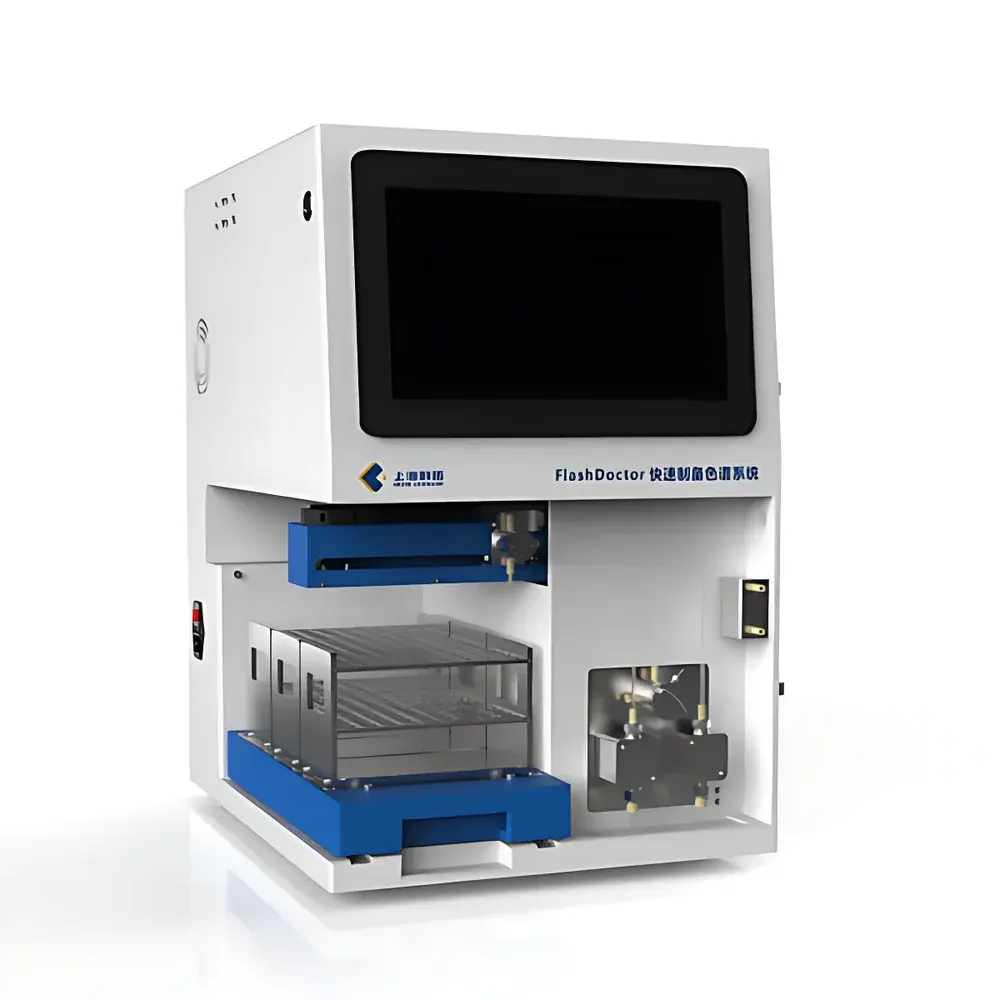
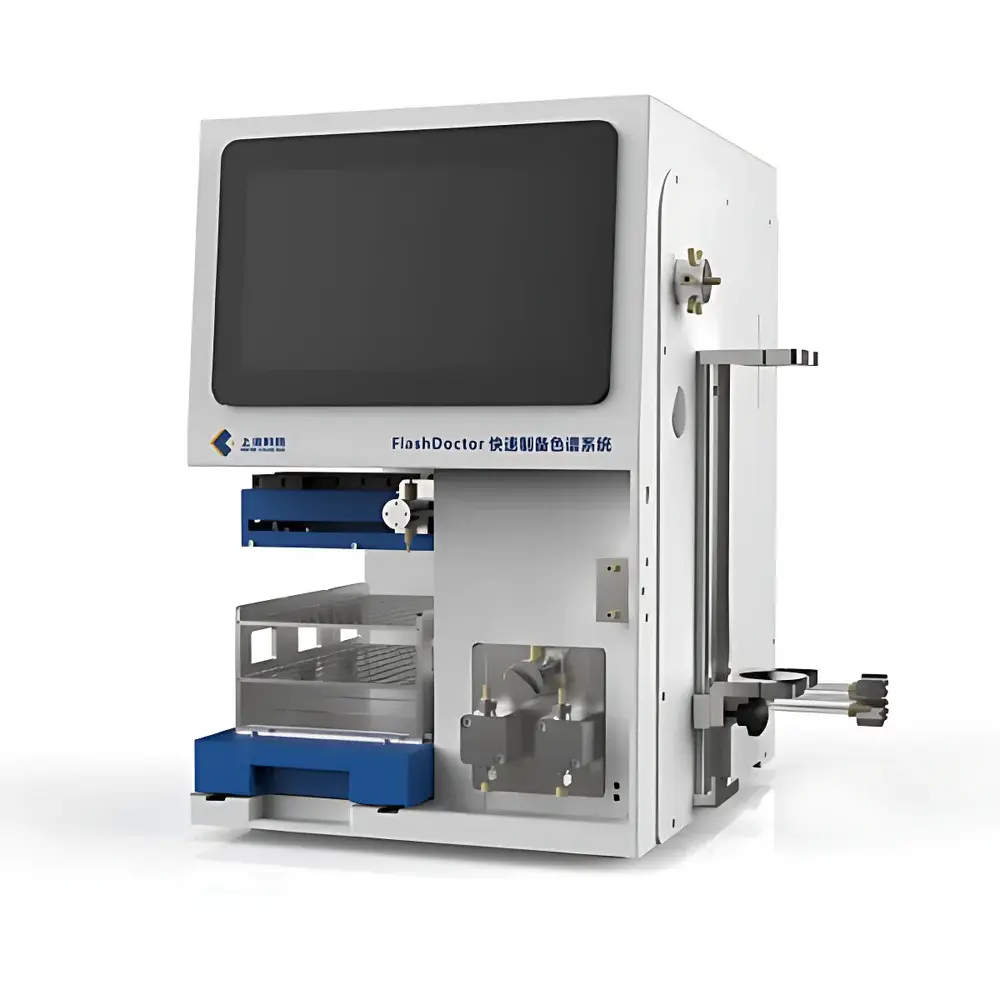
FlashDoctor-2000 Preparative Liquid Chromatography System by KEZHE Shanghai
| Brand | KEZHE Shanghai |
|---|---|
| Origin | Shanghai, China |
| Manufacturer Type | Original Equipment Manufacturer (OEM) |
| Product Category | Domestic |
| Model | FlashDoctor-2000 |
| Application Level | Laboratory-Scale |
| Instrument Type | High-Pressure Preparative Liquid Chromatograph |
| Flow Rate Range | 0–300 mL/min |
| Flow Accuracy | ±2.0% |
| Flow Precision | <1.5% |
| Maximum Pressure | 300 psi (2.07 MPa) |
| Wavelength Range | 200–800 nm |
| Wavelength Accuracy | ±1 nm |
| Baseline Noise | ±0.2 mAU (at 254 nm) |
| Baseline Drift | 0.2 mAU/h (at 254 nm) |
| Spectral Bandwidth | 8 nm |
| Flow Cell Path Length | 0.3 mm |
| Detection Modes | UV-Vis (DAD), optional ELSD |
| Fraction Collection | 2D X-Y robotic collector (135-tube capacity, standard 15 × 150 mm tubes) |
| Column Compatibility | Reversible normal-phase and reversed-phase (e.g., C18), flash columns up to 40 mm ID |
| Software Compliance | Audit trail, user management, electronic signature support per FDA 21 CFR Part 11 requirements |
| System Architecture | Integrated benchtop unit, ventilated cabinet compatible |
Overview
The FlashDoctor-2000 Preparative Liquid Chromatography System is an integrated, high-pressure preparative HPLC platform engineered for laboratory-scale purification of organic compounds, natural products, pharmaceutical intermediates, and synthetic molecules. Built upon classical liquid chromatographic separation principles—namely, differential partitioning of analytes between a mobile phase and stationary phase under controlled pressure—the system delivers robust performance in both normal-phase and reversed-phase modes. Its design targets reproducible method translation from analytical to preparative scale, supporting early-stage process development, compound library enrichment, and compliance-driven purification workflows. The FlashDoctor-2000 meets the operational requirements of Chinese national standard GB 5009.202–2016 for polar compound analysis in edible oils and aligns with broader regulatory expectations for traceable, auditable chromatographic data generation in GLP and GMP-adjacent environments.
Key Features
- High-precision quaternary solvent delivery system with dual-pump architecture, enabling gradient elution across four independent solvent channels and seamless switching between normal-phase (e.g., hexane/ethyl acetate) and reversed-phase (e.g., water/acetonitrile) conditions.
- Diode Array Detector (DAD) with dual-lamp source (deuterium + tungsten-halogen), covering 200–800 nm spectral range; 8 nm bandwidth, ±1 nm wavelength accuracy, and low-noise optical path (±0.2 mAU baseline noise at 254 nm).
- Two-dimensional robotic fraction collector with X-Y matrix positioning, accommodating up to 135 tubes (standard 15 × 150 mm format); supports full-loop, peak-triggered, time-windowed, and manual collection protocols.
- Real-time pressure monitoring with overpressure alarm and automatic shutdown logic to protect column integrity and ensure system stability at up to 300 psi (2.07 MPa).
- Integrated solvent level sensing to prevent air bubble ingress into pump heads or detector flow cells—critical for maintaining baseline stability and retention time reproducibility.
- Touchscreen-based control interface with workflow-oriented GUI; supports method import/export, sequence definition, and real-time chromatogram visualization.
- Intelligent method assistance module that interprets input TLC Rf values and recommends initial gradient profiles, column chemistries, and flow rates—reducing method development time without compromising resolution.
- Modular hardware architecture: pump module, DAD module, column oven/carrier module, fraction collector, and control unit are physically and functionally decoupled for serviceability and future expansion (e.g., ELSD integration).
Sample Compatibility & Compliance
The FlashDoctor-2000 accommodates diverse sample matrices including small-molecule APIs, plant extracts, lipid fractions, peptides, glycosides, and polymer degradation products. Its compatibility with flash columns (up to 40 mm internal diameter) and standard analytical-grade HPLC columns enables scalability from mg- to multi-gram purification. The system complies with ISO/IEC 17025 documentation practices for calibration and verification records. Software features—including electronic signatures, role-based user access, audit trail logging (with timestamped actions), and data immutability safeguards—meet core requirements of FDA 21 CFR Part 11 for regulated laboratories. While not certified for cGMP manufacturing, it satisfies method validation prerequisites per ICH Q2(R2) guidelines when used in research and development settings.
Software & Data Management
The embedded ChromaControl software provides comprehensive chromatographic data acquisition, processing, and reporting. It includes automated peak detection, integration, purity assessment (via spectral deconvolution), and quantitative analysis using external/internal standard methods. All raw data (.raw), processed results (.csv, .pdf), and method files (.mth) are stored in a structured local database with version-controlled backups. Audit trail entries capture operator login/logout, parameter changes, fraction collection events, and detector calibration updates—each cryptographically signed and tamper-evident. Data export conforms to ASTM E1955 (chromatographic data exchange) and supports LIMS integration via secure FTP or ODBC. Optional ELSD module adds universal detection capability for non-chromophoric compounds (e.g., carbohydrates, lipids), with dedicated signal processing algorithms for baseline stabilization and drift compensation.
Applications
- Purification of reaction mixtures in medicinal chemistry synthesis, particularly for isolating low-yield active pharmaceutical ingredients (APIs) prior to structural confirmation.
- Isolation of bioactive constituents from botanical extracts (e.g., flavonoids, alkaloids, terpenoids) for pharmacological screening and reference standard preparation.
- Separation of lipid oxidation products (e.g., polar compounds in frying oils) in food safety labs adhering to GB 5009.202–2016.
- Method scouting and optimization for downstream scale-up, leveraging consistent retention behavior across analytical and preparative dimensions.
- Support of academic and industrial metabolomics pipelines requiring rapid fractionation of complex biological fluids prior to MS or NMR analysis.
FAQ
What column formats are supported?
The system accepts standard stainless-steel or PEEK-packed preparative columns (10–40 mm ID) and flash cartridges (e.g., 12 g, 25 g, 40 g), with optional column oven for temperature-controlled separations.
Can the DAD detect multiple wavelengths simultaneously during collection?
Yes—the diode array captures full spectra (200–800 nm) at user-defined acquisition rates (default 1 Hz), enabling real-time peak tracking at optimal λmax and post-run spectral purity evaluation.
Is method transfer from analytical HPLC possible?
Yes—scaling rules (e.g., constant linear velocity, proportional flow rate adjustment) are implemented in the software; retention time correlation coefficients >0.99 are routinely achieved across 10×–50× scale-up factors.
How is data integrity ensured during long-duration runs?
Continuous checksum validation, automatic backup on power loss, and write-once-read-many (WORM) archive options prevent accidental overwrites or corruption of raw chromatograms.
Does the system support remote monitoring?
Remote desktop access and cloud-synced project folders (via optional secure gateway) enable off-site supervision, though all instrument control remains local per cybersecurity best practices.
Related Products





