
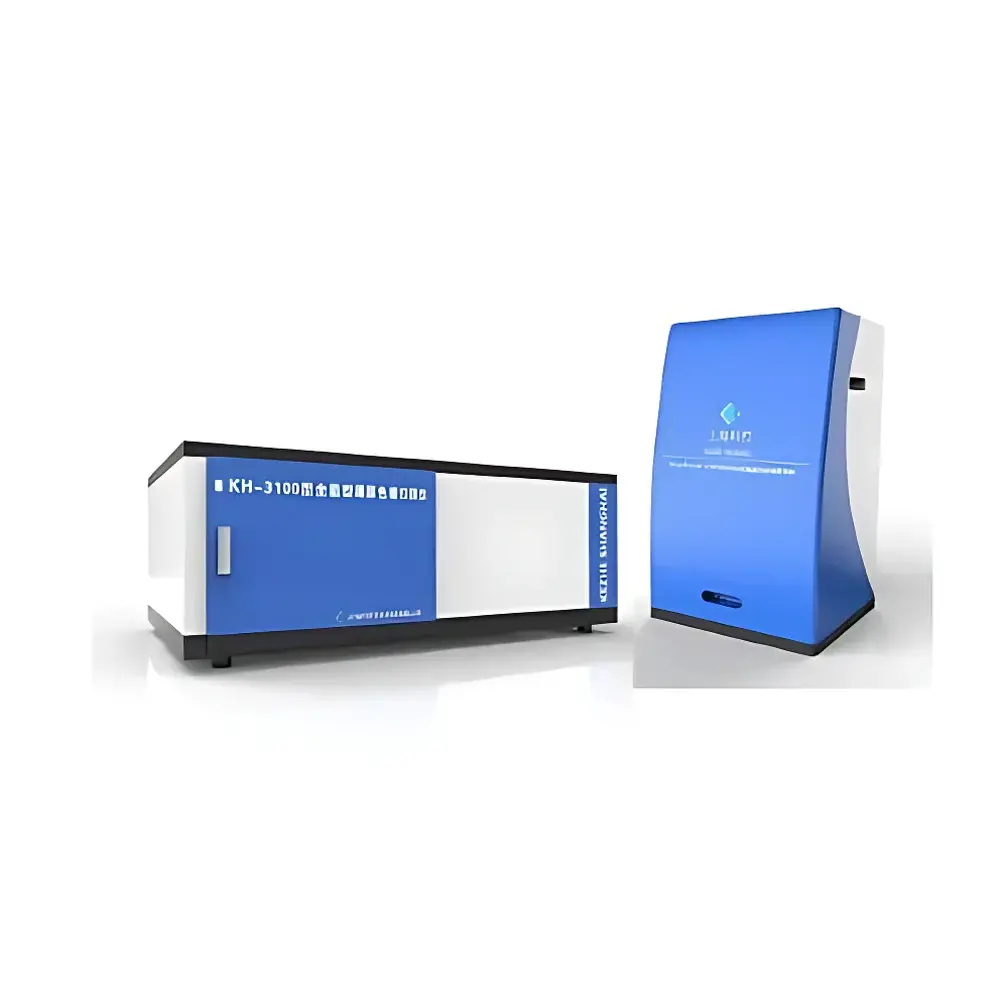
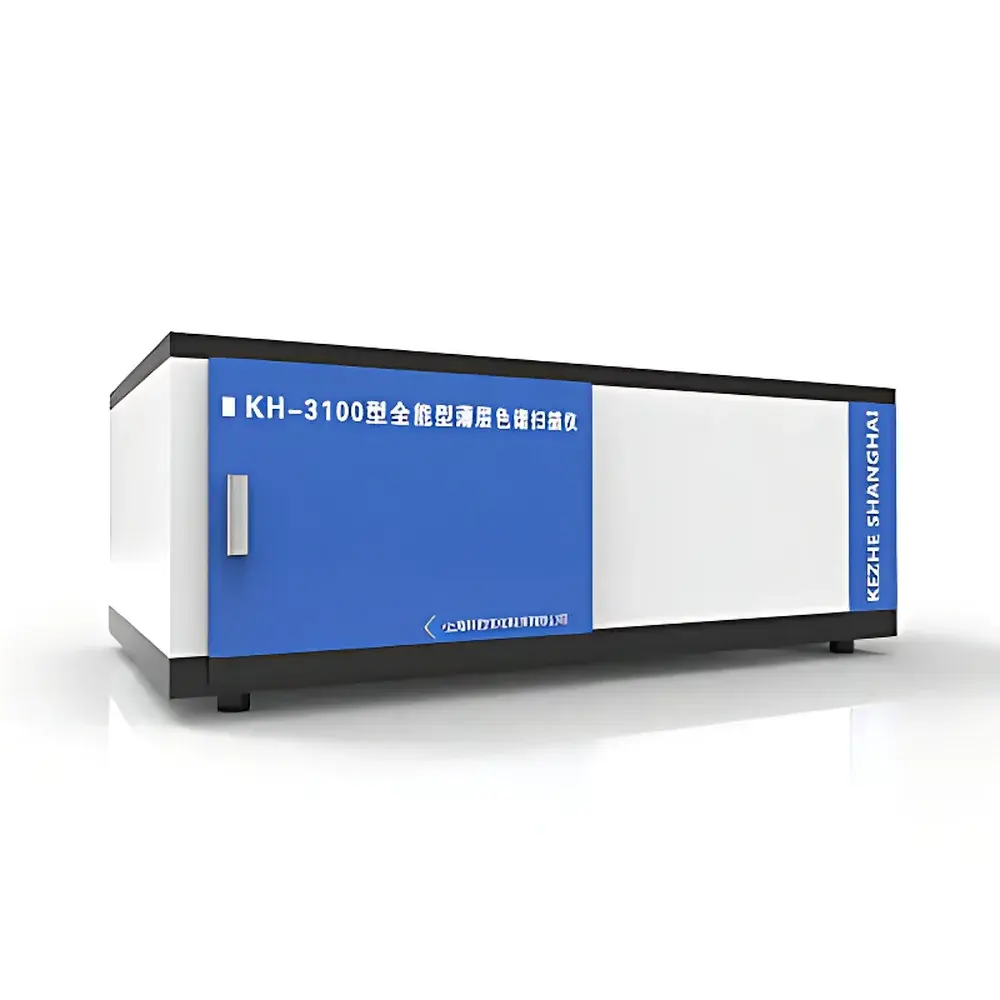
KEZHE SHANGHAI KH-3100 Universal Thin-Layer Chromatography Scanner
| Brand | KEZHE SHANGHAI |
|---|---|
| Origin | Shanghai, China |
| Manufacturer Type | Direct Manufacturer |
| Instrument Type | TLC Scanner |
| Measurement Mode | Absorption (Fluorescence optional) |
| Wavelength Range | 190–800 nm |
| Light Sources | Xenon lamp, Tungsten-halogen lamp, High-pressure Mercury lamp |
| Monochromator | Holographic grating (1200 lines/mm) with nitrogen purge capability |
| Spectral Bandwidth | 5 nm |
| Wavelength Accuracy | < ±1 nm |
| Wavelength Repeatability | < ±0.2 nm |
| Minimum Resolution | 25 µm |
| Imaging Wavelengths | 254 nm, 365 nm, White light |
| Sample Stage Capacity | 200 mm × 200 mm TLC plate |
| Maximum Scan Speed | 100 mm/s |
Overview
The KEZHE SHANGHAI KH-3100 Universal Thin-Layer Chromatography (TLC) Scanner is an integrated analytical platform engineered for high-precision, quantitative densitometric analysis of planar chromatographic separations. It operates on the principle of absorption-based reflectance scanning—measuring light attenuation at defined wavelengths across developed TLC plates—and optionally supports fluorescence detection via interchangeable excitation/emission optics. Designed specifically for herbal medicine fingerprinting and quality control in regulated pharmaceutical environments, the KH-3100 combines optical scanning, digital imaging, and chemometric software into a single GMP/GLP-aligned workflow. Its continuous spectral coverage from 190 to 800 nm enables method development across UV and visible regions, while its 25 µm spatial resolution ensures accurate peak integration even for closely eluted compounds. The system’s dual-detection architecture—simultaneous acquisition of densitometric data and high-fidelity RGB/UV images—provides orthogonal verification of band identity, position, and intensity, reducing ambiguity in qualitative and quantitative interpretation.
Key Features
- Automated wavelength calibration and monochromator alignment, ensuring long-term spectral fidelity and compliance with ISO 17025 traceability requirements
- Dual-source illumination system with automatic D2/tungsten-halogen lamp switching and real-time energy monitoring to maintain consistent photon flux across the UV–Vis range
- Holographic grating monochromator (1200 lines/mm) with nitrogen purge option to suppress ozone-induced absorption artifacts below 220 nm
- Motorized XYZ stage accommodating standard 200 mm × 200 mm TLC plates, with programmable scan paths and sub-micron positional repeatability
- Integrated GoodLook-1000 imaging module supporting simultaneous capture at 254 nm, 365 nm, and white light—enabling direct overlay of scanned profiles onto digitized plate images
- USB 2.0 interface with deterministic data transfer rates (>40 MB/s), supporting batch acquisition of multi-wavelength scans and image stacks without latency or packet loss
- Full computer control via Tstar-3100 workstation software, compliant with FDA 21 CFR Part 11 for electronic records and signatures
Sample Compatibility & Compliance
The KH-3100 accommodates silica gel, alumina, cellulose, and reversed-phase TLC plates—including pre-coated, handmade, and HPTLC formats—without mechanical adaptation. Its open-stage design permits analysis of irregularly shaped or oversized plates up to 200 mm square. Method templates pre-loaded in the Tstar-3100 software align with Chinese Pharmacopoeia (ChP) editions 2000–2015 for herbal quantification, and support validation per ICH Q2(R2) guidelines. Audit trail functionality logs all user actions—including parameter changes, reprocessing events, and report generation—with immutable timestamps and operator ID binding. Data integrity safeguards include role-based access control, electronic signature workflows, and encrypted local database storage compliant with GLP Annex 11 and EU GMP Annex 11 expectations.
Software & Data Management
The Tstar-3100 workstation integrates seven core modules: (1) TLC scanning acquisition with real-time baseline correction; (2) Image analysis for spot localization, Rf calculation, and morphological assessment; (3) Fingerprint profiling engine implementing cosine similarity, correlation coefficient, and Euclidean distance algorithms; (4) RGB-to-spectral curve conversion for pseudo-absorbance reconstruction; (5) Multi-sample parallel comparison with side-by-side chromatogram overlays and deviation heatmaps; (6) Track-following algorithm that uses registered plate images to auto-adjust scan trajectories—compensating for plate warping or migration drift; and (7) Document management system supporting SOP-controlled method libraries, sample metadata tagging, and PDF/A-2 report export. All raw data files are stored in vendor-neutral HDF5 format with embedded metadata (wavelength, slit width, integration time, plate ID), facilitating third-party reprocessing and regulatory submission.
Applications
The KH-3100 delivers validated performance across pharmacopeial and research-grade applications: quantitative analysis of marker compounds in botanicals (e.g., notoginsenosides in *Panax notoginseng*, berberine in *Coptis chinensis*); batch-to-batch consistency evaluation of finished TCM products (e.g., Liu Wei Di Huang Wan, Huang Lian Shang Qing Wan); detection of mycotoxins (aflatoxin B1, ochratoxin A) in raw herbs; stability-indicating assays for degradation product profiling; and screening of natural product libraries for bioactive constituents. Its ability to generate UV–Vis spectra per resolved band supports structural hypothesis generation when coupled with reference standards. In academic settings, it serves as a pedagogical tool for teaching planar chromatography fundamentals, spectral interpretation, and multivariate pattern recognition.
FAQ
Does the KH-3100 support fluorescence detection?
Yes—fluorescence mode is available as a factory-configured option, utilizing dedicated excitation sources and emission filters optimized for common fluorophores (e.g., dansyl chloride derivatives, coumarin-tagged analytes).
Can the system be validated for GMP-regulated environments?
Yes—the Tstar-3100 software includes full 21 CFR Part 11 compliance features: electronic signatures, audit trails, user privilege tiers, and secure data archiving. IQ/OQ/PQ documentation packages are available upon request.
Is nitrogen purge required for routine operation?
Nitrogen purging is recommended for measurements below 220 nm to eliminate atmospheric ozone absorption; it is optional for visible-range work but strongly advised for high-accuracy UV quantitation.
What file formats are supported for data export?
Raw scan data exports as HDF5 (with embedded metadata); processed results export as CSV, Excel (.xlsx), and PDF/A-2 reports; images save as TIFF (16-bit) or PNG with embedded EXIF tags.
How does the trajectory tracking function improve quantitation accuracy?
By registering the acquired plate image to a geometric reference grid, the system dynamically recalculates scan line positions during acquisition—correcting for mechanical drift, plate shrinkage, or uneven solvent front migration—thereby preserving peak alignment across repeated runs.
Related Products




