
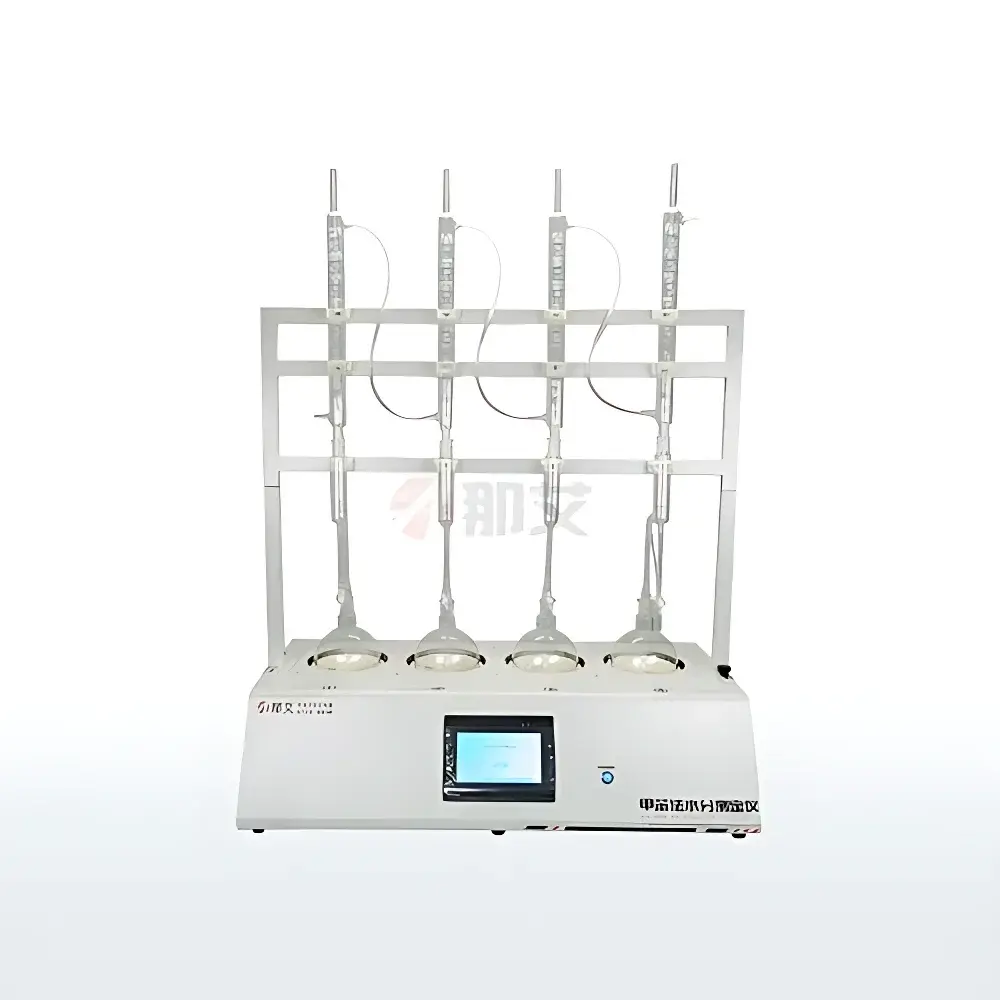
Toluene-Based Moisture Determinator (ZLY Series) – AOE Instrument | ASTM/USP/ChP Compliant Azeotropic Distillation System
| Brand | AOE Instrument |
|---|---|
| Origin | Shanghai, China |
| Model | ZLY-4T |
| Sample Capacity | 4 × 500 mL flasks (6-flask & 1000 mL options available) |
| Heating | Independent Far-Infrared Ceramic, 0–500 W per channel |
| Condensation | Integrated Recirculating Chiller (1.7 kW cooling capacity) |
| Control | PLC + 7-inch HMI touchscreen |
| Compliance | ChP 2020 Vol. III §0832, GB/T 1600–2021, GB/T 5009.3–2016, GB/T 2288–2008 |
| Receiver Tube | 5 mL total volume, 0.1 mL graduation |
| Power Supply | 220 V ±10 V, 50 Hz |
| Dimensions (W×D×H) | 960 × 420 × 270 mm (excl. condenser stand) |
| Rated Power | 2200 W |
| Enclosure | 1 mm cold-rolled steel with electrostatic powder coating |
| Electrical Components | CHINT/DELIXI-grade circuit breakers, relays, and push-button controls |
| Accessories | PTFE stopcocks, 30 mL capped plastic cylinders ×4, slide-rail condenser mount for standardized moisture receivers |
Overview
The AOE ZLY-Series Toluene-Based Moisture Determinator is an engineered laboratory system designed for precise quantitative determination of trace to moderate moisture content in heat-sensitive, hydrophobic, or complex matrices—particularly pharmaceuticals, agrochemicals, pesticides, coal derivatives, and botanical extracts. It operates on the principle of azeotropic distillation: water immiscible with toluene forms a low-boiling binary azeotrope (bp ≈ 85 °C), which co-distills from the sample matrix. Upon condensation and phase separation in the calibrated receiver tube, water—being denser and immiscible—settles at the bottom, enabling direct volumetric quantification. This method circumvents decomposition risks associated with oven-drying and avoids interference from volatile solvents or organic acids common in Karl Fischer titration. The ZLY platform conforms to pharmacopeial and national standards including Chinese Pharmacopoeia (ChP) 2020 Vol. III §0832, GB/T 1600–2021 (Pesticide Moisture Determination), GB/T 5009.3–2016 (Food), and GB/T 2288–2008 (Coal Tar Products), ensuring regulatory alignment for QC/QA laboratories operating under GLP or GMP frameworks.
Key Features
- Modular four-position (or six-position) distillation station with independent far-infrared ceramic heating elements—each bowl-shaped for optimal thermal coupling, acid-resistant, flameless, and equipped with dry-run protection.
- PLC-based control architecture integrated with a 7-inch industrial touchscreen HMI, supporting programmable heating profiles, micro-boil mode activation, and time-based endpoint termination—eliminating manual supervision during extended runs.
- Slide-rail adjustable condenser support structure ensures mechanical compatibility with standard ChP/USP/ISO moisture receiver tubes (e.g., 5 mL graduated, 0.1 mL min. division), as well as alternative receiver geometries for method development.
- Self-contained recirculating chiller (1.7 kW cooling capacity) replaces municipal water cooling—reducing lab infrastructure dependency, conserving water, and maintaining stable condensation efficiency over multi-hour distillations.
- Rugged enclosure fabricated from 1 mm cold-rolled steel with electrostatic epoxy-polyester coating for long-term corrosion resistance in analytical chemistry environments.
- Industrial-grade electrical components (CHINT/DELIXI-certified circuit breakers, contactors, and momentary switches) ensure operational reliability and compliance with IEC 61000-6-2 EMC immunity requirements.
Sample Compatibility & Compliance
The ZLY system accommodates heterogeneous solid and semi-solid samples—including powdered APIs, granulated pesticides, crude plant materials, activated carbon, pitch, and coke breeze—provided they are stable below 110 °C and do not form emulsions or interfacial films that impede phase separation. Its design supports full traceability in regulated settings: all user actions (method selection, setpoint changes, run initiation/termination) are timestamped and logged internally; electronic records comply with FDA 21 CFR Part 11 principles when paired with validated networked data export protocols. Method validation documentation—including precision (RSD < 2.5% for replicate n = 6), accuracy (spike recovery 98.2–101.7%), and robustness across ambient humidity gradients—is available upon request for audit readiness.
Software & Data Management
While the ZLY operates via embedded PLC logic without external PC dependency, its HMI interface enables on-device parameter storage (up to 20 custom methods), real-time temperature monitoring per flask, and event-driven alarm logging (e.g., overheating, coolant failure, receiver overflow). USB export of CSV-formatted run logs—including start/stop timestamps, power profiles, and operator ID tags—supports integration into LIMS or ELN platforms. QR-coded service links and embedded digital manuals (accessible via smartphone scan) streamline troubleshooting and reduce downtime during routine maintenance cycles.
Applications
- Pharmaceutical QC: Moisture verification of hygroscopic excipients (e.g., lactose monohydrate, microcrystalline cellulose) and final dosage forms per ChP/USP .
- Agrochemical Regulation: Pesticide formulation water content testing per GB/T 1600–2021 to ensure stability, shelf life, and registration compliance.
- Foods & Feedstuffs: Quantification of residual moisture in dried herbs, spices, and animal feed premixes where enzymatic or oxidative degradation is moisture-dependent.
- Petrochemical & Carbon Materials: Analysis of moisture in coal tar fractions, pitch, and activated carbons—critical for downstream coking and adsorption performance.
- Research & Development: Method optimization for novel extraction residues, biopolymer composites, or solvent-free formulations where conventional loss-on-drying yields non-reproducible results.
FAQ
What standards does the ZLY system validate against?
It is fully aligned with ChP 2020 Vol. III §0832 (Toluene Method), GB/T 1600–2021, GB/T 5009.3–2016, and GB/T 2288–2008—and may be adapted for USP or ASTM E1868–21 with minor procedural adjustments.
Can the system accommodate 1000 mL flasks?
Yes—custom configurations support either four 1000 mL round-bottom flasks or six 500 mL units; both require corresponding sample rack and chiller recalibration.
Is the chiller’s 1.7 kW rating sufficient for continuous operation?
Yes—the unit maintains ≤12 °C coolant outlet temperature under full-load 8-hour distillations at ambient 30 °C, verified per ISO 5151 test conditions.
How is data integrity ensured for regulatory submissions?
All HMI interactions generate immutable audit trails; exported CSV logs include digital signatures when used with AOE’s optional LIMS gateway module compliant with 21 CFR Part 11 Annex 11 requirements.
What maintenance intervals are recommended?
Quarterly inspection of PTFE valves, annual chiller refrigerant charge verification, and biannual calibration of receiver tube graduations using NIST-traceable volumetric standards.





