
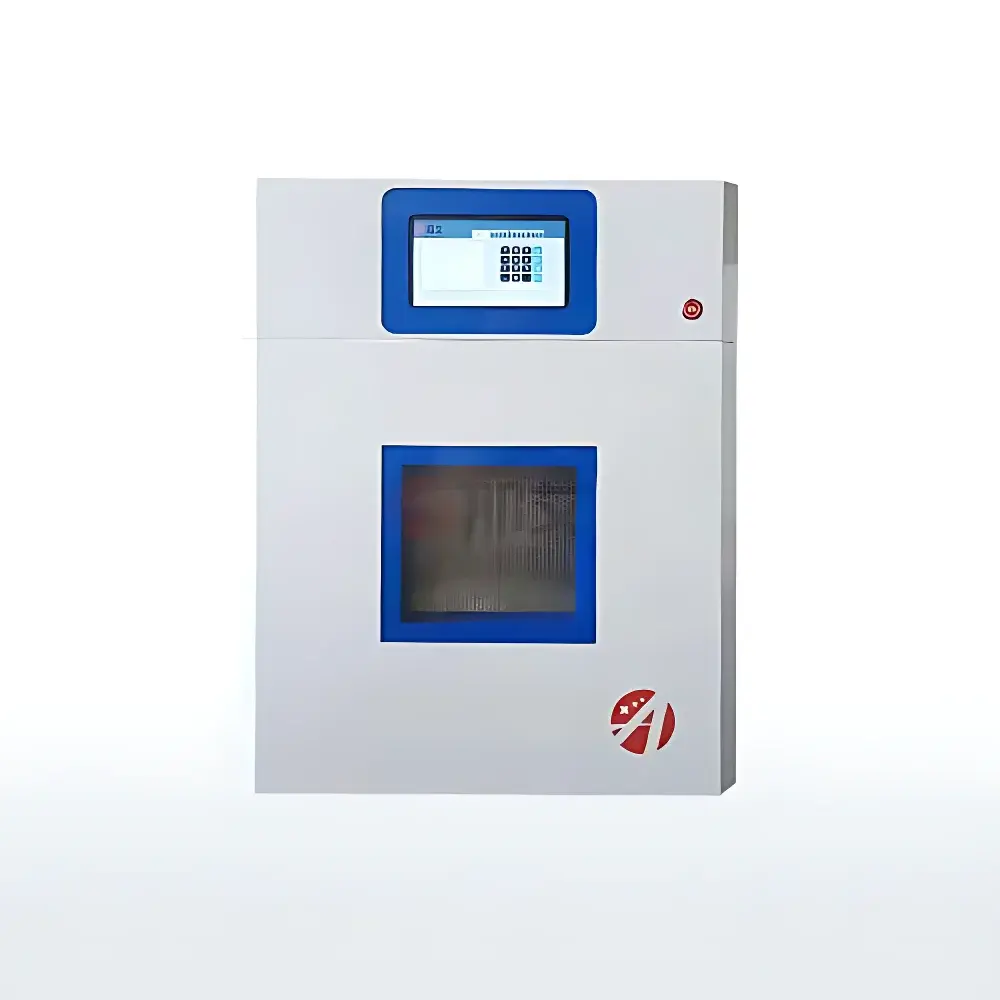
NAI-WB24 Industrial-Grade Microwave Digestion System with Infrared Temperature Monitoring
| Brand | NAI Instruments |
|---|---|
| Origin | Shanghai, China |
| Manufacturer Type | Authorized Distributor |
| Origin Category | Domestic (China) |
| Model | NAI-WB24 |
| Price Range | USD 21,000 – 28,000 |
| Cavity Class | Industrial Grade |
| Sample Capacity | 24 vessels (standard configuration) |
| Microwave Source | Dual Magnetron |
| Max Operating Temperature | 300 °C |
| Temp. Measurement Accuracy | ±1 °C |
| Temp. Control Stability | ±1 °C |
| Temp. Uniformity Across Cavity | ±1 °C |
| Max Operating Pressure | 1500 psi |
| Cavity Volume | 66 L |
| Power Output | 0–2200 W (continuously variable) |
| Control System | Siemens PLC with 8-inch TFT-LED touchscreen (800×480) |
| Vessel Material | TFM-modified PTFE inner vessel + PEEK reinforced safety sleeves |
| Vessel Volume | 70 mL (standard), optional 100 mL |
| Cooling | Integrated acid-resistant forced-air ventilation with internal cavity air circulation |
| Safety | Self-locking buffered anti-explosion door with multi-point mechanical interlock and real-time pressure/temperature dual monitoring |
Overview
The NAI-WB24 Industrial-Grade Microwave Digestion System is a high-performance sample preparation instrument engineered for complete, reproducible acid digestion of solid and semi-solid matrices prior to elemental analysis by ICP-OES, ICP-MS, AAS, or other trace metal quantification techniques. It employs continuous non-pulsed microwave energy delivery via dual magnetron architecture with automatic frequency tuning (2450 MHz ±50 MHz), ensuring stable power coupling and uniform electromagnetic field distribution across the 66 L stainless-steel (316-grade) cavity. Unlike legacy pulsed systems, this adaptive frequency control minimizes standing wave formation and thermal hotspots—critical for achieving consistent digestion efficiency across all 24 reaction vessels simultaneously. Temperature is monitored in real time using calibrated infrared pyrometry, enabling non-contact, vessel-independent measurement without optical window fouling or sensor drift. Pressure is independently measured via ruggedized piezoresistive transducers mounted on each rotor port. The dual-parameter (T/P) closed-loop feedback system maintains precise setpoint adherence throughout ramp, hold, and cooldown phases—meeting the stringent thermal protocol requirements of EPA Method 3051A, 3052, ISO 11466, and ASTM D5511.
Key Features
- Industrial-class 66 L cavity constructed from electropolished 316 stainless steel with six-layer PTFE–ceramic composite coating for exceptional resistance to HNO₃, HF, HCl, and aqua regia vapors
- Self-locking buffered anti-explosion door with triple-stage mechanical interlock, pressure-actuated latch release, and deformable energy-absorbing gasket—certified to withstand >1500 psi overpressure events without structural compromise
- Dual magnetron microwave source (2200 W max output) with vertical bidirectional waveguide design and 3D field homogenization for ±1 °C temperature uniformity across all 24 positions
- Infrared-based temperature monitoring system with spectral response optimized for 8–14 µm emission band—eliminates need for fiber-optic probes or thermocouples that degrade under aggressive acid conditions
- Siemens S7-1200 PLC controller with 8-inch industrial-grade TFT-LED touchscreen interface supporting multistep method programming, audit trail logging, and user-level access control
- Integrated corrosion-resistant forced-air cooling system with axial fans and heat-exchange ducting—enables rapid post-digestion cooldown (<15 min from 300 °C to 60 °C) while maintaining acid vapor containment
Sample Compatibility & Compliance
The NAI-WB24 accommodates standard 70 mL TFM-PTFE digestion vessels housed in reinforced PEEK outer sleeves, rated for sustained operation up to 300 °C and 1500 psi. It supports routine digestion of geological samples (soils, sediments, ores), biological tissues (plant, animal, clinical), polymers, foodstuffs, and environmental filters. All vessel configurations comply with ISO/IEC 17025 documentation requirements for method validation, and the system’s dual-parameter control architecture satisfies GLP/GMP data integrity criteria per FDA 21 CFR Part 11 when configured with electronic signature and audit trail modules. Full traceability—including timestamps, operator ID, method version, raw T/P curves, and failure event logs—is retained for ≥10,000 cycles.
Software & Data Management
The embedded control firmware provides intuitive method editor functionality with up to 100 programmable steps per protocol, including ramp rate (°C/min), hold duration (s), power modulation profiles, and safety cutoff thresholds. Data export is supported via USB 2.0 and Ethernet (TCP/IP) to CSV or XML formats compatible with LIMS integration. Optional software packages include NAI-DigestLink™ for remote monitoring, batch report generation, and statistical process control (SPC) charting of digestion repeatability (RSD < 2.5% for Cr, Pb, Cd in certified reference materials). All system logs are cryptographically hashed and timestamped to prevent tampering—aligned with ALCOA+ principles (Attributable, Legible, Contemporaneous, Original, Accurate, Complete, Consistent, Enduring, Available).
Applications
This system is routinely deployed in accredited environmental testing laboratories for EPA SW-846 compliant digestion of wastewater sludge and contaminated soils; in metallurgical QA/QC labs for total metal content determination in alloys and catalysts; in food safety facilities executing EN 13805 for heavy metals in infant formula and dietary supplements; and in academic research centers conducting speciation studies requiring quantitative recovery of volatile elements (e.g., As, Se, Hg) without loss. Its robust thermal management and IR-based sensing make it especially suitable for high-silica matrices (e.g., ceramics, fly ash) where conventional contact sensors fail due to condensate interference.
FAQ
Does the NAI-WB24 support regulatory-compliant audit trails for GLP environments?
Yes—the system records full operational history with immutable timestamps, user authentication, and method revision tracking. When paired with optional NAI-SecureLog™ module, it meets FDA 21 CFR Part 11 electronic record requirements.
Can the instrument digest samples containing hydrofluoric acid (HF)?
Yes—vessels are fabricated from TFM-modified PTFE, and the cavity interior features a multi-layer fluoropolymer–ceramic barrier proven resistant to HF concentrations up to 10% v/v at 250 °C.
What is the typical digestion cycle time for soil samples using EPA Method 3052?
Average cycle duration is 38–42 minutes, including ramp (15 min), hold (20 min at 180 °C), and active cooling (3–5 min), depending on sample mass and acid composition.
Is remote diagnostics or firmware update capability available?
Yes—via secure HTTPS-enabled web interface with role-based access; updates require digital signature verification and automatic rollback on checksum failure.
How is temperature calibration verified during routine operation?
Infrared sensor linearity is validated daily using NIST-traceable blackbody reference sources (±0.2 °C uncertainty); cavity uniformity is confirmed quarterly using spatially distributed thermocouple mapping per ISO/IEC 17025 Annex A.3.



