
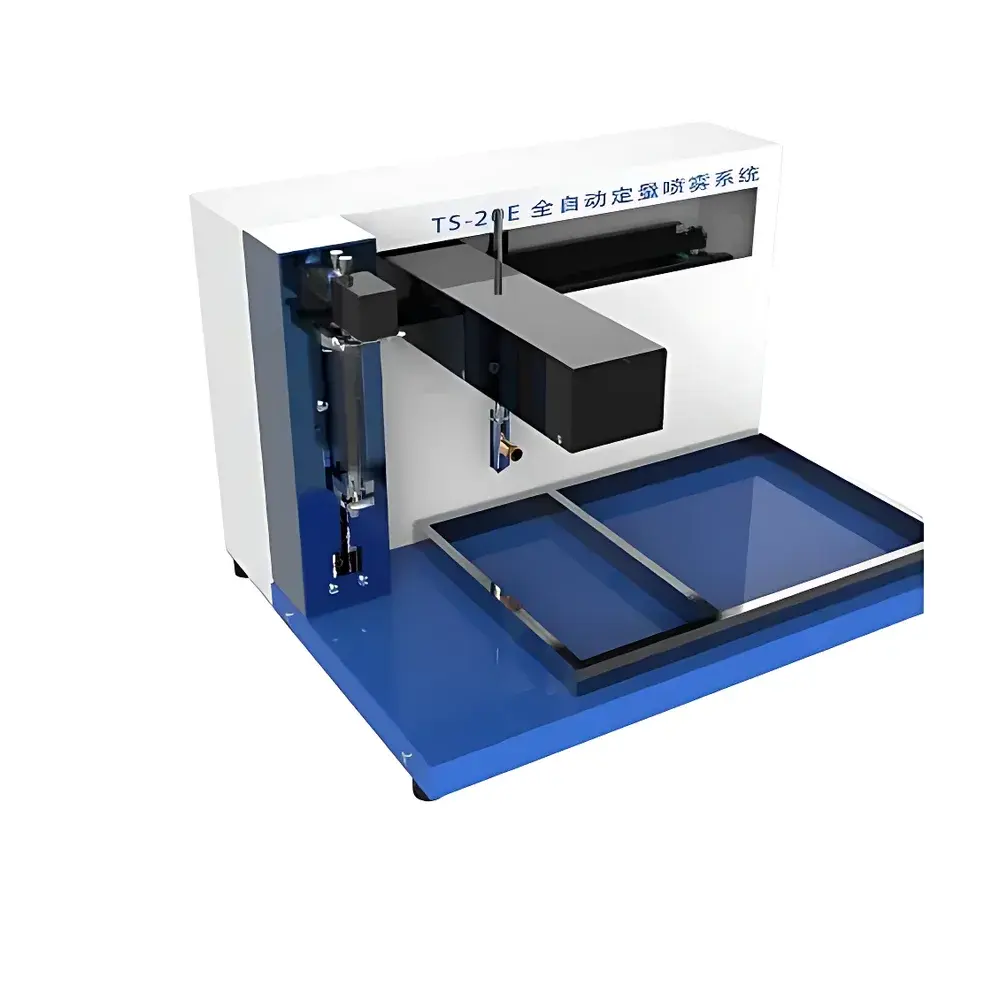
KEZHE TS-20E Automated Quantitative Spray System for Thin-Layer Chromatography
| Brand | KEZHE SHANGHAI |
|---|---|
| Origin | Shanghai, China |
| Manufacturer Type | Direct Manufacturer |
| Country of Origin | China |
| Model | TS-20E |
| Operation Mode | Fully Automatic |
| Measurement Modes | Reflectance Absorption, Reflectance Fluorescence, Transmittance Absorption, Transmittance Fluorescence |
| Wavelength Range | 190–800 nm |
| Light Sources | Xenon Lamp, Tungsten-Halogen Lamp, High-Pressure Mercury Lamp |
| Monochromator | Holographic Grating (1200 lines/mm) with Nitrogen Purge Capability |
| Spectral Bandwidth | 5 nm |
| Wavelength Accuracy | < 1 nm |
| Wavelength Repeatability | < 0.2 nm |
| Minimum Spatial Resolution | 25 µm |
| Imaging Wavelengths | 254 nm, 365 nm, White Light |
| Sample Stage Capacity | Accommodates TLC Plates up to 200 mm × 200 mm |
| Maximum Scanning Speed | 100 mm/s |
| Syringe Volume Range | 0.2–10 mL |
| Liquid Handling Speed | 0.1–25 mL/min (Aspiration/Dispense/Clean) |
| Pre-spray Area (X/Y) | 0–100 mm / 0–200 mm |
| Full Spray Area (X/Y) | 0–200 mm / 0–200 mm |
Overview
The KEZHE TS-20E Automated Quantitative Spray System is a precision-engineered platform designed specifically for reproducible, spatially controlled reagent delivery in thin-layer chromatography (TLC) and planar surface derivatization workflows. Unlike manual spraying or generic liquid handlers, the TS-20E integrates high-accuracy syringe pump technology with motorized X-Y stage control and optical alignment feedback to enable quantitative, non-contact spray deposition across full-size TLC plates (up to 200 mm × 200 mm). Its core operational principle relies on volumetric displacement via calibrated micro-syringes, synchronized with real-time stage positioning and programmable dispensing parameters—including flow rate, dwell time, nozzle height, and raster path geometry. This architecture ensures consistent droplet size distribution, minimal edge effects, and negligible cross-contamination between lanes or zones—critical requirements for combinatorial chemistry screening, quantitative densitometric analysis, and GLP-compliant plate-based assays.
Key Features
- Fully automated, software-controlled spray trajectory programming with support for full-plate, region-specific, or patterned deposition (e.g., grid, stripe, or custom ROI)
- High-precision dual-channel syringe pump system with volumetric accuracy ±1.5% over 0.2–10 mL range and flow rate control from 0.1 to 25 mL/min
- Corrosion-resistant spray head assembly compatible with organic solvents, acidic/basic derivatizing agents (e.g., anisaldehyde/H2SO4, ninhydrin, Dragendorff’s reagent), and fluorescent dyes
- Integrated nitrogen-purged monochromator and multi-source illumination (xenon, tungsten-halogen, Hg lamp) enabling simultaneous or sequential post-spray detection at 254 nm, 365 nm, or white light
- Optimized aerosol generation with adjustable nozzle pressure and pulse modulation to minimize overspray, solvent pooling, and thermal degradation of labile analytes
- Self-calibrating stage positioning with optical encoder feedback ensuring sub-millimeter repeatability across repeated spray cycles
Sample Compatibility & Compliance
The TS-20E accommodates standard silica gel, alumina, cellulose, and reversed-phase TLC plates (including pre-coated and handmade layers), as well as porous polymer membranes and nitrocellulose strips used in immunodetection. All wetted components—including fluidic pathways, syringe barrels, and spray nozzles—are constructed from chemically inert materials (e.g., PTFE, sapphire, stainless steel 316L) to ensure compatibility with aggressive reagents such as concentrated sulfuric acid, chlorinated solvents, and oxidizing agents. The system supports audit-trail-enabled operation per FDA 21 CFR Part 11 when integrated with compliant LIMS or ELN platforms. Routine performance verification follows ISO/IEC 17025 guidelines for volumetric delivery systems, with documented calibration against NIST-traceable standards for both volume and positional accuracy.
Software & Data Management
Control and method development are executed via the KEZHE QuantSpray™ workstation software—a Windows-based application supporting intuitive graphical workflow design, parameter scripting (CSV/XML import), and real-time monitoring of pump status, stage coordinates, and solvent consumption. Each spray run generates a timestamped metadata log including user ID, method name, plate ID, environmental conditions (optional external sensor integration), and digital signature for electronic record integrity. Export formats include PDF reports, CSV data tables, and TIFF/RAW image stacks aligned with plate coordinate space—facilitating downstream integration with commercial TLC imaging suites (e.g., ImageJ plugins, CAMAG WinCATS, or open-source densitometry pipelines). Remote diagnostics and firmware updates are supported over Ethernet with TLS 1.2 encryption.
Applications
- Uniform derivatization of combinatorial TLC libraries for high-throughput hit identification in medicinal chemistry
- Quantitative post-chromatographic visualization of low-abundance metabolites in natural product extracts using controlled iodine or vanillin/H2SO4 exposure
- Multi-step on-plate reactions requiring sequential reagent deposition (e.g., coupling followed by cyclization)
- Preparative TLC plate priming prior to electrospray or MALDI matrix application
- Standardized calibration curve generation via gradient spray of internal standards across a single plate
- Reproducible immobilization of antibodies or aptamers onto functionalized TLC surfaces for lateral flow assay development
FAQ
What types of derivatization reagents are compatible with the TS-20E?
The system supports aqueous, alcoholic, acidic, basic, and chlorinated organic solutions. Common examples include sulfuric acid–ethanol mixtures, p-anisaldehyde reagent, ninhydrin in acetone, and diazotized sulfanilic acid. Compatibility must be verified for highly viscous (>50 cP) or particulate-containing formulations.
Can the TS-20E perform gradient or multi-reagent spraying in a single run?
Yes—via optional dual-syringe configuration and valve-switching module, enabling sequential or co-spraying of up to two reagents with independent flow control and spatial registration.
Is the system suitable for GMP-regulated environments?
When deployed with validated software configurations, electronic signatures, and change-controlled documentation, the TS-20E meets baseline requirements for instrument qualification (IQ/OQ/PQ) under ICH Q7 and EU Annex 11 frameworks.
How is nozzle clogging mitigated during extended use?
The system includes automated solvent flush cycles before and after each run, plus ultrasonic cleaning mode for the spray head assembly. Filtered reagents (<0.45 µm) and regular maintenance of the sapphire nozzle tip are recommended.
Does the TS-20E integrate with third-party TLC imagers?
Yes—through standardized RS-232/Ethernet command protocols and TIFF-based image export, it interoperates with CAMAG, Desaga, and custom-built imaging stations. Coordinate mapping files (XML) can be exported for geometric registration.
Related Products





