
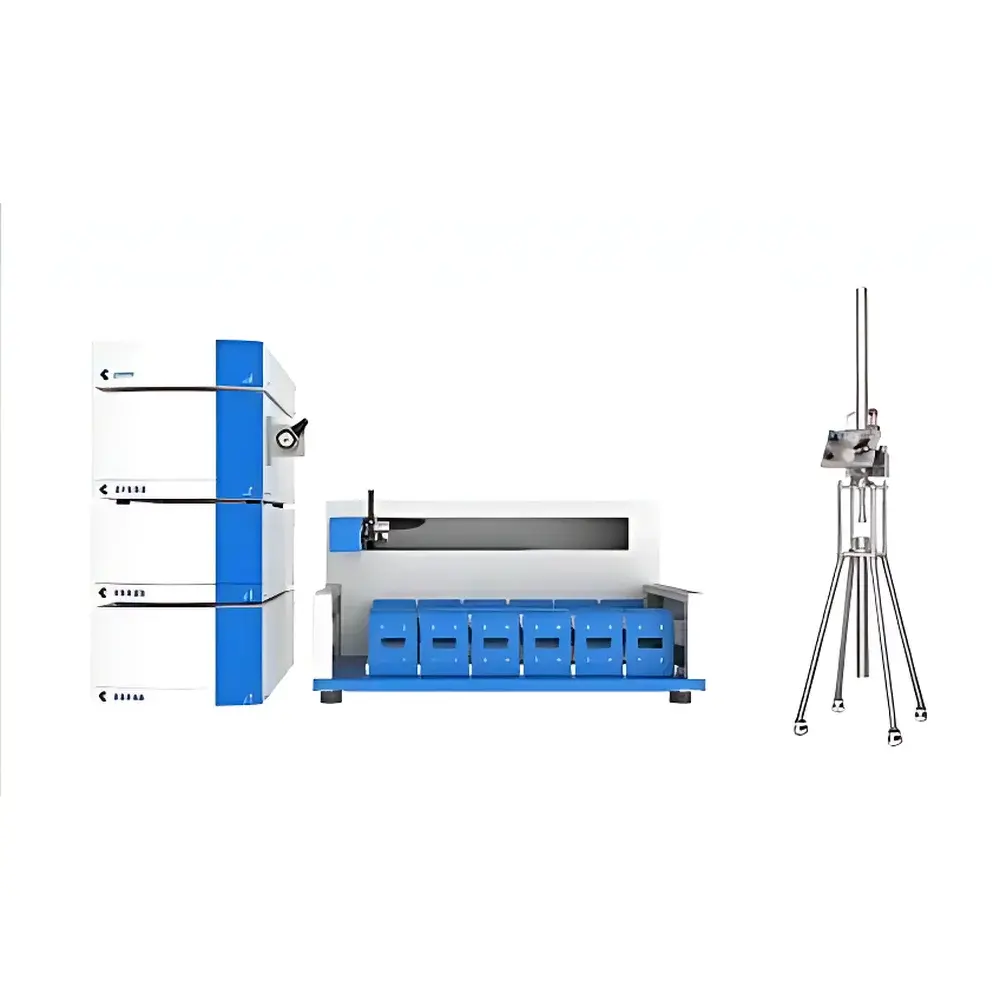
ScalePuri-50 Preparative High-Pressure Liquid Chromatography System
| Brand | KEZHE SHANGHAI |
|---|---|
| Origin | Shanghai, China |
| Manufacturer Type | Direct Manufacturer |
| Model | ScalePuri-50 |
| Application Level | Pilot-Scale Laboratory |
| Instrument Type | High-Pressure Preparative Liquid Chromatograph |
| Maximum Flow Rate | 0–200 mL/min |
| Flow Accuracy | ±2.0% |
| Pressure Rating | Up to 20 MPa |
| Wavelength Range | 190–850 nm |
| Wavelength Accuracy | ±1 nm |
| Spectral Bandwidth | 8 nm |
| Baseline Noise | ±0.2 mAU (at 254 nm) |
| Baseline Drift | 0.5 mAU (at 254 nm) |
| Detection Modes | Quadruple Wavelength Simultaneous Monitoring |
| Column Compatibility | Axial Compression Columns (DAC50, ID 10–50 mm) |
| Fraction Collection | Volume-, Peak-, Time-, or Threshold-Triggered |
| Software Compliance | 21 CFR Part 11 Ready, Audit Trail, Electronic Signatures, User & Role Management |
| Regulatory Alignment | Designed for GLP/GMP environments, supports IQ/OQ/PQ validation |
Overview
The ScalePuri-50 Preparative High-Pressure Liquid Chromatography System is an integrated, pilot-scale purification platform engineered for reproducible, scalable separation of complex mixtures under controlled high-pressure conditions. Built upon classical reversed-phase and normal-phase liquid chromatography principles, the system utilizes dual high-precision parallel plunger pumps to deliver stable binary gradient elution—enabling precise modulation of solvent composition across a wide flow range (0–200 mL/min). Its core architecture supports axial compression dynamic adsorption columns (e.g., DAC50, 10–50 mm i.d.), ensuring uniform flow distribution, minimized channeling, and enhanced resolution at pressures up to 20 MPa. Unlike analytical HPLC systems optimized for detection sensitivity, the ScalePuri-50 prioritizes mass throughput, column loading capacity (gram-scale), and operational robustness—making it suitable for early-stage process development in pharmaceutical, natural product, and synthetic chemistry laboratories where transition from mg- to g-scale purification is critical.
Key Features
- Dual high-accuracy parallel plunger pumps with linear binary gradient mixing and real-time pressure monitoring, including overpressure alarm and automatic shutdown protection.
- UV-Vis detector with simultaneous quadruple-wavelength monitoring (190–850 nm), equipped with deuterium and tungsten-halogen lamps, 8 nm spectral bandwidth, and active light-intensity calibration and lamp-life tracking.
- Integrated axial compression column interface supporting DAC50 columns (10–50 mm i.d.), enabling high-resolution separations with improved packing stability and column reusability.
- Intelligent fraction collector with programmable triggers: volume-based, UV-threshold, time-segmented, or peak-synchronized collection—compatible with customizable rack configurations (e.g., 60-position 30 mm test tube trays).
- Modular LC workstation software featuring full remote instrument control, on-the-fly parameter adjustment, real-time chromatogram overlay, peak integration, and quantitative analysis with retention time alignment algorithms.
- Comprehensive data governance framework compliant with regulatory requirements: audit trail with immutable timestamps, role-based user access control, electronic signatures, and configurable password policies.
- Hardware and firmware architecture designed for qualification: supports Installation Qualification (IQ), Operational Qualification (OQ), and Performance Qualification (PQ) documentation packages aligned with ISO/IEC 17025, USP , and ICH Q5C guidelines.
Sample Compatibility & Compliance
The ScalePuri-50 accommodates diverse sample matrices—including crude extracts, reaction mixtures, fermentation broths, and synthetic intermediates—across polarity ranges suitable for C18, silica, amino, and cyano stationary phases. Its column hardware interface accepts standard 1/4″ and 1/8″ tubing connections and integrates seamlessly with optional accessories such as inline filters, evaporative light-scattering detectors (ELSD), and auxiliary solvent degassers. From a compliance standpoint, the system’s firmware and software architecture adhere to fundamental principles of Good Manufacturing Practice (GMP) and Good Laboratory Practice (GLP). All data acquisition, processing, and storage operations are traceable, version-controlled, and protected against unauthorized modification—fulfilling baseline expectations for FDA 21 CFR Part 11 Subpart B (electronic records and signatures) and EU Annex 11 (computerized systems). Validation support documentation—including risk assessments, URS templates, and test protocols—is provided to facilitate site-specific 3Q implementation.
Software & Data Management
The ScalePuri-50 operates via a dedicated modular liquid chromatography workstation built on a Windows-based architecture with deterministic real-time kernel extensions. The software provides synchronized control of pump gradients, detector wavelength selection, fraction collection logic, and valve sequencing—all accessible through a unified graphical interface. Raw chromatographic data are stored in vendor-neutral, timestamped .CDF files (compatible with ASTM E1985-02 and ISO/IEC 11179 metadata standards), while processed results (peak tables, purity reports, yield calculations) export to CSV, PDF, or Excel formats. Audit trail entries record every user action—including method creation, parameter edits, run initiation, and data deletion—with hash-verified integrity checks. The system supports multi-level user roles (Administrator, Analyst, Reviewer), each with granular permissions over method libraries, report generation, and archive access. Optional network deployment enables centralized data backup, LDAP/Active Directory integration, and scheduled database maintenance routines.
Applications
The ScalePuri-50 serves as a bridge between analytical characterization and industrial-scale manufacturing. It is routinely deployed in: isolation of bioactive constituents from botanical extracts (e.g., flavonoids, alkaloids, terpenoids); purification of synthetic peptides and oligonucleotides; removal of residual catalysts or protecting groups in fine chemical synthesis; recovery of enantiomerically enriched compounds using chiral stationary phases; and preparative fractionation of monoclonal antibody fragments or recombinant proteins under denaturing or native conditions. Its ability to perform both coarse desalting and high-resolution polishing in a single platform reduces method transfer overhead and accelerates process optimization cycles. Academic and contract research organizations leverage its scalability for generating reference standards, stability-indicating impurity isolates, and material for structural elucidation (NMR, MS).
FAQ
What column formats are supported by the ScalePuri-50?
The system is optimized for axial compression columns (DAC series), with standard compatibility for 10–50 mm internal diameter columns—including the included DAC50. Custom column adapters are available for non-standard geometries.
Does the system support method transfer from analytical HPLC?
Yes—gradient delay volume compensation, dwell volume calibration, and linear velocity scaling tools enable systematic translation of analytical methods to preparative scale while preserving selectivity and resolution.
Is the software validated for regulated environments?
The workstation includes preconfigured 21 CFR Part 11 compliance modules (audit trail, electronic signatures, user management), and validation documentation packages are supplied for IQ/OQ/PQ execution.
Can the UV detector operate at multiple wavelengths simultaneously?
Yes—the detector acquires four independent wavelength channels in real time, allowing concurrent monitoring of primary analyte, impurities, and solvent front without spectral scanning delays.
What safety features prevent column damage during operation?
Hardware-level pressure sensors trigger immediate pump stop and audible/visual alerts if set thresholds exceed 20 MPa; additionally, flow-rate ramping profiles and solvent compressibility compensation algorithms minimize hydraulic shock during gradient transitions.





