
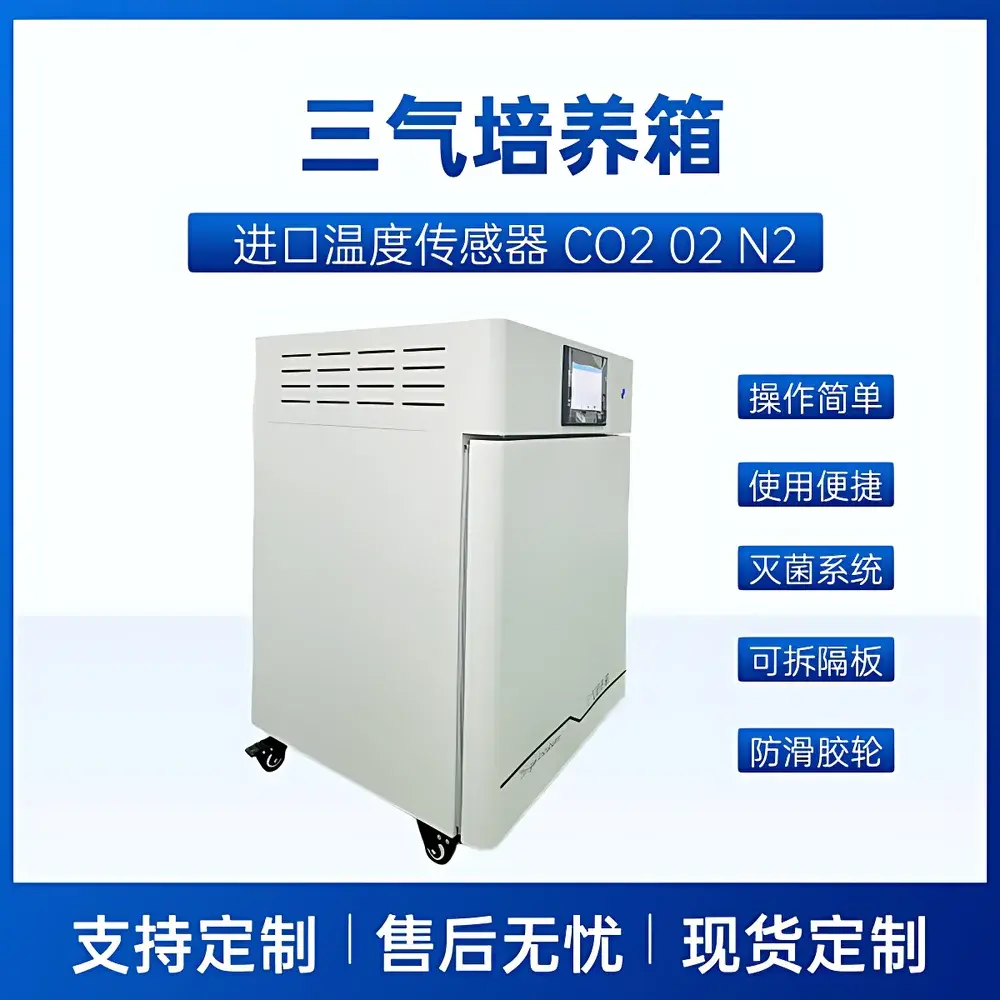
ANYAN CYSQ-30-III Tri-Gas Incubator for Hypoxic Embryo and Cell Culture
| Key Features | IR-based CO₂ sensing |
|---|---|
| Temperature range | Rt+3–60 °C |
| Temp. uniformity | ±0.3 °C @ 37 °C |
| CO₂ range | 0–20% (±0.1% accuracy) |
| O₂ range | 1–95% (±0.3% accuracy) |
| External dimensions | 550×530×890 mm |
| Construction | 304 stainless steel interior |
| Gas supply logic | N₂/CO₂ blending for hypoxia (<19.8% O₂) |
| Compliance | Designed for ISO 13485-aligned lab environments, GLP-compliant operation support |
Overview
The ANYAN CYSQ-30-III Tri-Gas Incubator is an engineered environmental control system designed to maintain precise, independent regulation of oxygen (O₂), carbon dioxide (CO₂), and temperature within a sealed chamber—critical for advanced cell culture, embryology, stem cell research, and hypoxia/hyperoxia modeling. Unlike standard CO₂ incubators, this tri-gas platform employs dual gas modulation logic: below 19.8% O₂, high-purity nitrogen (N₂) and CO₂ are blended to achieve stable low-oxygen conditions without compromising CO₂ setpoint fidelity; above 23% O₂, medical-grade oxygen is introduced alongside CO₂ to sustain elevated O₂ environments while preserving pH stability via controlled bicarbonate buffering. The system operates on a forced-air micro-circulation principle—mimicking natural convection—to accelerate recovery of thermal and gaseous equilibria after door openings, ensuring minimal perturbation during routine access. Its chamber is constructed entirely from electropolished 304 stainless steel with seamless, radius-rounded corners to eliminate microbial harborage points and facilitate validated cleaning protocols.
Key Features
- IR infrared CO₂ sensor: Non-contact, drift-resistant detection with <±0.1% full-scale accuracy and >10-year operational lifespan—eliminating calibration drift associated with thermal conductivity or chemical sensors.
- Electrochemical O₂ sensor: Linear response across 1–95% O₂ range, factory-calibrated against traceable NIST standards, with built-in temperature compensation to ensure measurement integrity under dynamic thermal loads.
- Distributed PT100 temperature monitoring: Five wall-mounted and one door-mounted platinum resistance thermometers feed real-time data to a PID-controlled heating algorithm, enabling spatially resolved thermal management and minimizing gradient formation.
- Independent door temperature control: A dedicated heating circuit maintains the door surface at near-chamber temperature, reducing condensation, thermal bridging, and cold-spot formation at the interface—particularly critical during prolonged incubation cycles.
- Micro-fan air circulation system: Low-turbulence airflow pattern optimized for laminar distribution—validated via ASTM F2118 thermal mapping protocols—to achieve ±0.3 °C uniformity at 37 °C across the entire working volume.
- UV-C sterilization module: 254 nm germicidal lamp with programmable activation cycles (15–60 min), integrated interlock preventing operation during door open states, supporting routine decontamination without chemical agents.
- Natural evaporation humidification: Stainless steel water pan design ensures ≥90% relative humidity without ultrasonic misting—avoiding mineral deposition, aerosol generation, or microbiological amplification risks inherent in active humidification systems.
Sample Compatibility & Compliance
The CYSQ-30-III supports a broad spectrum of biological sample formats—including Petri dishes, multi-well plates (6–96-well), T-flasks, roller bottles, and IVF culture dishes—without requiring mechanical adapters or airflow obstructions. Its gas-tight sealing mechanism (dual silicone gasket + magnetic latch) maintains chamber integrity under differential pressure conditions typical of rapid O₂ ramping (e.g., 21% → 1% in <15 min). The incubator meets structural and functional requirements referenced in ISO 13485:2016 (Medical Devices – Quality Management Systems) for laboratory equipment used in regulated reproductive medicine workflows. While not FDA-cleared as a medical device, its architecture supports 21 CFR Part 11-compliant data logging when paired with optional external audit-trail software—enabling electronic signatures, user-level access controls, and immutable event records for GLP/GMP-aligned studies.
Software & Data Management
The 5-inch capacitive touchscreen interface provides intuitive parameter setting, real-time trend visualization (temperature, O₂, CO₂, humidity), and configurable alarm thresholds (e.g., O₂ deviation >±0.5%, door-open duration >60 s). All sensor outputs are logged internally at 10-second intervals for up to 30 days, exportable via USB to CSV format for integration into LIMS or statistical analysis platforms (e.g., JMP, GraphPad Prism). Optional Ethernet/Wi-Fi connectivity enables remote monitoring through secure HTTPS endpoints and SNMP-based network health alerts. Audit trail functionality—when enabled—records operator ID, timestamp, parameter change, and pre/post values, satisfying ALCOA+ principles (Attributable, Legible, Contemporaneous, Original, Accurate) for regulatory submissions.
Applications
- Hypoxia research: Modeling physiological (1–5% O₂) and pathological (<1% O₂) oxygen tension in cancer biology, ischemic injury, and placental development studies.
- Embryo culture: Maintaining optimal gas composition (5% CO₂, 5% O₂, 90% N₂) for human blastocyst development in ART laboratories per ESHRE guidelines.
- Stem cell expansion: Preserving pluripotency in induced pluripotent stem cells (iPSCs) under controlled O₂ (2–5%) to reduce oxidative stress and genomic instability.
- Microaerophilic pathogen cultivation: Supporting growth of Campylobacter jejuni, Helicobacter pylori, and other fastidious organisms requiring sub-atmospheric O₂.
- Preclinical toxicology: Exposing primary hepatocytes or co-cultures to graded O₂ gradients to assess metabolic adaptation and drug-induced mitochondrial dysfunction.
FAQ
How does the CYSQ-30-III achieve ±0.3 °C temperature uniformity at 37 °C?
Through a combination of five-wall PT100 sensing, adaptive PID heating, micro-fan-driven laminar airflow, and independently heated door surfaces—validated per ISO 15189 Annex A.3 thermal mapping procedures.
What gas purity specifications are required for optimal O₂ and CO₂ control?
Medical-grade CO₂ (99.995% purity, <5 ppm hydrocarbons) and N₂/O₂ (99.999% purity, <1 ppm moisture) are recommended to prevent sensor poisoning and ensure long-term calibration stability.
Can the incubator operate continuously for >72 hours under 1% O₂ without performance degradation?
Yes—its electrochemical O₂ sensor includes automatic baseline correction and temperature-compensated diffusion membranes, enabling stable operation across extended hypoxic runs with no observed signal drift over 168-hour validation cycles.
Is the UV sterilization cycle validated for log-6 reduction of Bacillus atrophaeus spores?
Validation data is available upon request; standard 30-min UV exposure achieves ≥log-4 reduction of common environmental isolates (Aspergillus niger, Staphylococcus aureus) per ISO 15714:2019 methodology.
Does the system support third-party integration with building management systems (BMS)?
Yes—Modbus RTU over RS-485 is supported for real-time status polling (door state, alarm flags, current setpoints) and remote emergency shutdown initiation.




