
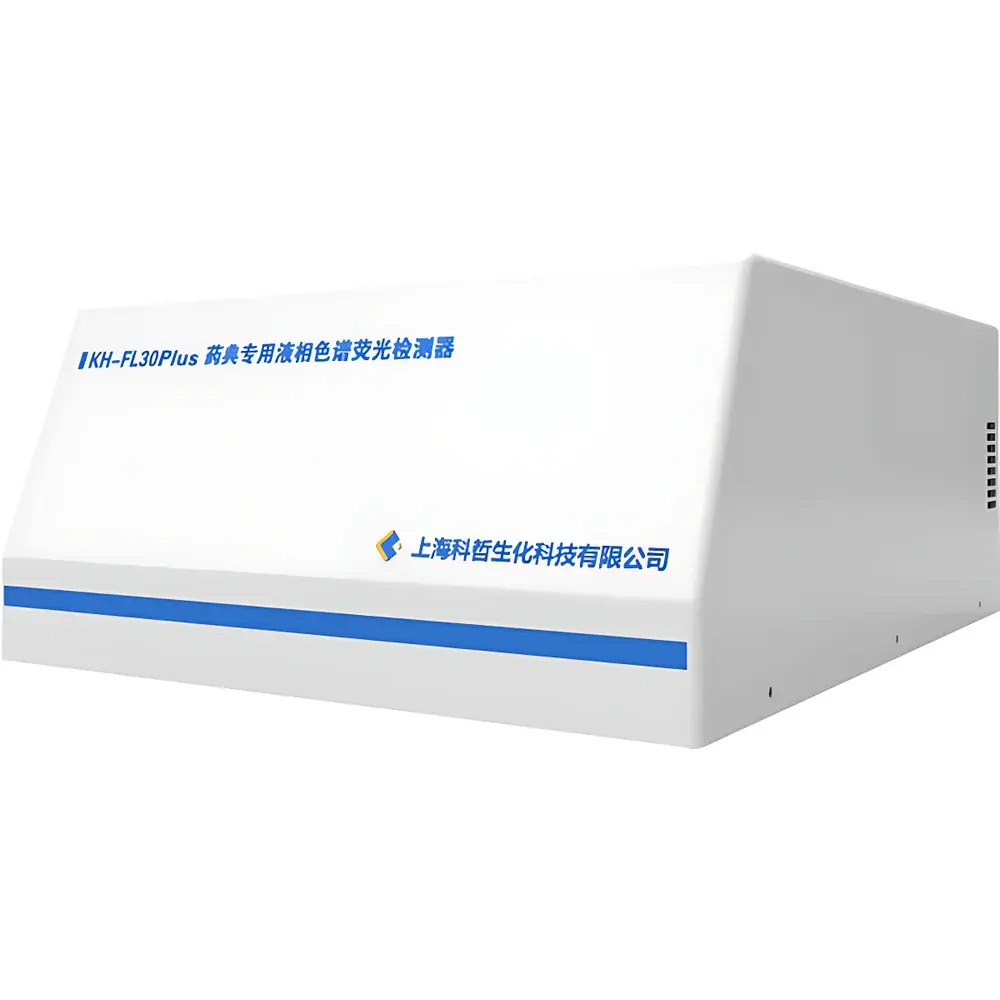
Kezhe KH-FL30Plus HPLC Fluorescence Detector
| Brand | Kezhe Shanghai |
|---|---|
| Origin | Shanghai, China |
| Manufacturer Type | Direct Manufacturer |
| Product Category | Domestic |
| Model | KH-FL30Plus |
| Instrument Type | Fluorescence Detector (FD) |
| Wavelength Range | 190–900 nm (Excitation & Emission) |
| Wavelength Accuracy | ±0.2 nm |
| Wavelength Precision | ±1 nm |
| Spectral Bandwidth | 10 nm / 15 nm |
| Light Source | 150 W DC Xenon Lamp |
| Monochromator | 1200-line Holographic Grating |
| Detector | Photomultiplier Tube (PMT) |
| AD/DA Resolution | 24-bit |
| Temperature Control Range | Ambient to 50 °C (Optional) |
| Compliance | Chinese Pharmacopoeia 2010/2015 Edition, GLP/GMP-Ready, LIMS-Compatible |
Overview
The Kezhe KH-FL30Plus is a high-performance, pharmacopoeia-compliant HPLC fluorescence detector engineered for trace-level quantification of native or derivatized fluorescent analytes in regulated pharmaceutical, food safety, and life science laboratories. It operates on the principle of selective excitation and emission wavelength discrimination using dual monochromators—each based on a 1200-line holographic grating—to isolate narrow spectral bands with high optical throughput and minimal stray light. The detector employs a stabilized 150 W DC xenon lamp as its broadband excitation source, delivering uniform intensity across the full 190–900 nm range—enabling sensitive detection of compounds such as aflatoxins, polycyclic aromatic hydrocarbons (PAHs), carbamates, riboflavin (vitamin B₂), and therapeutic agents without requiring external derivatization hardware in many applications. Its optical architecture supports both fluorescence and phosphorescence modes, with programmable time-resolved emission scanning to enhance selectivity in complex matrices.
Key Features
- Dual-grating monochromator system (excitation & emission) with 1200-line holographic gratings, enabling spectral resolution down to 10 nm bandwidth and wavelength accuracy of ±0.2 nm
- Integrated post-column photochemical derivatization module (standard), optimized for aflatoxin B₁/B₂/G₁/G₂ analysis per Chinese Pharmacopoeia 2015 Edition without auxiliary pumps or heating units
- High-gain, low-noise photomultiplier tube (PMT) detector with 24-bit analog-to-digital conversion, providing >10⁵ dynamic range and sub-picomolar detection limits under typical HPLC flow conditions
- Real-time xenon lamp energy monitoring and automatic intensity calibration to minimize baseline drift and photometric noise over extended runs
- Self-calibrating wavelength alignment function—performed automatically at startup or on demand—to maintain long-term spectral fidelity without manual intervention
- Bio-compatible flow cell design (stainless steel housing with fused-silica optical path) suitable for protein, peptide, and nucleic acid analysis under GLP-compliant conditions
- Analog output interface (0–1 V / 0–5 V / 0–10 V) compatible with major third-party HPLC systems including Agilent, Waters, Shimadzu, and Thermo Fisher platforms
- Optional temperature-controlled flow cell (ambient to 50 °C) with PID regulation—maintains retention time reproducibility and signal stability without compromising sensitivity
Sample Compatibility & Compliance
The KH-FL30Plus is validated for use in regulatory environments requiring documented traceability and audit readiness. It meets the instrumental performance criteria specified in Chapter 0512 of the Chinese Pharmacopoeia (2010 and 2015 editions) for fluorescence detection in HPLC assays. Its firmware and FM-2000 workstation software support full 21 CFR Part 11 compliance—including electronic signatures, audit trails, user access control, and immutable data archiving—making it suitable for GMP manufacturing QC labs and contract research organizations operating under GLP frameworks. The detector has been successfully deployed in routine testing of mycotoxins (aflatoxins, ochratoxin A), environmental contaminants (PAHs), vitamins, and small-molecule pharmaceuticals where native fluorescence or simple photochemical derivatization suffices.
Software & Data Management
The FM-2000 Chromatography Workstation provides integrated instrument control, real-time spectral visualization, peak integration, calibration curve generation, and report export (PDF, CSV, XML). It supports multi-wavelength fluorescence scanning, time-programmed emission wavelength switching (e.g., stepping through λem during a single chromatographic run), and synchronous fluorescence mode for enhanced specificity. All acquisition and processing parameters are stored with metadata tags—including operator ID, method version, instrument serial number, and timestamp—ensuring full traceability. Raw data files are structured in vendor-neutral formats and can be imported into LIMS via standardized ODBC or REST API interfaces. Audit trail logs record every parameter change, data modification, or user login event with tamper-proof timestamps.
Applications
- Aflatoxin analysis in cereals, nuts, and dairy products per national food safety standards
- Quantification of riboflavin (vitamin B₂) in fortified foods and pharmaceutical formulations
- Detection of carbamate pesticides in agricultural commodities using post-column UV irradiation
- Pharmaceutical impurity profiling of fluorescent APIs (e.g., quinolones, tetracyclines)
- Life science research involving intrinsic fluorescence of tryptophan, tyrosine, or NADH in protein and metabolic studies
- Environmental monitoring of PAHs in soil and water extracts following EPA Method 8310
FAQ
Does the KH-FL30Plus require external derivatization equipment for aflatoxin analysis?
No—the integrated photochemical derivatization unit eliminates the need for separate derivatization pumps, reactors, or thermal modules, reducing system complexity and operational cost.
Is the detector compatible with non-Kezhe HPLC systems?
Yes—it features universal analog output and RS-232/USB connectivity, allowing seamless integration with Agilent 1260/1290, Waters e2695, Shimadzu Nexera, and other legacy or modern LC platforms.
Can emission wavelength be changed during a chromatographic run?
Yes—the FM-2000 software supports time-programmed λem switching, enabling multi-analyte detection with optimized selectivity per compound.
What validation documentation is provided for GMP use?
The system includes IQ/OQ protocols, wavelength accuracy verification reports, linearity and LOD/LOQ test data, and 21 CFR Part 11 configuration guides—all delivered with the instrument.
Is temperature control of the flow cell mandatory for pharmacopoeial compliance?
Not mandatory, but recommended for methods requiring high retention time reproducibility; the optional温控 unit maintains ±0.2 °C stability without attenuating signal intensity.





