
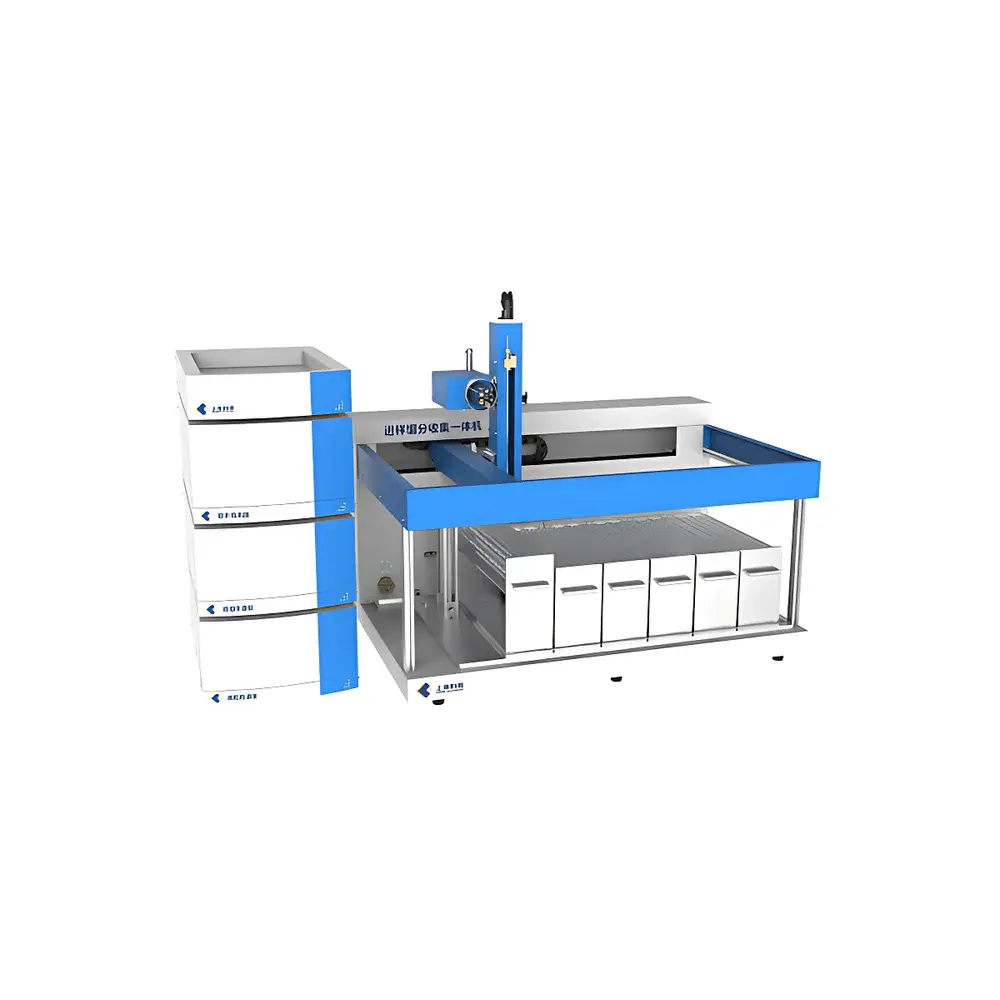
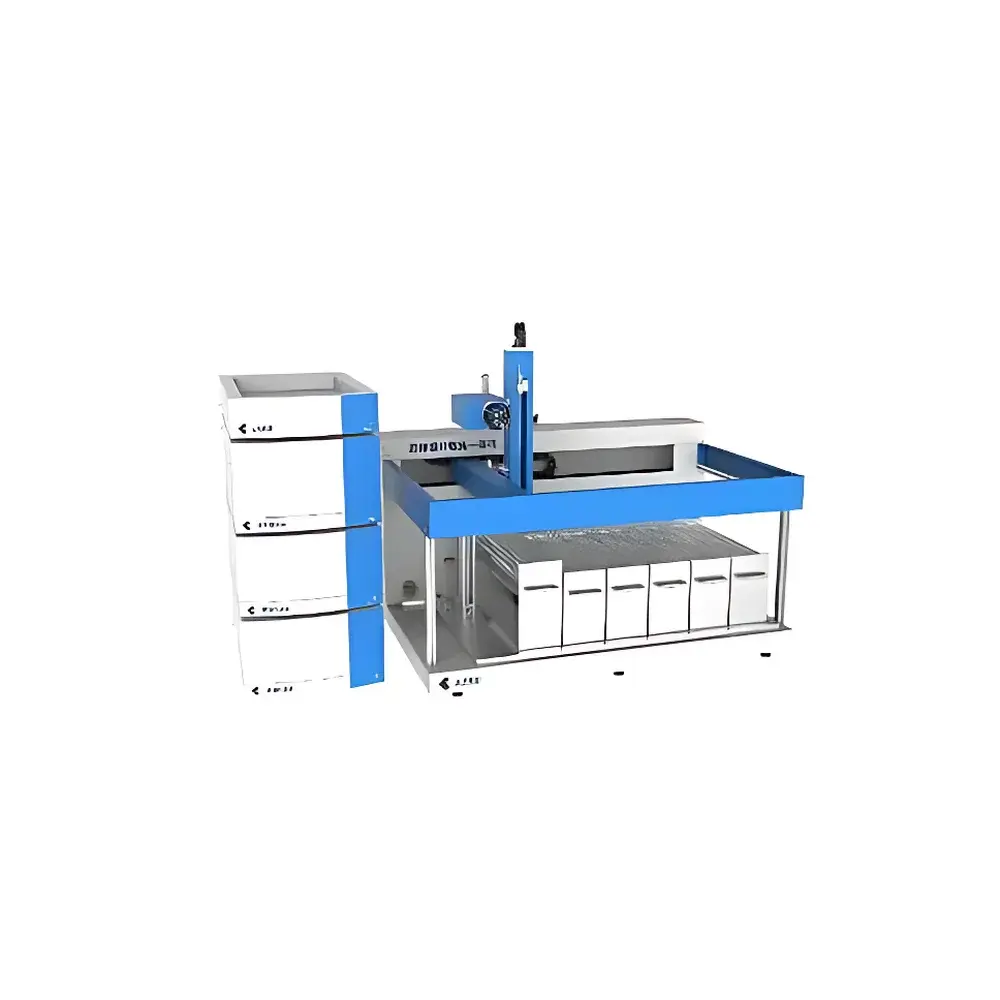
KEZHE PrepChromaster-8000 High-Pressure Preparative Liquid Chromatography System
| Brand | KEZHE SHANGHAI |
|---|---|
| Origin | Shanghai, China |
| Manufacturer Type | OEM Manufacturer |
| Product Category | Domestic |
| Model | PrepChromaster-8000 |
| Flow Rate Range | 0–200 mL/min (single pump), 0–400 mL/min (dual pump) |
| Flow Accuracy | RSD ≤ 0.5% |
| Flow Precision | RSD ≤ 1% |
| Maximum Pressure | 15 MPa |
| Wavelength Range | ±1 nm |
| Wavelength Repeatability | 0.2 nm |
| Baseline Noise | 3 × 10⁻⁵ AU |
| Data Acquisition Rate | 5 Hz |
Overview
The KEZHE PrepChromaster-8000 is a modular, high-pressure preparative liquid chromatography (Prep-LC) system engineered for scalable isolation and purification of small-molecule compounds in pharmaceutical, natural product, and synthetic chemistry laboratories. It operates on the fundamental principle of differential partitioning of analytes between a mobile phase (liquid solvent gradient) and a stationary phase (packed column), with separation resolution governed by column efficiency, gradient control fidelity, and detector sensitivity. Unlike analytical HPLC systems optimized for detection, the PrepChromaster-8000 is purpose-built for mass recovery—supporting gram-scale purification across column diameters from 10 mm to 100 mm. Its dual-pump architecture enables precise binary gradient formation at flow rates up to 400 mL/min, while its 15 MPa pressure rating accommodates high-efficiency stainless-steel columns packed with sub-10 µm particles—enabling higher resolution than conventional flash systems without sacrificing throughput.
Key Features
- Modular high-pressure binary gradient pump system with real-time pressure monitoring, overpressure alarm, and automatic pressure-limiting safety cutoff.
- UV-Vis detector with dual-lamp source (deuterium + tungsten), covering 190–850 nm; capable of simultaneous acquisition and display of four user-defined wavelengths.
- Full-spectrum scanning function with automated wavelength calibration and lamp-life tracking—ensuring long-term photometric stability and traceable maintenance history.
- Dual-path fluidic design: independent sample introduction and fraction collection lines eliminate cross-contamination between runs.
- Intelligent fraction collector with programmable triggers—including time-based, peak-threshold, UV-signal derivative, and manual initiation modes.
- Flexible sample introduction: supports both liquid injection (via 5 mL loop) and direct solid/semi-solid loading—reducing solvent consumption and minimizing pre-injection dilution.
- High-speed, low-dead-volume valve switching (< 100 ms actuation) minimizes band broadening and maximizes recovery yield.
- Monochromator self-calibration routine ensures consistent spectral accuracy across instrument lifetime—critical for method transfer and regulatory compliance.
- Optimized flow cell design delivers baseline noise of ≤3 × 10⁻⁵ AU at 254 nm, enabling robust integration of low-abundance peaks in complex botanical extracts.
Sample Compatibility & Compliance
The PrepChromaster-8000 accommodates diverse sample matrices—including crude plant extracts, reaction mixtures, fermentation broths, and synthetic intermediates—without requiring extensive pre-filtration or derivatization. Its compatibility with both commercial Flash cartridges (e.g., silica, C18, NH₂) and custom-packed stainless-steel columns (up to 100 mm ID, 20 MPa rated) allows seamless transition from rapid screening to high-resolution purification. From a regulatory standpoint, the system’s software architecture supports audit trail generation (per FDA 21 CFR Part 11 requirements), role-based user access control, electronic signature capability, and immutable data archiving—making it suitable for GLP-compliant natural product isolation workflows and early-phase API purification under ICH Q5A/Q5B guidelines. All hardware components meet CE electromagnetic compatibility (EMC) and low-voltage directive standards.
Software & Data Management
The modular PrepChromaster Workstation software provides integrated control of all subsystems—including pump gradient programming, auto-sampler sequencing, UV spectral acquisition, and fraction collection logic—within a single synchronized timeline view. Gradient profiles support linear, stepwise, and “point-and-drag” curve editing, with real-time preview of expected retention shifts. Chromatograms, fraction maps, and system status indicators (valve positions, injection arm location, pump pressure) are overlaid in one coordinated display. Data processing includes peak detection using second-derivative algorithms, area/height quantitation, retention time locking, and customizable report templates compliant with ISO/IEC 17025 documentation frameworks. Raw data files are stored in vendor-neutral .CDF format, facilitating third-party reprocessing and long-term archival per institutional data retention policies.
Applications
- Purification of bioactive alkaloids, flavonoids, terpenoids, and saponins from traditional Chinese medicine (TCM) extracts.
- Isolation of synthetic drug candidates and chiral intermediates following asymmetric catalysis.
- Downstream processing of peptide fragments and modified nucleosides in oligonucleotide therapeutics development.
- Method development and scale-up studies bridging analytical HPLC conditions to preparative throughput.
- Quality control of reference standards used in pharmacopoeial assays (USP, EP, ChP).
FAQ
What column dimensions and particle sizes are supported?
The system is validated for columns ranging from 10 mm to 100 mm internal diameter, with recommended particle sizes from 5 µm to 25 µm—optimized for both high-resolution stainless-steel columns and cost-effective Flash cartridges.
Can the system be integrated with mass spectrometry?
Yes—the UV detector output and fraction collector trigger signals are TTL-compatible, enabling synchronization with external LC-MS interfaces for offline structural confirmation of collected fractions.
Is remote monitoring and control supported?
The workstation software supports secure LAN-based access via authenticated client connections, allowing real-time supervision and parameter adjustment from authorized workstations within institutional networks.
Does the software comply with 21 CFR Part 11?
Yes—audit trails, electronic signatures, user permission tiers, and data immutability features are implemented per current FDA guidance for electronic records in regulated environments.
What maintenance intervals are recommended for the UV lamp and pump seals?
Lamp usage is tracked automatically; replacement is advised after 2,000 hours or upon intensity drop >20%. Pump seal inspection is scheduled every 6 months under continuous operation at ≥10 MPa.





