
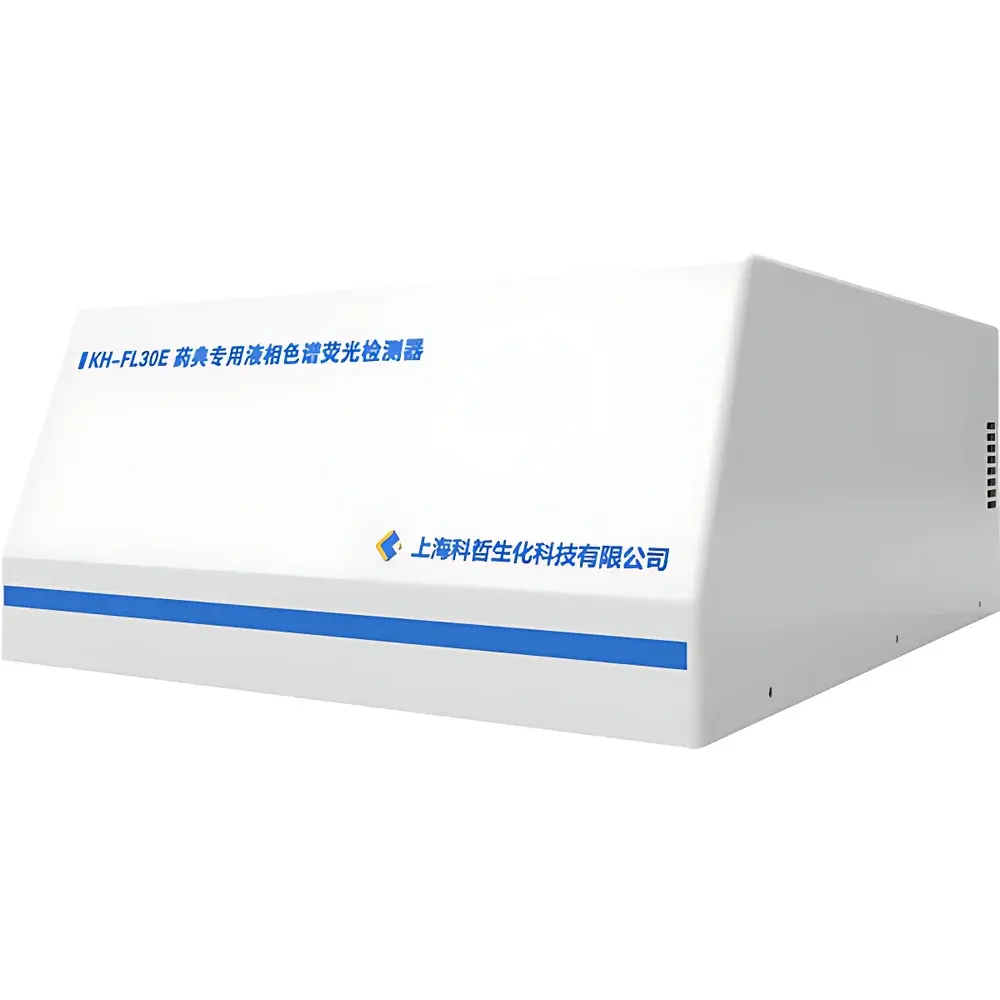
Kezhe KH-FL30E HPLC Fluorescence Detector
| Brand | Kezhe Shanghai |
|---|---|
| Origin | Shanghai, China |
| Manufacturer Type | Original Equipment Manufacturer (OEM) |
| Product Category | Domestic |
| Model | KH-FL30E |
| Instrument Type | Fluorescence Detector (FD) |
| Wavelength Range | 190–900 nm (Excitation & Emission) |
| Measurement Mode | Dual-Beam |
| Light Source | 150 W DC Xenon Lamp |
| Spectral Bandwidth | 10 nm / 15 nm |
| Wavelength Accuracy | ±0.2 nm |
| Wavelength Precision | ±1 nm |
| Monochromator | 1200-line Holographic Grating |
| Detector | Photomultiplier Tube (PMT) |
| AD/DA Resolution | 24-bit |
| Temperature Control Range (Flow Cell) | Ambient to 50 °C |
| Software | FM-2000 Chromatography Workstation |
| Compliance | Chinese Pharmacopoeia (2010 & 2015 Editions), GLP/GMP-ready, LIMS-compatible, FDA 21 CFR Part 11 support (audit trail & electronic signature enabled) |
Overview
The Kezhe KH-FL30E is a high-performance, dual-beam HPLC fluorescence detector engineered for regulatory-compliant quantitative analysis in pharmaceutical quality control, food safety testing, and life science research. It operates on the principle of molecular fluorescence emission following selective excitation—where analytes absorb photons at defined excitation wavelengths and re-emit at longer wavelengths with characteristic Stokes shifts. The detector integrates a stabilized 150 W DC xenon lamp, providing broad-spectrum irradiance across 190–900 nm with superior temporal stability and low baseline drift. Its dual-beam optical architecture actively compensates for source intensity fluctuations in real time, ensuring long-term signal reproducibility essential for GxP environments. Designed specifically to meet the method requirements outlined in the Chinese Pharmacopoeia (ChP) 2010 and 2015 editions for fluorescent analytes—including aflatoxins, polycyclic aromatic hydrocarbons (PAHs), carbamates, riboflavin (vitamin B₂), and therapeutic agents—the KH-FL30E delivers trace-level sensitivity without sacrificing robustness or operational flexibility.
Key Features
- Dual-monochromator design with independently tunable excitation and emission gratings (1200 lines/mm holographic), enabling precise wavelength selection from 190 to 900 nm for both channels
- High-sensitivity photomultiplier tube (PMT) detector with 24-bit analog-to-digital and digital-to-analog conversion, delivering >10⁵ dynamic range and sub-picomolar detection limits for optimized S/N ratio
- Real-time xenon lamp energy monitoring and automatic photometric correction to minimize baseline noise and thermal drift over extended run times
- Programmable fluorescence emission wavelength scanning—supporting time-resolved spectral acquisition and multi-wavelength quantification within a single chromatographic run
- Bio-compatible flow cell with optional Peltier-based temperature control (ambient to 50 °C), maintaining consistent retention and fluorescence quantum yield across variable ambient conditions
- Self-calibrating monochromator system with built-in wavelength reference, ensuring ±0.2 nm accuracy and eliminating manual alignment or external calibration standards
- Analog output interface (0–1 V / 0–5 V / 0–10 V) compatible with third-party HPLC systems from Agilent, Waters, Shimadzu, Thermo Fisher, and others—enabling seamless integration into legacy and hybrid workflows
Sample Compatibility & Compliance
The KH-FL30E supports a broad spectrum of native and derivatized fluorescent compounds, including mycotoxins (e.g., aflatoxin B₁, B₂, G₁, G₂), PAHs (e.g., benzo[a]pyrene), carbamate pesticides (e.g., carbaryl), urea derivatives, riboflavin, fluoroquinolones, and endogenous biomarkers such as serotonin and catecholamines. Its flow cell design accommodates standard stainless-steel or bio-inert PEEK-lined capillaries (ID: 0.12–0.17 mm) and is compatible with post-column derivatization modules (optional). Regulatory alignment includes full conformance with ChP 2010/2015 fluorescence detection protocols, ISO/IEC 17025 method validation criteria, and GLP/GMP documentation requirements. Audit trail, user access control, electronic signatures, and data integrity safeguards are implemented per FDA 21 CFR Part 11 and EU Annex 11 specifications. System qualification documentation (IQ/OQ/PQ templates) and raw data export in .csv and .cdf formats are provided for laboratory accreditation readiness.
Software & Data Management
The included FM-2000 Chromatography Workstation provides instrument control, real-time spectral visualization, peak integration, calibration curve generation (linear, quadratic, weighted), and compliance reporting. It supports multi-channel acquisition (fluorescence, phosphorescence, chemiluminescence), time-programmed excitation/emission switching, and synchronized data capture with gradient elution profiles. All raw detector signals—including wavelength-scanned spectra—are stored with metadata (timestamp, operator ID, method name, audit log entries). Data files are encrypted and tamper-evident; revision history and electronic signature workflows comply with ALCOA+ principles. Integration with LIMS platforms (e.g., LabVantage, STARLIMS) is achieved via ASTM E1384-compliant HL7 or direct SQL database connectors.
Applications
- Pharmaceutical QC: Quantification of vitamin B₂ in multivitamin formulations per ChP monograph; residual solvent screening using fluorescent tagging
- Food & Feed Safety: Aflatoxin M₁ in milk, ochratoxin A in cereals, and PAHs in smoked meats per GB 2761–2017 and EU Commission Regulation (EC) No 1881/2006
- Clinical Research: Monitoring urinary 8-hydroxy-2′-deoxyguanosine (8-OHdG) as an oxidative stress biomarker
- Environmental Analysis: Detection of polycyclic aromatic hydrocarbons in soil extracts and wastewater effluents
- Biopharmaceutical Development: Stability-indicating assays for monoclonal antibody conjugates with fluorescent labels (e.g., Alexa Fluor dyes)
FAQ
Does the KH-FL30E support phosphorescence and chemiluminescence detection?
Yes—it offers configurable acquisition modes for fluorescence, room-temperature phosphorescence (RTP), and chemiluminescence, each with independent gain and delay settings.
Is the flow cell temperature-controlled by default?
The base configuration includes a passive thermostatic housing; active Peltier-based temperature control (ambient to 50 °C, ±0.1 °C stability) is available as an optional module.
Can the detector be used with non-Kezhe HPLC systems?
Yes—its analog voltage output and RS-232/USB interfaces ensure interoperability with all major commercial HPLC platforms without proprietary coupling hardware.
What spectral bandwidth options are available?
Fixed bandwidths of 10 nm and 15 nm are selectable via software; no mechanical slit adjustment is required.
How is wavelength calibration verified during routine operation?
The system performs automated wavelength self-check using internal holmium oxide and didymium glass references prior to each sequence, logging results to the audit trail.



