
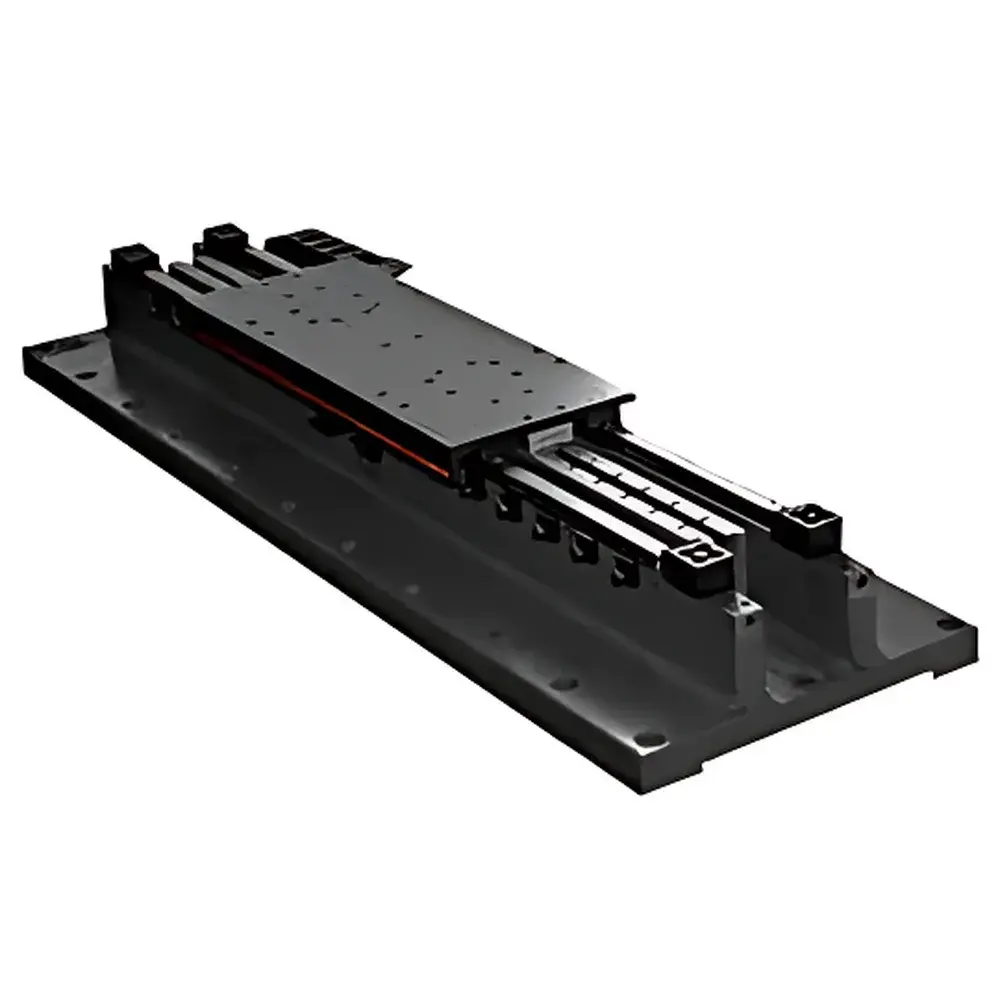
ZOLIX LMA-TE Series Linear Motor Translation Stage
| Brand | ZOLIX |
|---|---|
| Origin | Beijing, China |
| Manufacturer Type | OEM Manufacturer |
| Product Origin | Domestic (China) |
| Model | LMA-TE Series |
| Pricing | Available Upon Request |
| Motor Type | Imported Coreless Linear Motor |
| Guide System | Precision Linear Roller Slides (4-Point Contact) |
| Encoder Options | 0.1 µm / 0.5 µm / 1 µm Resolution Optical Encoders |
| Travel Range | 100–600 mm |
| Max Theoretical Speed | 5 m/s |
| Repeatability | ±1 µm (dependent on encoder and controller) |
| Positioning Accuracy | ±3 µm (system-level, dependent on encoder, controller, and environmental conditions) |
| Straightness | <3 µm / 200 mm (LMA-TE-100), <4 µm / 200 mm (LMA-TE-200) |
| Flatness | <4 µm / 200 mm (LMA-TE-100), <5 µm / 200 mm (LMA-TE-200) |
| Yaw | <15 arcsec (LMA-TE-100), <20 arcsec (LMA-TE-200) |
| Pitch | <20 arcsec (LMA-TE-100), <40 arcsec (LMA-TE-200) |
| Horizontal Load Capacity | 25–35 kg |
| Mass | 10–20 kg |
Overview
The ZOLIX LMA-TE Series Linear Motor Translation Stage is a high-performance, direct-drive motion platform engineered for demanding optical alignment, interferometry, beam steering, and precision metrology applications. Built upon a coreless linear motor architecture—sourced from established international suppliers—the stage eliminates mechanical transmission elements such as lead screws or belts, thereby removing backlash, hysteresis, and wear-related drift. Motion is generated via Lorentz-force interaction between the motor’s moving coil assembly and a stationary permanent magnet track, delivering smooth, deterministic force profiles with exceptional dynamic response. The structural foundation consists of hardened, ground linear roller slides with four-point preloaded contact geometry, ensuring high rigidity, minimal deflection under load, and long-term geometric stability. All stages are manufactured in Beijing using ZOLIX’s proprietary precision grinding and assembly protocols, enabling sub-micron repeatability and arcsecond-level angular stability over extended travel ranges up to 600 mm.
Key Features
- Coreless linear motor design: Delivers high acceleration (>1 g), zero cogging, and continuous operation without thermal saturation or mechanical wear.
- Four-point linear roller guide system: Optimized for low friction, high stiffness, and uniform load distribution across full stroke—critical for maintaining straightness and flatness specifications.
- Integrated Hall-effect end-of-travel sensors and dual-direction mechanical bumpers: Provide reliable hardware-based motion limits and shock absorption during emergency stops or overshoot events.
- Pre-installed cable management system: Includes industrial-grade drag chain with strain relief and routing channels to maintain cable integrity over >10⁶ cycles.
- Modular optical encoder interface: Supports field-installable incremental or absolute optical encoders with selectable resolutions of 0.1 µm, 0.5 µm, or 1 µm—enabling traceable positioning performance aligned with ISO 230-2 and VDI/VDE 2617 standards.
- Unified mounting interface: Standardized M6 and 1/4″-20 tapped holes on top and base plates conform to common optical breadboard and cage system footprints (e.g., Thorlabs, Newport).
Sample Compatibility & Compliance
The LMA-TE series is compatible with standard optical payloads including mirror mounts, kinematic platforms, fiber couplers, and detector translation assemblies. Its horizontal load capacity (25–35 kg) supports multi-component setups without compromising positional fidelity. All units comply with CE marking requirements for electromagnetic compatibility (EMC Directive 2014/30/EU) and low-voltage safety (LVD Directive 2014/35/EU). Mechanical design adheres to ISO 9001-certified manufacturing processes, and dimensional tolerances are validated using coordinate measuring machines (CMM) traceable to NIM (National Institute of Metrology, China). While not inherently certified for cleanroom use, optional stainless-steel components and lubricant-free operation support Class 1000 (ISO 6) environments when integrated into controlled systems.
Software & Data Management
The stage is fully compatible with ZOLIX’s TMC (Total Motion Control) software suite—a Windows-based application supporting real-time trajectory generation, multi-axis synchronization, and script-driven automation via Python SDK. Encoder data is acquired at up to 10 MHz sampling rate, enabling closed-loop control with jitter <50 ns. Audit trails, parameter versioning, and user-access logging meet GLP/GMP documentation requirements. When paired with third-party controllers (e.g., Aerotech A3200, PI C-887), the LMA-TE complies with IEEE 1451.4 transducer electronic data sheet (TEDS) conventions and supports FDA 21 CFR Part 11-compliant electronic signatures through external authentication modules.
Applications
- Active alignment of free-space optical paths in laser cavity construction and quantum optics experiments.
- High-speed scanning in confocal microscopy and optical coherence tomography (OCT) reference arms.
- Sub-pixel calibration of scientific CMOS and sCMOS cameras using programmable step-and-settle routines.
- Position feedback integration in adaptive optics wavefront correction loops.
- Automated wafer inspection staging where nanometer-level repeatable positioning is required across large fields.
- Integration into vacuum-compatible systems (with optional dry-film lubrication and non-outgassing materials).
FAQ
What encoder resolution options are supported?
The LMA-TE accepts industry-standard incremental optical encoders with selectable resolutions of 0.1 µm, 0.5 µm, or 1 µm—each requiring corresponding controller firmware configuration.
Is vacuum compatibility available?
Standard units are rated for ambient operation; vacuum variants (up to 10⁻⁶ Torr) are available with modified bearings, outgassing-tested materials, and custom cabling—contact engineering support for configuration.
How is thermal drift managed over extended operation?
The coreless motor design minimizes resistive heating, and the aluminum alloy baseplate provides passive thermal equalization; active temperature compensation is achievable via external sensor input to the TMC controller.
Can multiple LMA-TE stages be synchronized?
Yes—TMC software supports master-slave axis coordination with sub-millisecond latency; hardware trigger I/O and PTP (Precision Time Protocol) enable tight synchronization across distributed motion systems.
What maintenance is required?
None beyond periodic visual inspection of the drag chain and guide surfaces; the absence of mechanical transmission eliminates scheduled lubrication or recalibration intervals.




