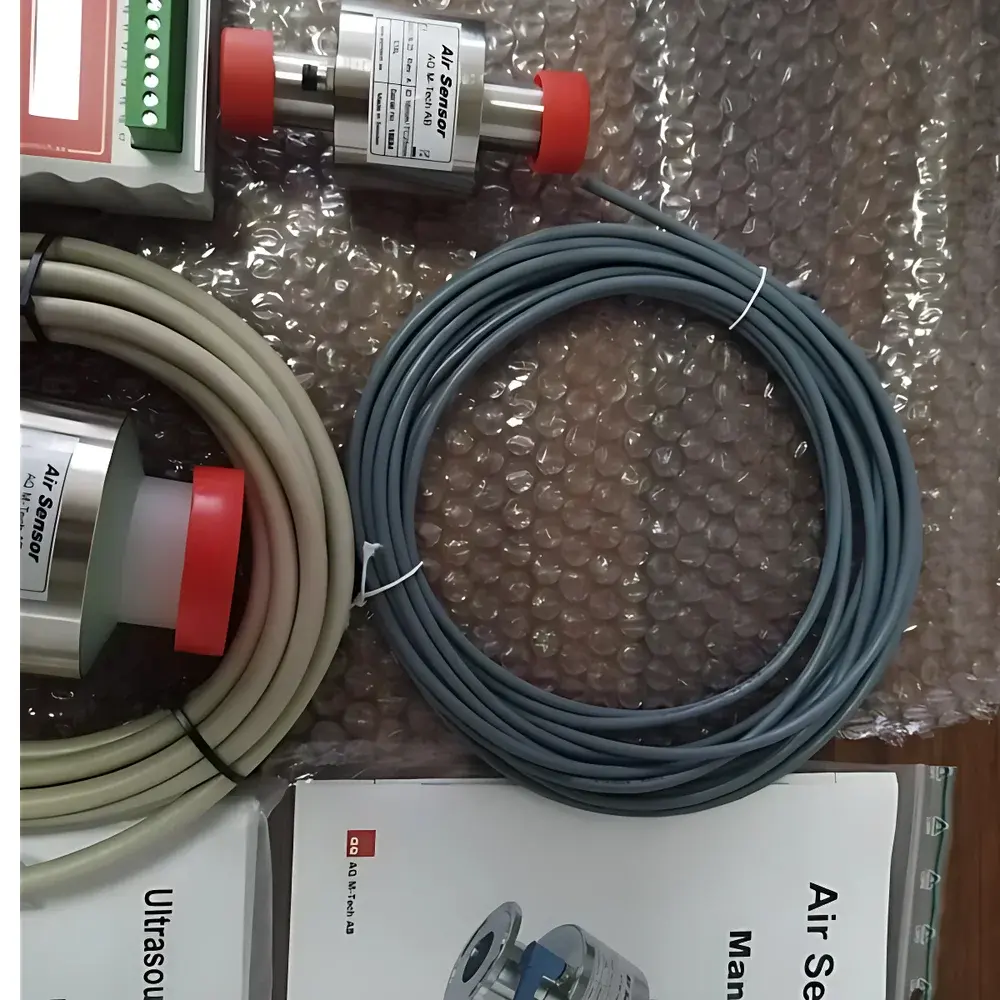
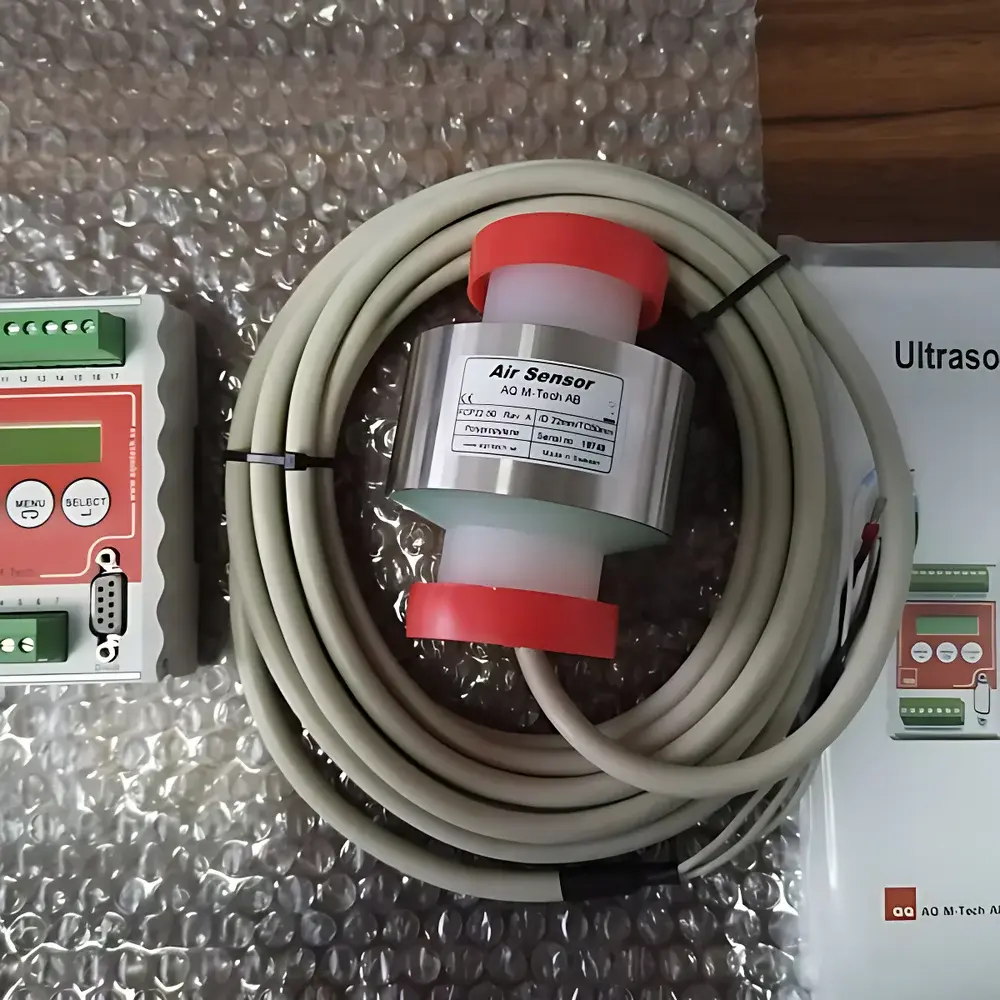
AQ M-Tech FCP4-25 Bubble Detection Sensor
| Brand | AQ M-Tech |
|---|---|
| Origin | Sweden |
| Model | FCP4-25 |
| Housing Material | Polypropylene (PP) |
| Inner Diameter | Ø4 mm |
| Outer Diameter | Ø40 mm |
| Clamp Connection | 25 mm |
| Standard Cable Length | 5 m |
| Compliance | Designed for hygienic applications in regulated industries |
Overview
The AQ M-Tech FCP4-25 Bubble Detection Sensor is a non-invasive, ultrasonic-based inline sensor engineered for real-time detection of air bubbles and particulate anomalies in liquid streams. Operating on the principle of ultrasonic transmission and reflection analysis, the sensor emits high-frequency sound waves through the pipe wall and measures changes in acoustic impedance caused by entrained gas or suspended solids. Unlike optical or capacitive methods, this ultrasonic approach eliminates dependency on fluid clarity, conductivity, or dielectric properties—making it highly robust across diverse process media including sterile buffers, cell culture harvests, pharmaceutical intermediates, and food-grade syrups. The FCP4-25 is specifically designed for tubing with an inner diameter of 4 mm and integrates seamlessly into sanitary process lines using a standard 25 mm tri-clamp (DIN 11851 / ISO 2852) interface. Its compact polypropylene housing ensures chemical resistance to common cleaning agents (CIP) and sterilants (SIP), while maintaining compliance with hygienic design principles outlined in EHEDG Doc. 8 and ASME BPE-2022.
Key Features
- Ultrasonic transduction technology enabling reliable bubble detection independent of liquid conductivity, color, or turbidity
- Polypropylene (PP) wetted housing rated for continuous operation up to 80 °C and compatible with NaOH, HNO₃, and peracetic acid-based CIP cycles
- Fixed 5-meter shielded cable with IP67-rated connector for industrial environments; optional ATEX/IECEx-certified FCP4-25-EX variant available for Zone 1/21 hazardous areas
- Zero-flow calibration capability and adjustable sensitivity thresholds via external ultrasonic controller (e.g., AQ UCC series)
- No moving parts or internal electronics—maximizing mean time between failures (MTBF) and minimizing validation burden
- Validated performance across flow rates from 0.1 to 15 L/min in 4 mm ID tubing, with repeatable response times < 50 ms
Sample Compatibility & Compliance
The FCP4-25 is validated for use with aqueous solutions, organic solvents (e.g., ethanol, isopropanol), glycerol-water mixtures, and protein-containing bioprocess fluids. It is routinely deployed upstream of sterile filters, in chromatography eluent lines, and within single-use bioreactor harvest manifolds. The sensor meets material compatibility requirements per USP , FDA 21 CFR Part 11 (when paired with compliant controllers), and supports full GMP documentation packages—including DQ/IQ/OQ protocols, material traceability (EN 10204 3.1), and extractables/leachables data upon request. All PP components comply with EU Regulation (EC) No. 1935/2004 for food contact materials.
Software & Data Management
The FCP4-25 operates as a field device requiring integration with AQ’s proprietary ultrasonic control units (e.g., UCC-100 or UCC-200). These controllers provide analog (4–20 mA) and digital (RS-485 Modbus RTU) outputs, configurable alarm relays, and timestamped event logging. Firmware supports audit trail functionality per FDA 21 CFR Part 11, including user access levels, electronic signatures, and immutable change history. Raw signal data can be exported in CSV format for trend analysis in LIMS or MES platforms. Optional OPC UA gateway modules enable direct integration with Siemens Desigo, Rockwell FactoryTalk, or DeltaV DCS environments.
Applications
- Early-phase detection of air ingress in peristaltic pump discharge lines during buffer preparation
- Monitoring bubble formation in ultrafiltration/diafiltration (UF/DF) hold tanks prior to sterile filtration
- Verification of degassing efficiency in downstream purification skids handling monoclonal antibodies
- Real-time integrity verification of disposable fluid paths in ATMP manufacturing (e.g., CAR-T wash steps)
- Prevention of cavitation-induced damage in high-pressure chromatography systems
- Compliance-driven monitoring in FDA-inspected facilities where bubble presence constitutes a critical quality attribute (CQA)
FAQ
Is the FCP4-25 suitable for steam-in-place (SIP) cycles?
Yes—the PP housing withstands repeated exposure to saturated steam at 121 °C for ≤30 minutes, provided pressure does not exceed 3 bar(g) and thermal ramp rates remain below 10 °C/min.
Can the sensor detect microbubbles smaller than 50 µm?
Detection sensitivity is flow- and viscosity-dependent; under laminar flow conditions (Re 95% probability per pass.
Does installation require pipe cutting or welding?
No—sensor mounting uses standard sanitary clamp fittings; no process interruption or welding qualification is required.
Is third-party calibration certification available?
Yes—NIST-traceable calibration reports (ISO/IEC 17025 accredited) are provided upon request, covering acoustic output stability, response linearity, and temperature drift characterization.
How does the FCP4-25 differ from optical bubble sensors?
Unlike optical sensors, it requires no transparent tubing, is unaffected by protein fouling or pigment interference, and maintains accuracy in opaque or highly scattering media such as cell lysates or fermentation broths.