
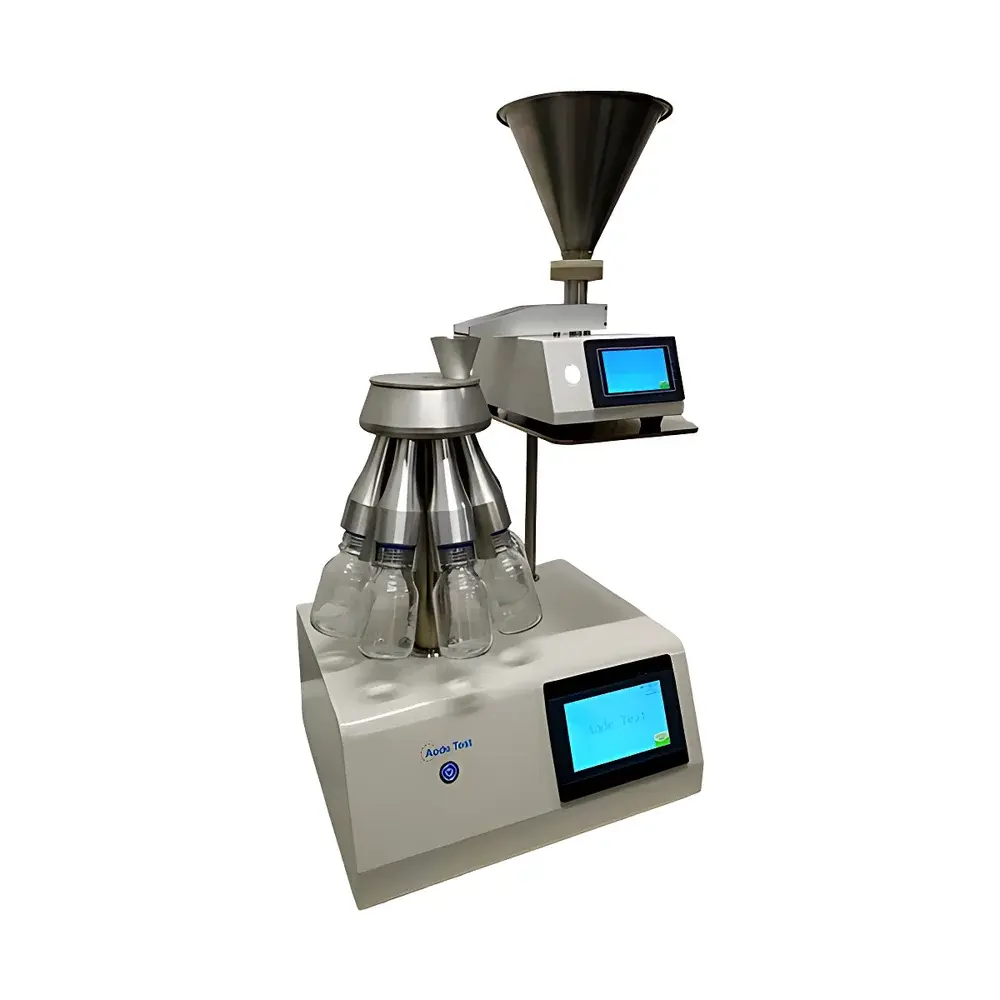
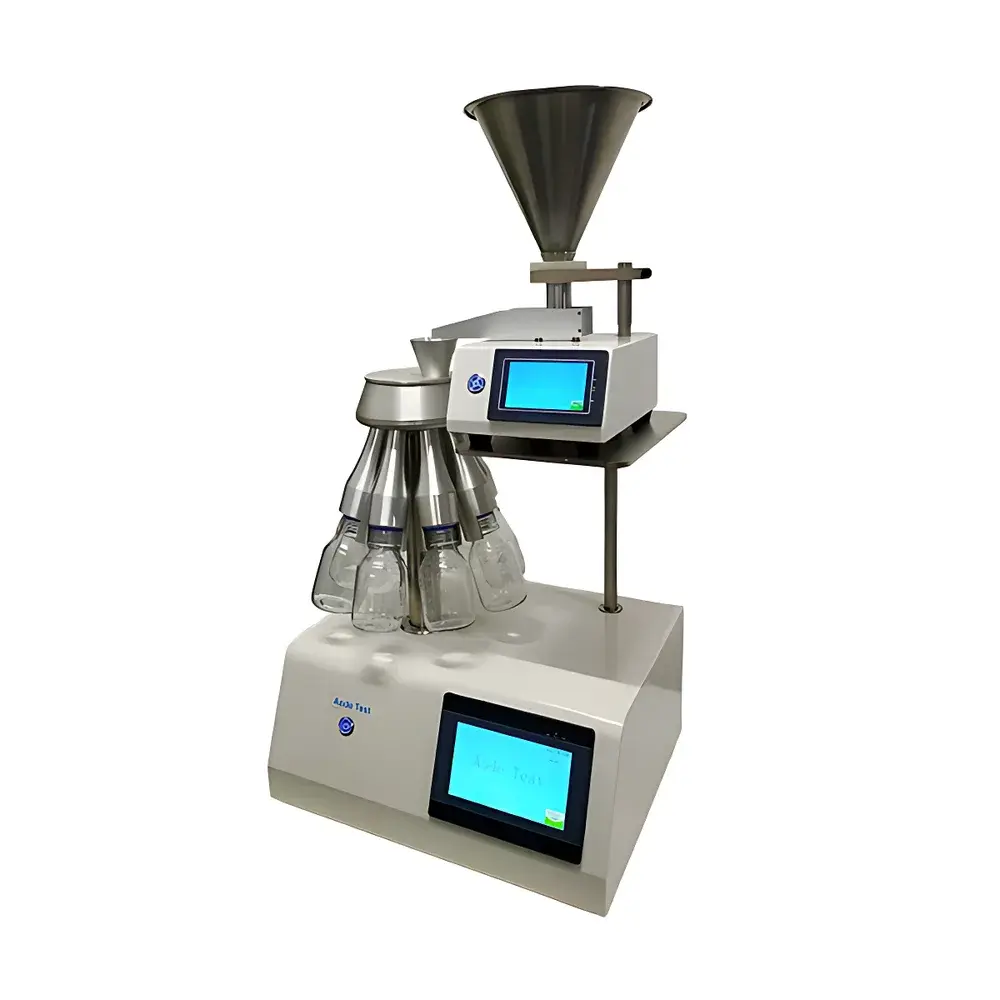
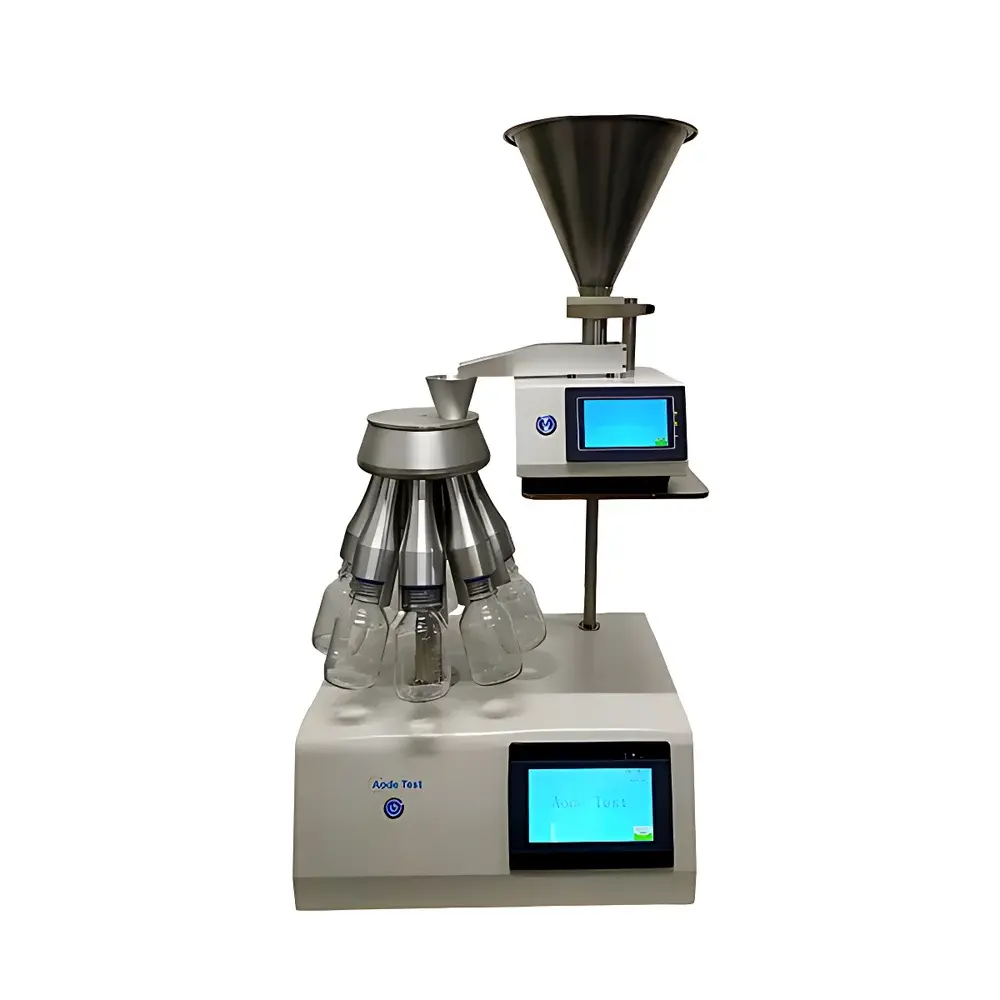
Aode Aode100 Automated Rotary Sample Divider
| Brand | Aode |
|---|---|
| Origin | Liaoning, China |
| Manufacturer Type | Direct Manufacturer |
| Model | Aode100 |
| Price Range | USD 7,000 – 14,000 |
| Sample Capacity | 5–5000 mL |
| Particle Max Diameter | 15 mm |
| Dividing Speed | 80–120 rpm (adjustable) |
| Bottle Options | 30 / 100 / 250 / 500 mL |
| Dividing Ports | Standard 8-port (6- or 10-port available on request) |
| Power Supply | 220 V, 50 Hz, 60 W |
| Dimensions | 50 × 40 × 69 cm |
| Weight | 35 kg |
| Construction Material | Anodized 6061 Aluminum Alloy |
| Sample Compatibility | Dry powders, granules, and non-viscous suspensions |
| Compliance | Designed for GLP-compliant laboratories |
Overview
The Aode Aode100 Automated Rotary Sample Divider is a precision-engineered laboratory instrument designed to perform statistically valid, reproducible sample subdivision of dry particulate materials. Based on the rotary riffling principle—where centrifugal force and gravitational flow act in concert within a rotating multi-orifice distributor—the Aode100 ensures mass-proportional splitting without bias from particle segregation, agglomeration, or flow inconsistency. Unlike manual scooping or static riffle splitters, this system maintains continuous, synchronized material feed and rotational distribution, eliminating operator-induced variability and preserving the intrinsic heterogeneity distribution of the original bulk sample. Its architecture conforms to fundamental sampling theory as defined in ISO 13320 (particle size analysis—general principles) and aligns with the representative sampling framework outlined in ASTM D6938 (standard practice for sampling aggregates). The device is intended for use in QC/QA labs, geological survey centers, pharmaceutical R&D facilities, and materials science departments where traceability, repeatability, and regulatory readiness are critical.
Key Features
- Integrated vibratory feeder and rotary divider assembly—ensures fully synchronized, closed-loop sample delivery and distribution with no manual intervention.
- Anodized 6061 aluminum alloy divider rotor—resistant to abrasion, non-stick surface minimizes residue retention, and enables rapid cleaning between batches.
- Modular bottle interface with quick-connect bayonet mounts—supports interchangeable vial configurations (30 mL, 100 mL, 250 mL, 500 mL) and accommodates custom port counts (6-, 8-, or 10-way division).
- Dual-speed control system—separately adjustable vibration frequency (feeder) and rotor speed (80–120 rpm), both monitored via embedded Hall-effect sensors to maintain setpoint stability under variable load or line voltage fluctuations.
- Low-noise (<55 dB(A)) operation enabled by brushless DC motor drive and balanced rotor dynamics—suitable for shared lab environments.
- Programmable timing logic—users define total run duration, target feed rate, and rotation speed prior to initiation, enabling unattended overnight operation.
- Multiple feed chute options (V-type, U-type, narrow, wide, and tapered) allow optimization for cohesive fines, free-flowing granules, or irregularly shaped particles up to 15 mm diameter.
Sample Compatibility & Compliance
The Aode100 accepts dry powders, milled solids, crushed ores, catalyst pellets, agricultural grains, and low-viscosity slurries (e.g., aqueous suspensions <500 cP). It is not suitable for fibrous, hygroscopic, or highly electrostatic materials without preconditioning. All wetted components—including sample bottles—are fabricated from borosilicate glass or USP Class VI-certified polypropylene, ensuring chemical inertness and compatibility with standard analytical workflows (e.g., XRF, ICP-OES, laser diffraction). The system supports Good Laboratory Practice (GLP) documentation protocols: run parameters (time, speed, bottle ID) are logged internally and exportable via USB. While the Aode100 itself does not carry CE or FDA 510(k) certification, its operational methodology satisfies foundational requirements of ISO/IEC 17025 (clause 7.7 on sampling) and ASTM E1444 (sampling of particulate solids).
Software & Data Management
The Aode100 operates via an embedded microcontroller with a tactile LCD interface—no external PC or proprietary software required. All operational parameters (feed duration, rotation speed, pause intervals) are stored in non-volatile memory and recalled at power-up. Timestamped session logs—including start/stop times, average RPM, and estimated total mass processed—are retained for up to 1,000 runs and downloadable as CSV files. Optional RS-232 or USB-C output enables integration into LIMS environments for automated metadata capture. Audit trails comply with ALCOA+ principles (Attributable, Legible, Contemporaneous, Original, Accurate), supporting 21 CFR Part 11 readiness when paired with validated electronic signature systems.
Applications
- Preparation of subsamples for elemental analysis (XRF, ICP-MS) in mining and metallurgy labs.
- Homogenization and division of active pharmaceutical ingredients (APIs) and excipients prior to content uniformity testing (USP <905>).
- Representative splitting of cement, fly ash, or slag for Blaine fineness and particle size distribution studies.
- Field-deployable sample reduction in environmental soil screening programs requiring chain-of-custody integrity.
- Quality control of polymer pellets, toner powders, and food-grade starches where batch homogeneity must be verified across multiple test points.
FAQ
What particle size range is compatible with the Aode100?
The system handles particles up to 15 mm in maximum dimension. For optimal statistical representativeness, it is recommended for materials with D90 < 10 mm when processing >100 g batches.
Can the Aode100 be used for moisture-sensitive samples?
Yes—provided ambient humidity is controlled and samples are introduced in sealed containers. The unit contains no internal heating elements or vacuum components that could induce desiccation.
Is calibration required before use?
No routine calibration is needed. However, users should verify mass balance across all outlets using certified reference weights during initial installation and after any mechanical maintenance.
Does the Aode100 support GMP-regulated environments?
It supports GMP-aligned workflows through parameter logging, user-access controls (via password-protected setup mode), and compatibility with electronic record systems—but formal validation (IQ/OQ/PQ) must be performed by the end-user lab per Annex 11 guidelines.
How often does the rotor require cleaning?
Cleaning is recommended after each sample type change or every 5–10 operating hours for high-dust applications. Residue removal takes <90 seconds using compressed air and lint-free wipes.



