
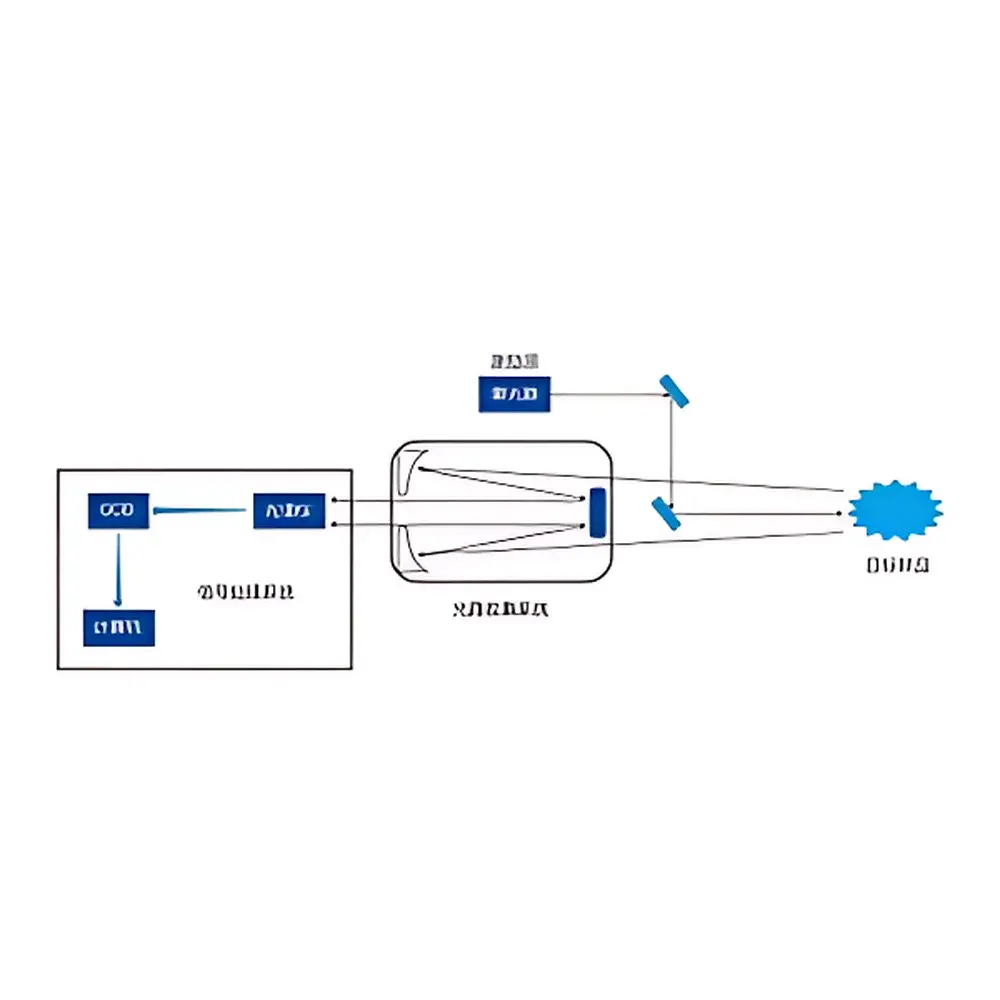
ZOLIX Remote Raman Spectroscopy Solution
| Brand | ZOLIX |
|---|---|
| Origin | Beijing, China |
| Manufacturer Type | Original Equipment Manufacturer (OEM) |
| Instrument Type | Confocal Micro-Raman Spectrometer |
| Spectral Range | 100–4000 cm⁻¹ (laser-dependent) |
| Spectral Resolution | <2 cm⁻¹ (with 1800 gr/mm grating) |
| Spatial Resolution | ~100 µm (at 100 µm core fiber) |
| Minimum Wavenumber | 100 cm⁻¹ |
| Spectral Reproducibility | <±0.1 cm⁻¹ over 8-hour operation |
| Excitation Wavelengths | 405, 514, 532, 633, 670, 671, 785, 808 nm |
| Detector Options | ICCD (gate width <2 ns) or back-illuminated deep-depletion CCD |
| Collection Optics | Cassegrain telescope (f = 1000 mm, optional), Raman fiber probe (NA = 0.22), or custom long-working-distance optics |
| Laser Options | CW diode lasers (e.g., 785 nm, 100 mW) or Q-switched pulsed lasers (e.g., 532 nm, 290 mJ, 10 Hz) |
| Compliance | ASTM E1840, ISO/IEC 17025–compliant system architecture, FDA 21 CFR Part 11–ready data acquisition framework |
Overview
The ZOLIX Remote Raman Spectroscopy Solution is an engineered platform for standoff molecular identification and structural analysis based on inelastic laser scattering—the Raman effect. Unlike conventional benchtop Raman systems, this solution integrates high-stability excitation sources, large-aperture signal collection optics, high-throughput dispersion modules, and time-gated or low-noise detection architectures to enable quantitative vibrational spectroscopy at distances ranging from 20 mm to >100 m. The system operates on the fundamental principle that monochromatic incident light (typically from a narrow-linewidth laser) interacts with molecular bonds, producing scattered photons shifted in energy by amounts corresponding to quantized vibrational modes. These shifts—expressed in wavenumbers (cm⁻¹)—form fingerprint spectra sensitive to chemical composition, crystallinity, stress state, phase distribution, and molecular symmetry. Designed for field-deployable and mission-critical applications, the platform supports both continuous-wave (CW) and pulsed excitation modalities, enabling optimization for signal-to-background ratio, fluorescence suppression, and temporal discrimination in complex ambient environments.
Key Features
- Modular optical architecture supporting interchangeable excitation lasers (405–808 nm), collection optics (fiber probe, Cassegrain telescope, or custom reflective fore-optics), and spectrometers (Czerny-Turner or VPH-based)
- High-sensitivity detection options: gated ICCD (optical gate width <2 ns, MCP gain ≥10⁴) for pulsed operation; back-illuminated, deep-depletion CCD (2000 × 256 pixels, 15 × 15 µm, read noise <4.5 e⁻) for CW applications
- Configurable spectral resolution: ≤2 cm⁻¹ with 1800 grooves/mm grating (320 mm focal length C-T spectrometer); 5 cm⁻¹ with high-throughput VPH spectrometer (85 mm focal length, f/1.8)
- Ruggedized probe housing constructed from 316 stainless steel or ultra-hard anodized aluminum; IP65-rated for outdoor deployment; operational temperature range: 0–85 °C; maximum pressure rating: 15 psi
- Fiber-coupled design with FC/APC or SMA interfaces; standard 100/100 µm core/clad multimode fiber; optional UV-VIS-NIR optimized fibers available
- Integrated calibration traceability: NIST-traceable neon/argon lamp reference, automated wavelength and intensity calibration routines
Sample Compatibility & Compliance
The ZOLIX Remote Raman Solution accommodates diverse sample geometries and environmental constraints without physical contact—including bulk solids (minerals, explosives, pharmaceuticals), liquids (aqueous solutions, organic solvents), gases (in sealed cells or open-path configurations), and thin films (CVD-grown diamond, graphene, transition metal dichalcogenides). Its non-destructive, non-invasive nature ensures integrity preservation during repeated interrogation. The system architecture adheres to foundational metrological standards: spectral accuracy and repeatability are validated per ASTM E1840 (Standard Practice for Raman Shift Standards), while optical alignment stability meets ISO/IEC 17025 requirements for testing laboratories. For regulated industries, the software framework supports audit trails, electronic signatures, and raw-data immutability—fully compatible with FDA 21 CFR Part 11 implementation when deployed with validated computing infrastructure. All optical components comply with RoHS and REACH directives; laser safety class is certified per IEC 60825-1 (Class IV for pulsed configurations; Class IIIb for CW).
Software & Data Management
ZOLIX RamanControl™ v4.x provides unified control of laser timing, spectrometer grating position, detector integration/gating, and real-time spectral acquisition. It features embedded preprocessing pipelines—including cosmic ray removal, dark current subtraction, fluorescence background correction (via asymmetric least squares), and peak deconvolution using Voigt or pseudo-Voigt line shapes. Spectra are stored in HDF5 format with metadata tags compliant with the ISA-Tab and SpectralML schema extensions. Batch processing supports multivariate analysis (PCA, PLS-DA) and library matching against internal or user-defined spectral databases (e.g., RRUFF, ICDD PDF-4+). Export options include CSV, JCAMP-DX, and Bruker OPUS-compatible formats. For integration into larger analytical workflows, RESTful API endpoints enable programmatic access to acquisition parameters, live spectrum streams, and processed results—facilitating linkage with LIMS, MES, or planetary rover telemetry systems.
Applications
- Planetary Surface Exploration: Validated in Mars-analog mineral identification (malachite, azurite, calcite, gypsum) using 532 nm pulsed excitation and Cassegrain collection optics at standoff distances up to 66 m (Sharma et al., Appl. Spectrosc. 2002)
- Nuclear Facility Monitoring: Detection and classification of radioactive contaminants (e.g., uranyl nitrate, cesium iodide) at 1 m standoff using spatial heterodyne Raman spectroscopy (Foster et al., J. Raman Spectrosc. 2020)
- In Situ Materials Synthesis: Real-time monitoring of CVD diamond growth (Gnyba et al., Photonics Lett. Pol. 2009) and liquid-phase graphene synthesis (Jankowski et al., ACS Nano 2021), tracking layer count, stacking order, defect density, and doping via evolving G/2D band ratios and linewidths
- Hazardous Substance Screening: Standoff identification of explosives (TNT, RDX), chemical warfare agents, and industrial pollutants under daylight conditions using time-gated ICCD detection to suppress solar background
- Geological & Environmental Field Surveys: Portable deployment on UAVs or robotic platforms for rapid mineral mapping, hydrocarbon leak detection, and microplastic characterization in aqueous matrices
FAQ
What is the maximum effective standoff distance for reliable Raman signal acquisition?
Depends on laser pulse energy, telescope aperture, atmospheric transmission, and target reflectivity. With a 290 mJ, 532 nm pulsed laser and 1000 mm Cassegrain telescope, detection has been demonstrated at ≥66 m for highly scattering minerals; for low-reflectivity organics, practical limits are typically 1–10 m.
Can the system operate under ambient daylight conditions?
Yes—when configured with pulsed excitation and ICCD gating (6) and shaded collection paths for outdoor use.
Is the software compatible with GLP/GMP laboratory workflows?
Yes—RamanControl™ supports full 21 CFR Part 11 compliance when deployed on validated Windows Server environments with domain authentication, role-based access control, and immutable audit logs.
Do you provide application-specific configuration support?
Yes—ZOLIX offers pre-sales feasibility studies, optical path modeling (Zemax/Code V), and on-site system commissioning including NIST-traceable performance verification reports.
Are OEM integration services available for embedding into third-party platforms (e.g., rovers, drones)?
Yes—custom mechanical, electrical, and software integration packages—including compact form factor variants, MIL-STD-810G ruggedization, and CAN bus or RS-422 communication interfaces—are available under NDA.






