
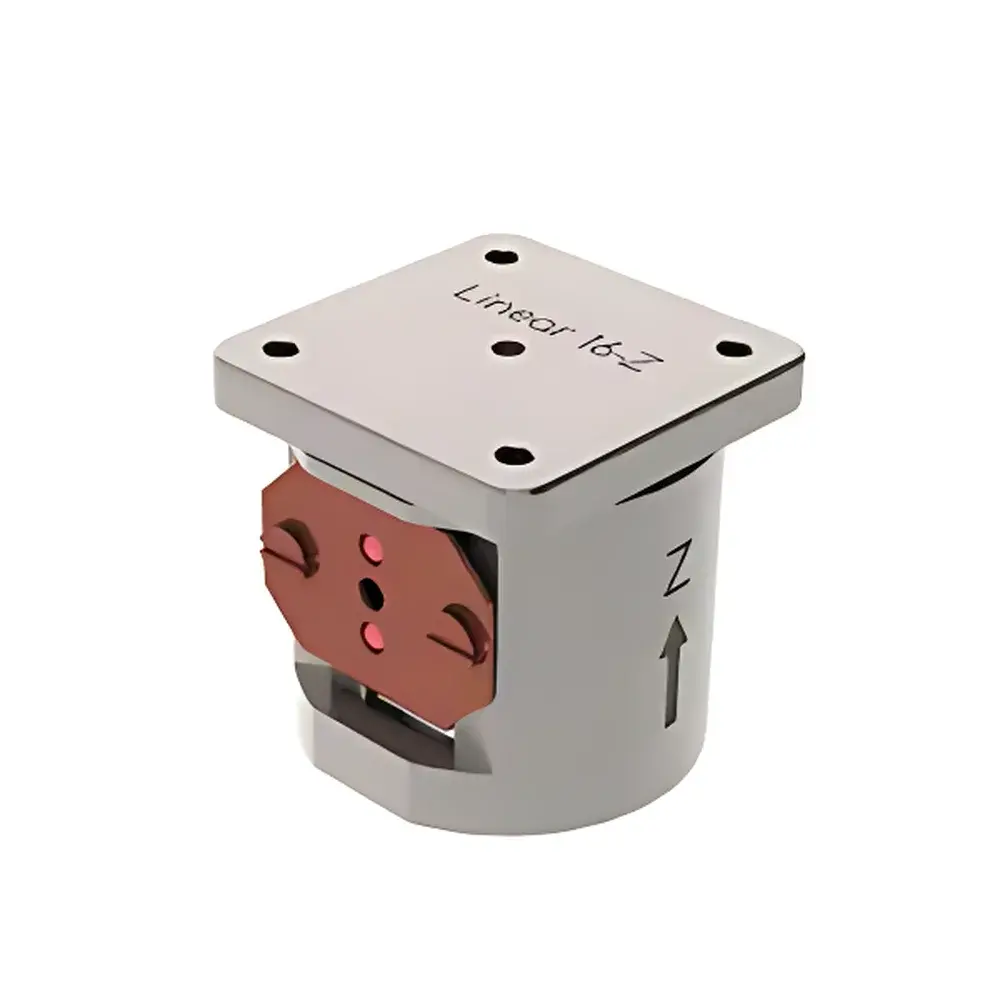
ZOLIX Linear16-z Closed-Loop Piezoelectric Linear Translation Stage
| Brand | ZOLIX |
|---|---|
| Origin | Beijing, China |
| Manufacturer Type | Direct Manufacturer |
| Product Category | Domestic |
| Model | Linear16-z |
| Pricing | Upon Request |
| Product Type | Motorized Translation Stage |
| Compact Dimensions | 16 × 15.7 × 16 mm |
| Mass | 12 g |
| Travel Range | 3 mm |
| Max Load | 250 g |
| Max Thrust | 3 N |
| Drive Voltage | ≤ 200 V |
| Max Speed @ 300 K | ~2 mm/s |
| Vacuum Compatibility | UHV up to 2 × 10⁻¹¹ mbar |
| Temperature Range | 1.4 K – 400 K (optional down to 30 mK) |
| Magnetic Field Tolerance | Up to 18 T |
| Materials | Pure Titanium & Beryllium Copper |
| Sensor Resolution | ~150 nm |
| Position Repeatability | 1–2 µm |
| Feedback | Integrated capacitive or strain-gauge position sensor (closed-loop) |
Overview
The ZOLIX Linear16-z is an ultra-compact, closed-loop piezoelectric linear translation stage engineered for extreme experimental environments—specifically cryogenic, ultra-high vacuum (UHV), and high magnetic field applications. Unlike conventional stepper- or servo-driven stages, the Linear16-z employs direct piezoelectric actuation with integrated position feedback, enabling sub-micron motion control without mechanical backlash or gear slippage. Its operational principle relies on the inverse piezoelectric effect: applied voltage induces precise dimensional change in the piezo stack, translated into linear displacement via a flexure-guided mechanism. This architecture eliminates rotating components and lubricants, ensuring long-term stability under thermal cycling and vacuum outgassing constraints. Designed for integration into dilution refrigerators, superconducting magnet systems, and synchrotron end-stations, the Linear16-z meets stringent requirements for positional fidelity, material compatibility, and electromagnetic neutrality.
Key Features
- Minimal footprint: 16 × 15.7 × 16 mm package—smallest in ZOLIX’s 16-mm linear stage family
- Hermetically sealed UHV-compatible construction rated to 2 × 10⁻¹¹ mbar; validated per ISO 10110 and ASTM E595 outgassing specifications
- Cryogenic operation certified from 1.4 K to 400 K; optional 30 mK qualification available for He-3 and dilution refrigerator integration
- Non-magnetic structural materials: grade-1 pure titanium housing and beryllium copper flexures—fully compatible with static fields up to 18 Tesla
- Closed-loop control architecture with embedded position sensor (capacitive or strain-gauge type), delivering real-time feedback and eliminating open-loop drift
- High-force output: 3 N nominal thrust supports active alignment of optical elements, fiber couplers, or MEMS devices under load
- Low-mass design (12 g) minimizes thermal inertia and mechanical resonance—critical for dynamic stabilization in interferometric setups
Sample Compatibility & Compliance
The Linear16-z is explicitly qualified for use in GLP- and GMP-aligned research infrastructure where traceability and environmental integrity are mandated. All materials—including phosphor bronze twisted-pair cabling (20 cm standard length), glass-fiber-reinforced polyetheretherketone (PEEK) pin insulators, and beryllium copper contact pins—comply with NASA/ESA low-outgassing standards (CVCM ≤ 0.1%, TML ≤ 1.0%). Surface finishes meet ISO 14644-1 Class 5 cleanroom handling protocols. The stage conforms to IEC 61000-6-2 (immunity) and IEC 61000-6-4 (emission) for electromagnetic compatibility in shielded laboratory enclosures. Optional configurations include ULT (ultra-low temperature), UHV (ultra-high vacuum), and HV (high vacuum) variants—each supplied with vacuum-bakeable documentation and material certification dossiers.
Software & Data Management
The Linear16-z interfaces via standard analog ±10 V input for drive signal and differential analog output for sensor readback. It is fully compatible with common motion control ecosystems including National Instruments LabVIEW, MATLAB Instrument Control Toolbox, and Python-based PyVISA frameworks. Firmware supports configurable PID tuning parameters and user-defined trajectory profiles (trapezoidal, S-curve). All position data streams include timestamped metadata compliant with HDF5 v1.12 schema, facilitating synchronization with time-resolved detectors (e.g., single-photon avalanche diodes or lock-in amplifiers). Audit trails—including command history, sensor calibration logs, and thermal drift compensation records—are retained per FDA 21 CFR Part 11 requirements when deployed in regulated QC/QA workflows.
Applications
- Precision alignment of single-mode optical fibers and photonic integrated circuits inside cryostats
- Nanoscale positioning of scanning probe microscopy (SPM) tips in magnetic field-dependent transport experiments
- Active stabilization of cavity-length in ultra-stable Fabry–Pérot interferometers operating below 4 K
- Beam steering and focus adjustment in X-ray microprobe beamlines requiring <1 µrad angular stability
- Integration into quantum computing testbeds where RF noise, magnetic susceptibility, and thermal contraction must be minimized
- In-situ strain application during low-temperature Raman or magneto-optical Kerr effect (MOKE) measurements
FAQ
What vacuum level is the Linear16-z rated for, and what validation data is provided?
The standard UHV version is tested and certified to 2 × 10⁻¹¹ mbar, with full outgassing reports (TML, CVCM, WVR) and residual gas analysis (RGA) traces available upon request.
Can the Linear16-z operate continuously at 30 mK?
Yes—optional ULT configuration includes enhanced thermal anchoring, low-conductivity cabling, and cryo-qualified sensor calibration across the 30 mK–400 K range.
Is the position sensor resolution of ~150 nm achievable under closed-loop operation at 4 K?
Yes—the sensor maintains specified resolution and linearity across the full temperature range; thermal drift compensation algorithms are embedded in the control firmware.
How is electromagnetic interference mitigated in high-field environments?
All conductive paths are routed through symmetric twisted pairs; housing provides >60 dB magnetic shielding above 1 kHz, and no ferromagnetic components are present in the actuator or sensor path.
Does ZOLIX provide OEM integration support for custom motion control firmware?
Yes—ZOLIX supplies SDKs, register-level communication protocols (SPI/I²C over isolation barrier), and reference designs for FPGA-based real-time controllers.




