
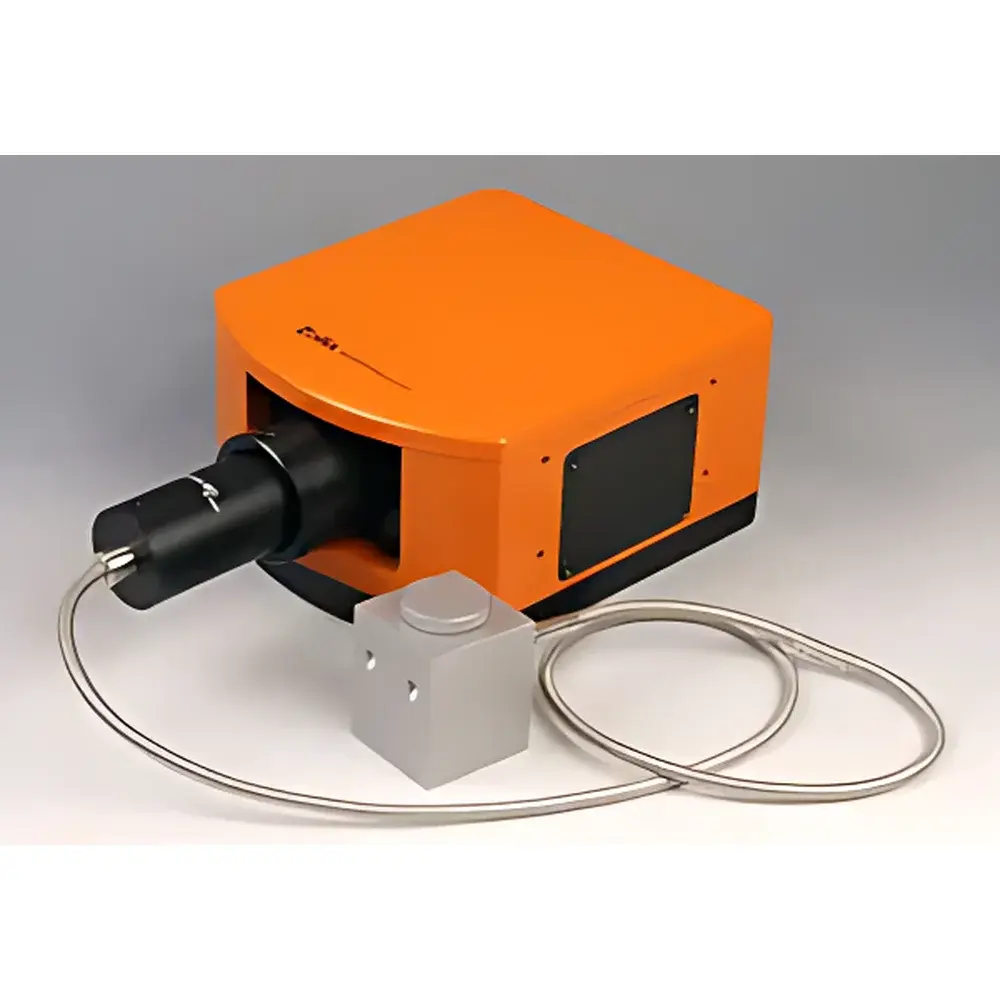
ZOLIX IV-B2 Solar Simulator Spectral Validation Spectrometer
| Brand | ZOLIX |
|---|---|
| Origin | Beijing, China |
| Manufacturer Type | Manufacturer |
| Origin Category | Domestic (China) |
| Model | IV-B2 |
| Pricing | Upon Request |
| Wavelength Range | 350–1100 nm |
| Grating | 300 grooves/mm, blaze wavelength 500 nm |
| Slit Dimensions | 50 µm × 1 mm |
| Wavelength Calibration Source | Hg-Ne lamp |
| Responsivity Calibration Source | 150 W tungsten-halogen lamp (NIM-traceable) |
| Optical Fiber | Quartz, 200–1100 nm, 1 mm core diameter |
| Integrating Sphere | 30 mm diameter, PTFE-coated interior, 11 mm input port, 320–2200 nm spectral range, >90% reflectance across band |
Overview
The ZOLIX IV-B2 Solar Simulator Spectral Validation Spectrometer is a purpose-built optical metrology instrument engineered to quantitatively assess the spectral match performance of solar simulators against internationally recognized standards—including IEC 60904-9 (Ed. 3, 2020), ASTM E927-22, and JIS C 8912. It operates on the principle of calibrated, absolute spectral irradiance measurement using a thermally stabilized, fiber-coupled Czerny-Turner spectrometer architecture. Unlike generic spectrometers, the IV-B2 integrates traceable radiometric calibration and standardized spectral weighting functions directly into its firmware and software stack, enabling direct computation of spectral mismatch correction factors (MMF) and classification into Class A, B, or C per IEC criteria. Its design prioritizes reproducibility in photovoltaic (PV) R&D labs, module certification facilities, and manufacturing QA environments where regulatory compliance and inter-laboratory comparability are mandatory.
Key Features
- Full-spectrum validation across 350–1100 nm—covering the critical AM1.5G photovoltaic response region with ±0.5 nm wavelength accuracy (Hg-Ne reference locked)
- NIM-traceable absolute responsivity calibration using a 150 W tungsten-halogen standard lamp, certified by the National Institute of Metrology (China), ensuring SI-traceable irradiance measurements
- High-fidelity light collection via a 30 mm PTFE-coated integrating sphere (≥90% reflectance from 320–2200 nm) with 11 mm input aperture, minimizing angular dependence and spatial non-uniformity errors
- Optimized optical train: 300 g/mm blazed grating (500 nm), 50 µm entrance slit, and low-stray-light quartz fiber (200–1100 nm, 1 mm core) for high signal-to-noise ratio under low-flux solar simulator conditions
- Dedicated C++-based acquisition software with embedded IEC 60904-9 spectral weighting tables, automatic MMF calculation, and pass/fail classification reporting per spectral class requirements
- USB 2.0 interface with real-time data streaming, compatible with Windows XP through Windows 10 (32/64-bit); driver-free operation with minimal system resource footprint
Sample Compatibility & Compliance
The IV-B2 is designed exclusively for collimated or diffused broadband light sources meeting solar simulator geometry constraints (e.g., Class AAA, AB, or B systems per IEC 60904-9). It accepts input via bare fiber or direct coupling to the integrating sphere—enabling rapid deployment without optical realignment. All calibration artifacts (Hg-Ne lamp, tungsten-halogen standard) are maintained under controlled environmental conditions and recalibrated at prescribed intervals per ISO/IEC 17025 guidelines. The instrument supports full audit trail generation for GLP and GMP-regulated environments, including timestamped calibration logs, operator ID tagging, and immutable spectral data export in CSV and XML formats compliant with FDA 21 CFR Part 11 requirements when used with validated software configurations.
Software & Data Management
The IV-B2 control and analysis suite provides deterministic spectral processing workflows: raw detector counts are corrected for dark current, pixel-to-pixel non-uniformity, grating efficiency, and fiber transmission loss before applying NIM-certified responsivity curves. The software computes weighted integrals over the 350–1100 nm band using the AM1.5G reference spectrum (IEC 60904-3), then evaluates deviation bands (±12.5%, ±25%, ±50%) to assign spectral class. Reports include graphical overlay of measured vs. reference spectra, tabular MMF values per sub-band (UV, VIS, NIR), and summary compliance statements. Exported datasets retain full metadata (calibration date, lamp serial number, integration time, temperature drift compensation status) to support ISO 17025 technical records.
Applications
- Pre-shipment verification of solar simulator spectral output prior to delivery to PV testing laboratories
- In-house QA during production of continuous or pulsed solar simulators (Xe, metal halide, LED-based)
- Periodic revalidation of installed simulators in accredited calibration labs (ISO/IEC 17025 scope)
- Research into spectral aging effects of light sources and optical components under long-term illumination
- Development of custom spectral filters or secondary optics requiring empirical transmission characterization
- Training and method transfer in photovoltaic metrology courses aligned with IEC and ASTM curricula
FAQ
Does the IV-B2 comply with IEC 60904-9 Ed. 3 (2020)?
Yes—the instrument implements all spectral evaluation algorithms, wavelength binning schemes, and tolerance thresholds defined in Clause 7.2 and Annex A of IEC 60904-9:2020.
Is the calibration traceable to international standards?
All radiometric calibrations are performed against a NIM-certified 150 W tungsten-halogen standard lamp; spectral calibration uses a NIM-verified Hg-Ne lamp. Full calibration certificates with uncertainty budgets are supplied.
Can the IV-B2 measure pulsed solar simulators?
Yes—software supports gated acquisition synchronized to external TTL triggers, enabling accurate spectral capture of flash-type simulators with pulse widths ≥10 ms.
What operating systems are supported?
Native support for Windows XP SP3 and later, including Windows 10 (32- and 64-bit); no virtual machine or legacy OS emulation required.
Is the integrating sphere included in the base configuration?
Yes—the 30 mm PTFE-coated integrating sphere with 11 mm input port and SMA fiber interface is standard equipment, not an optional accessory.






