
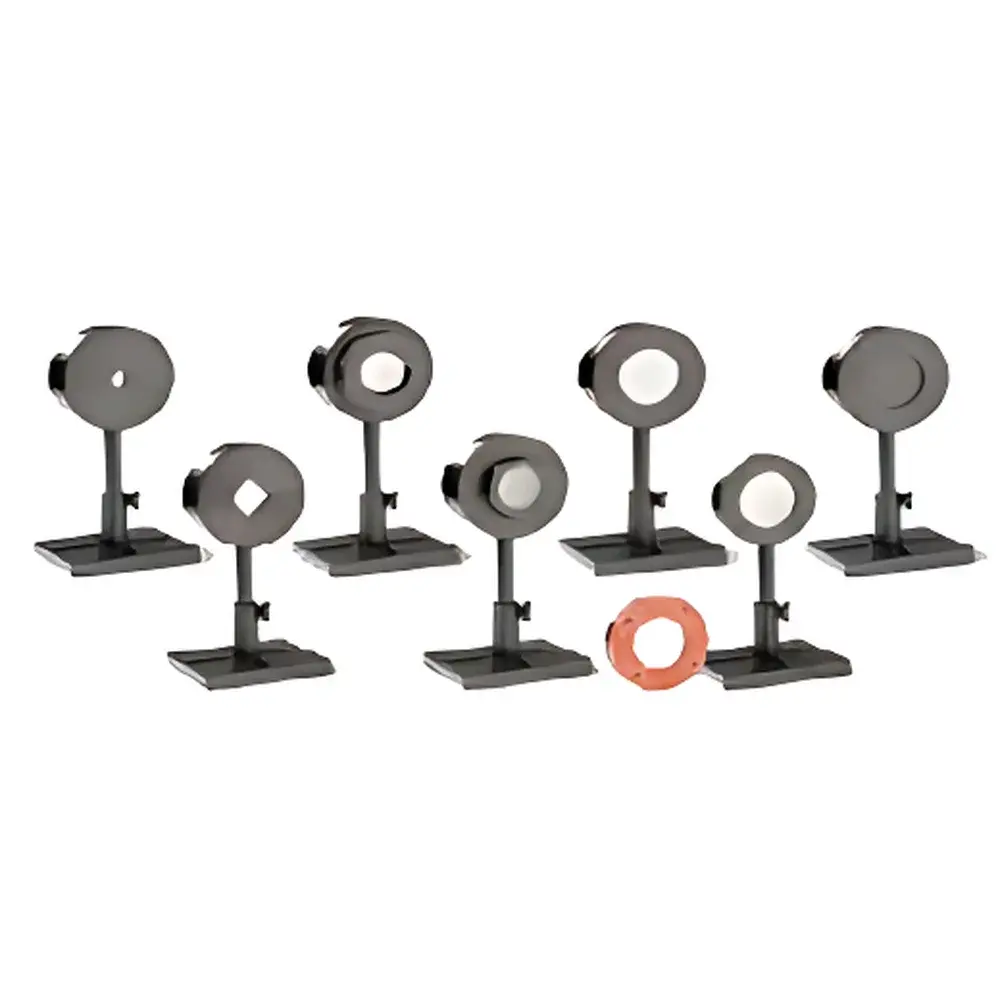
Ophir PE50BF-C Energy Sensor
| Brand | Ophir |
|---|---|
| Origin | France |
| Type | Pyroelectric Energy Sensor |
| Max. Repetition Rate | 25 kHz |
| Pulse Width Range | 10 ns – 20 ms |
| Energy Range | 10 µJ – 50 J |
| Spectral Range | 0.19–20 µm (with appropriate absorber) |
| Calibration Uncertainty | ±3% (k=2) |
| Rise Time | ~1.5 ms (BF-type) |
| Damage Threshold | 1 J/cm² (1064 nm, 10 ns) |
| Interface | USB or RS-232 (via StarLab or Nova II meter) |
Overview
The Ophir PE50BF-C is a high-stability, broadband pyroelectric laser energy sensor engineered for precision measurement of pulsed laser energy across ultraviolet (UV), visible (VIS), and infrared (IR) spectral bands. Operating on the fundamental principle of pyroelectric detection, the sensor converts absorbed radiant energy into a transient electrical charge proportional to the temperature change in its ferroelectric crystal—typically lithium tantalate (LiTaO₃) coated with a spectrally optimized black absorber (BF-type). Unlike photodiode-based sensors, which saturate at moderate pulse energies and require strict linearity correction, the PE50BF-C delivers inherently linear response over six orders of magnitude (10 µJ to 50 J per pulse) without gain switching or recalibration. Its design accommodates both short nanosecond pulses (≥10 ns) and long millisecond-duration pulses (up to 20 ms), with stable operation at repetition rates up to 25 kHz—enabled by proprietary signal conditioning circuitry that compensates for thermal relaxation dynamics and minimizes baseline drift during high-duty-cycle operation.
Key Features
- Pyroelectric sensing architecture with BF-type black-coated absorber for uniform spectral responsivity from 190 nm to 20 µm
- Wide dynamic energy range: 10 µJ to 50 J per pulse, traceable to NIST-certified calibration standards
- High repetition rate capability: continuous measurement at up to 25,000 pulses per second with <0.5% pulse-to-pulse deviation
- Robust thermal design: integrated thermistor compensation and active ambient temperature stabilization ensure <±0.2%/°C sensitivity drift
- Dual-interface compatibility: native support for USB 2.0 and RS-232 communication protocols via Ophir StarLab v3.3x or Nova II display meters
- Compliant with ISO 11554:2017 (Lasers and laser-related equipment — Test methods for laser beam parameters) for energy measurement uncertainty reporting
Sample Compatibility & Compliance
The PE50BF-C is compatible with all standard pulsed laser sources including Nd:YAG (1064/532/355/266 nm), Ti:sapphire (700–1000 nm), excimer (193/248 nm), CO₂ (10.6 µm), and ultrafast fiber lasers (e.g., 1030 nm, 300 fs–10 ps). Its BF absorber exhibits minimal spectral dependence (<±2% variation across 0.19–20 µm), eliminating the need for wavelength-specific calibration factors in most industrial and research applications. The sensor meets IEC 60825-1:2014 safety classification requirements for Class 3B and Class 4 laser measurement instrumentation and supports full audit trail functionality under FDA 21 CFR Part 11 when used with StarLab software in validated laboratory environments (GLP/GMP-compliant workflows).
Software & Data Management
Ophir StarLab v3.3x firmware provides real-time energy logging, statistical analysis (mean, std dev, min/max, histogram), and automated pass/fail threshold evaluation. All measurements are timestamped and stored with full metadata—including pulse width, repetition rate, ambient temperature, and sensor serial number—to satisfy ISO/IEC 17025 documentation requirements. Raw analog output (0–5 V) is available for integration into custom DAQ systems, while digital USB streaming supports up to 10 kHz sustained data acquisition. Calibration certificates include full uncertainty budgets compliant with ISO/IEC Guide 98-3 (GUM), and users may perform in-field verification using Ophir’s optional calibrated reference diodes (e.g., PD300-1W).
Applications
- Laser manufacturing process validation: monitoring ablation energy stability in PCB drilling, thin-film scribing, and battery electrode patterning
- Medical laser system qualification: energy consistency verification for ophthalmic (e.g., femtosecond LASIK) and dermatological (Q-switched pigment removal) platforms
- National metrology institute (NMI) intercomparisons: serving as transfer standard in laser energy metrology round-robin studies
- Ultrafast laser amplifier diagnostics: characterizing energy fluctuations in CPA and OPCPA systems operating at kHz–MHz repetition rates
- Aerospace component testing: quantifying pulse-to-pulse energy delivery in LIDAR transmitter qualification under thermal cycling conditions
FAQ
What is the maximum average power this sensor can handle?
The PE50BF-C is rated for ≤5 W average power; exceeding this limit risks absorber degradation and calibration drift.
Can it measure single-shot pulses at low repetition rates?
Yes—supports single-pulse measurement down to 10 µJ with full accuracy; no minimum repetition rate requirement.
Is water cooling required for continuous operation?
No—passive air cooling suffices under nominal operating conditions (≤5 W avg. power, ambient <35°C); optional heat sink kit recommended for extended high-duty-cycle use.
How often does it require recalibration?
Ophir recommends annual recalibration; however, in controlled lab environments with documented handling logs, recalibration intervals may be extended to 24 months per ISO/IEC 17025 Clause 6.6.2.
Does it support trigger synchronization with external laser systems?
Yes—TTL-compatible trigger input allows precise pulse-by-pulse gating and eliminates jitter-induced measurement uncertainty in time-resolved energy profiling.





