
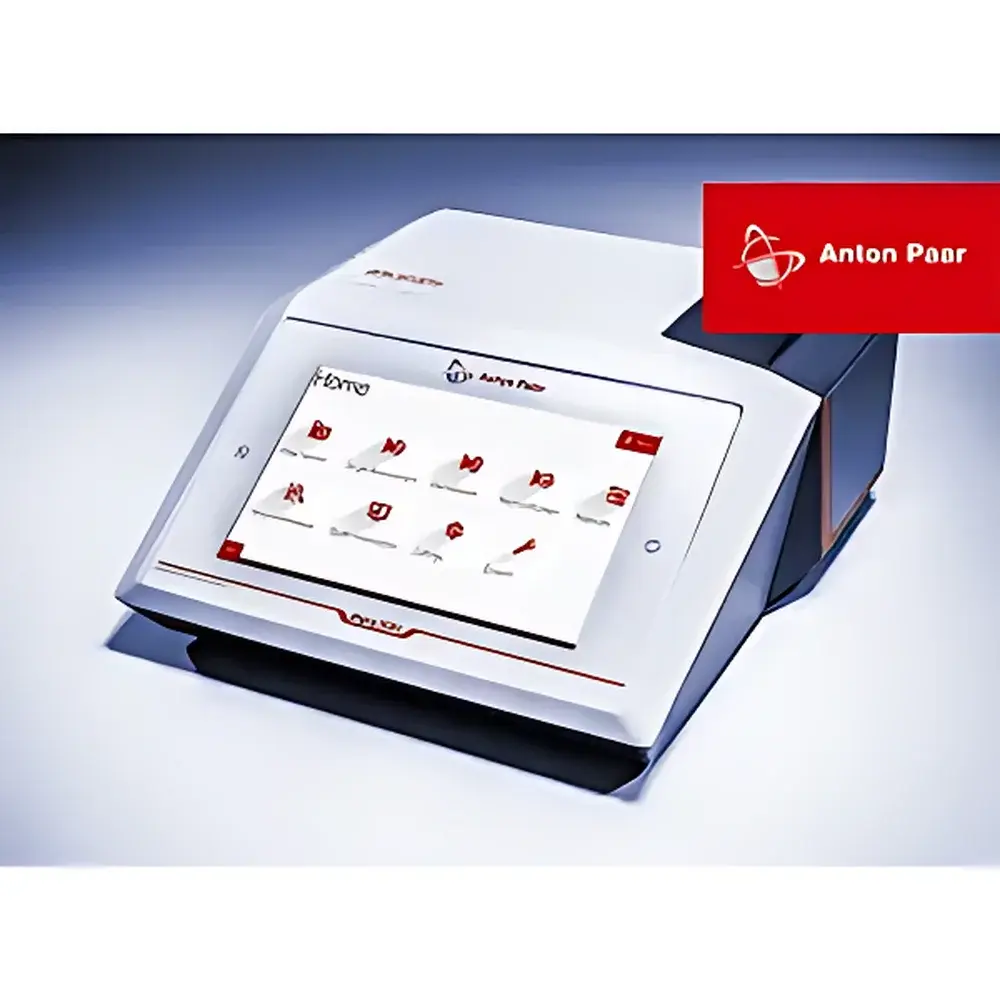
Anton Paar Cora 5001 Compact Raman Spectrometer
| Brand | Anton Paar |
|---|---|
| Origin | Austria |
| Model | Cora 5001 |
| Detector Type | CMOS |
| Laser Class | Class 1 |
| Safety Interlock | Integrated shutter-based activation (laser only active when sample chamber is fully closed) |
| Optical Architecture | Monolithic aluminum optical bench, no moving parts |
| Focus Mechanism | Motorized auto-focus with real-time signal optimization |
| Excitation Options | Dual-wavelength “Dual-Core Raman” configuration available (e.g., 785 nm and 1064 nm) |
| Sample Compatibility | Solids (tablets, films, crystals), liquids (in vials of circular/square/rectangular cross-section), powders, pastes |
| Accessories | Magnetic sample holders, universal vial adapters, solid-sample stage with quick-lock positioning |
| Compliance | IEC 60825-1:2014 (Class 1 laser product), CE marked, RoHS compliant |
| Software | Cora Suite v3.x with spectral library matching (≥10,000 reference spectra), GLP-compliant audit trail, FDA 21 CFR Part 11 optional module |
Overview
The Anton Paar Cora 5001 Compact Raman Spectrometer is a purpose-engineered, benchtop-class portable instrument designed for rapid, reliable, and operator-safe molecular identification and qualitative analysis in regulated and non-regulated environments. Built upon a monolithic aluminum optical bench architecture, the Cora 5001 eliminates mechanical drift and sensitivity to environmental vibration—making it suitable for deployment in quality control laboratories, warehouse inspection zones, production floors, and academic teaching labs. Its core measurement principle relies on inelastic scattering of monochromatic light (Raman scattering), where incident photons interact with molecular vibrational modes, producing frequency-shifted scattered light that serves as a unique “fingerprint” for chemical composition and molecular structure. Unlike dispersive spectrometers with grating scanners or filter wheels, the Cora 5001 employs fixed-optics design with CMOS detector arrays optimized for high quantum efficiency in the near-infrared range—ensuring consistent spectral fidelity across repeated measurements without recalibration.
Key Features
- Class 1 laser safety certification (IEC 60825-1:2014): No external safety interlocks or protective eyewear required; laser emission is physically inhibited unless the sample chamber door is fully latched.
- Monolithic optical bench: All critical optics—including excitation laser path, notch filters, holographic transmission gratings, and CMOS detector—are integrated into a single, CNC-machined aluminum block, eliminating alignment drift and thermal hysteresis.
- Motorized auto-focus system: Dynamically locates the optimal focal plane by maximizing Raman intensity in real time—critical for low-signal samples such as turbid suspensions, opaque tablets, or thin polymer films.
- Dual-Core Raman option: Two independent, factory-aligned optical channels (e.g., 785 nm and 1064 nm excitation) housed within one chassis; wavelength switching is software-controlled with zero mechanical reconfiguration or recalibration.
- Magnetic sample positioning system: Enables repeatable, sub-millimeter placement of solids, vials, or cuvettes—eliminating manual refocusing between samples and reducing measurement variability.
- Ruggedized industrial enclosure: IP52-rated housing, shock-absorbing feet, and reinforced hinge mechanism support operation in non-laboratory environments including manufacturing cleanrooms and logistics hubs.
Sample Compatibility & Compliance
The Cora 5001 accommodates diverse physical forms without preprocessing: intact pharmaceutical tablets, lyophilized powders in standard 8–12 mm diameter vials (round, square, or rectangular), liquid solutions in quartz or borosilicate glass, and heterogeneous solids such as catalyst pellets or battery electrode fragments. Optional accessories include temperature-controlled sample stages (−10 °C to +60 °C), fiber-coupled probes for remote sampling, and ATR attachments for surface-sensitive analysis. From a regulatory perspective, the instrument meets essential requirements of ISO/IEC 17025:2017 for analytical equipment validation, supports GLP documentation workflows via timestamped audit trails, and offers an optional FDA 21 CFR Part 11-compliant software package with electronic signatures, role-based access control, and immutable data archiving.
Software & Data Management
Cora Suite v3.x provides a unified interface for acquisition, processing, library search, and reporting. It includes baseline correction (asymmetric least squares), cosmic ray removal, peak deconvolution (Voigt fitting), and multivariate analysis tools (PCA, PLS-DA). Spectral libraries are expandable and support user-defined entries with metadata tagging (batch ID, operator, date/time, instrument serial number). All raw and processed data are stored in HDF5 format—self-describing, platform-independent, and compatible with third-party chemometric platforms such as MATLAB, Python (SciPy/NumPy), and Unscrambler X. Audit logs record every parameter change, spectrum acquisition, and library match event—including user identity and system timestamp—to satisfy internal QA audits and external regulatory inspections.
Applications
The Cora 5001 delivers validated performance across multiple sectors: raw material identity testing per USP <197> and Ph. Eur. 2.2.48; counterfeit detection in supply chain security; polymorph screening in API development; reaction monitoring in process chemistry; contamination identification in semiconductor fabrication; and polymer degradation analysis in automotive and aerospace component qualification. Its dual-wavelength capability specifically addresses fluorescence interference—enabling robust analysis of dyes, biological tissues, and carbon-rich materials that typically suppress Raman signals under conventional 785 nm excitation.
FAQ
Is the Cora 5001 suitable for GMP-regulated environments?
Yes—when configured with the optional 21 CFR Part 11 software module and operated under documented SOPs, it fulfills ALCOA+ data integrity principles for pharmaceutical and medical device manufacturing.
Can I use my own spectral libraries with Cora Suite?
Yes—libraries in common formats (.spc, .jdx, .csv) can be imported and tagged with custom metadata; all matches generate traceable confidence scores and residual plots.
Does the instrument require routine wavelength calibration?
No—factory calibration is permanently stored in non-volatile memory; the monolithic optical bench ensures long-term stability without field recalibration.
What is the typical measurement time per sample?
Acquisition times range from 0.1 s to 60 s depending on signal strength and integration settings; auto-focus completes in ≤3 s, and full spectral acquisition + library match takes <10 s for routine ID checks.
Is remote operation supported?
Yes—Cora Suite supports secure network deployment via TLS-encrypted client-server architecture, enabling centralized fleet management and off-site troubleshooting through authorized IT infrastructure.







